The Rassam Cylinder
The Rassam Cylinder, a significant artifact of the Neo-Assyrian Empire, dates to 643 BCE and was produced under the reign of King Ashurbanipal, one of Assyria’s most renowned rulers.
This cylinder is a prism-shaped cuneiform document with ten faces, containing extensive accounts of Ashurbanipal’s military achievements, religious practices, and interactions with neighboring powers.
Discovered in 1854 by Assyriologist Hormuzd Rassam, the cylinder provides invaluable insight into the political dynamics of the 7th century BCE, illustrating Assyrian expansion and the complexities of its relationships with rival kingdoms.
Currently housed in the British Museum, the Rassam Cylinder remains a key artifact for understanding Assyrian imperialism and its influence on the ancient Near East.

The Rassam Cylinder is a cuneiform artifact created in 643 BCE under the reign of Neo-Assyrian king Ashurbanipal. It is a prism-shaped cylinder with ten faces.
Discovery and Composition of the Rassam Cylinder
The Rassam Cylinder was discovered in the ruins of the North Palace at Nineveh, located in present-day Iraq. This palace was once the center of Assyrian governance under King Ashurbanipal, whose military and cultural endeavors helped to extend Assyrian dominance across a vast territory.
Rassam, an Iraqi-born Assyriologist, found the cylinder during his excavation work, which was one of the earliest archaeological expeditions aimed at unearthing ancient Mesopotamian history. Given its unique ten-sided prism shape, the cylinder is notable not only for its form but also for the extensive narrative inscribed upon it.

Composed in the Akkadian language using cuneiform script, the cylinder records Ashurbanipal’s views on his military exploits, divine patronage, and administrative achievements. It is one of several cuneiform artifacts, including other cylinders and tablets, created under Ashurbanipal’s orders to document his reign and glorify his accomplishments. These documents served as both historical records and ideological statements, designed to affirm Assyria’s power and convey Ashurbanipal’s loyalty to the Assyrian gods, particularly Ashur and Ishtar.
Ashurbanipal’s Egyptian Campaign Against Taharqa

Relief depicting Ashurbanipal hunting a lion. 645 – 635 BC.
One of the Rassam Cylinder’s most notable narratives is Ashurbanipal’s campaign in Egypt. This campaign marked a significant moment in the long-standing struggle between the Assyrian Empire and the Kushite rulers of Egypt’s Twenty-fifth Dynasty, who sought to expand their influence in the Levant and resist Assyrian control.
Taharqa, the Kushite king of Egypt and Nubia, is central to this story. Previously, Taharqa had been subdued by Ashurbanipal’s father, King Esarhaddon, who had temporarily brought Egypt under Assyrian influence by installing vassal rulers loyal to Assyria in key Egyptian territories.
However, after Esarhaddon’s death, Taharqa sought to reclaim his authority in Egypt by challenging Assyrian influence and reoccupying Memphis, Egypt’s ancient capital. This bold move set the stage for Ashurbanipal’s response, as Taharqa’s defiance was seen as an affront not only to Assyria’s political authority but also to its religious patronage, as Assyrian kings claimed divine support from their gods for their conquests.

King Taharqa of the 25th Dynasty of Egypt
The cylinder records Ashurbanipal’s interpretation of Taharqa’s rebellion as an act of hubris, wherein the Kushite king “forgot the might of Ashur, Ishtar, and the other great gods,” choosing to rely on his own power instead.
Ashurbanipal launched a military campaign to suppress this rebellion, leading his forces into Egypt and successfully defeating Taharqa. The Rassam Cylinder emphasizes Ashurbanipal’s belief that his victory was granted by the gods, underscoring the central role of divine will in Assyrian military ideology. This campaign secured Assyrian control over parts of Egypt once more and reestablished Assyrian dominance, at least temporarily, in the region.
Significance of the Rassam Cylinder in Assyrian Propaganda
The Rassam Cylinder was not merely a historical record but a piece of political and religious propaganda intended to strengthen Ashurbanipal’s position.
Assyrian kings often commissioned such inscriptions to legitimize their rule, highlight their piety, and demonstrate their role as agents of the gods. By recounting his victories in Egypt and other regions, Ashurbanipal presented himself as a divinely favored ruler who upheld Assyria’s interests and protected its religious traditions.
The cylinder’s repeated invocation of gods like Ashur and Ishtar exemplifies Assyrian kings’ emphasis on divine support in their military and political endeavors. Ashurbanipal’s narrative on the cylinder reflects a worldview in which the king’s actions were guided and sanctioned by the gods. This connection to the divine was essential in justifying the king’s aggressive expansionist policies, particularly in cases where Assyrian armies faced significant resistance, as they did in Egypt.

Ashurbanipal, one of the Assyrian kings, assembled a vast library in Nineveh. This collection included a diverse range of texts, preserving knowledge from various cultures, and contributing to the understanding of languages, literature, and science.
Furthermore, the cylinder’s focus on Taharqa’s defiance and Ashurbanipal’s response reinforced the perception of Assyria as a powerful, unyielding empire capable of quelling dissent even in distant lands like Egypt. This was a crucial message for Assyria’s own population and the empire’s rivals, as it demonstrated that Assyrian power extended across vast territories and was backed by divine mandate.
By showcasing Ashurbanipal’s success in Egypt, the cylinder helped to maintain the empire’s image as invincible and to discourage potential rebellions within the empire’s borders.
Broader Historical and Political Context
The Rassam Cylinder provides a unique window into the political landscape of the 7th century BCE, a period marked by intense competition among powerful empires.
Assyria, under Ashurbanipal’s rule, was one of the dominant forces in the Near East, extending its influence over regions such as Babylonia, Syria, and parts of Anatolia, as well as into Egypt. The Kushite rulers of Egypt’s Twenty-fifth Dynasty, based in Nubia, posed a challenge to Assyrian supremacy by expanding their influence into the Levant and supporting resistance against Assyrian control.
Ashurbanipal’s campaign against Taharqa was part of a broader strategy to maintain Assyrian authority in these contested regions. The cylinder’s account of this campaign highlights the interconnectedness of the ancient world, where the actions of a ruler in Assyria could have significant repercussions as far away as Egypt. It also underscores the importance of military strength and strategic alliances in maintaining control over such a vast and diverse empire.
By documenting these campaigns, the Rassam Cylinder reflects the complexities of empire-building in the ancient world, where power was often maintained through a combination of military force, diplomacy, and religious justification.
The cylinder also hints at the challenges Assyrian kings faced in governing their vast empire, which included managing the loyalties of local rulers, suppressing rebellions, and countering the ambitions of other regional powers.
READ MORE: Nubian Rulers of Ancient Egypt
Translation and Modern Scholarship
The Rassam Cylinder has been extensively studied by modern scholars who view it as a valuable source for understanding Neo-Assyrian politics, military history, and religious beliefs.
A full English translation by Daniel Luckenbill was published in Ancient Records of Assyria and Babylonia, making the content accessible to a wider audience. This translation provides insight into the intricacies of Ashurbanipal’s campaigns, his religious motivations, and his views on kingship.
The Cuneiform Digital Library Initiative (CDLI) also offers a transcription of the original cuneiform text, enabling scholars and students to study the artifact in its ancient script. These resources have allowed researchers to analyze the cylinder’s language, structure, and historical references in detail, contributing to a broader understanding of Assyrian imperial ideology.
Importance of the Rassam Cylinder in Assyriology and Ancient Near Eastern Studies
The Rassam Cylinder remains a significant artifact in the study of Assyriology and ancient Near Eastern history. Its detailed accounts provide evidence of Assyria’s influence over Egypt and illustrate how the Assyrian kings saw themselves as both political and religious figures with responsibilities beyond their own territory. The cylinder also demonstrates how Assyrian rulers used written records to shape perceptions of their reign, presenting a version of history that emphasized their divine support and justified their military actions.
The cylinder’s record of Ashurbanipal’s Egyptian campaign has been complemented by reliefs from Nineveh, which visually depict scenes from these battles. Together, these artifacts offer a comprehensive view of Assyrian military achievements and the narrative techniques used to glorify them. They also underscore the Assyrian practice of documenting victories in multiple formats to reinforce their legitimacy and intimidate potential challengers.
For historians and archaeologists, the Rassam Cylinder is a critical source that contributes to reconstructing the history of Assyrian relations with Egypt and Kush. By providing a firsthand account of Ashurbanipal’s campaign against Taharqa, the cylinder enhances our understanding of the geopolitical dynamics of the 7th century BCE and the impact of Assyrian expansion on the region.
Conclusion
The Rassam Cylinder is an invaluable artifact that encapsulates the power, ambition, and religious ideology of the Neo-Assyrian Empire under King Ashurbanipal. Created in 643 BCE, it recounts key moments in Ashurbanipal’s reign, including his campaign against Taharqa, the Kushite king of Egypt and Nubia. Through its detailed narrative, the cylinder presents Ashurbanipal as a divinely sanctioned ruler whose victories were granted by the Assyrian gods, particularly Ashur and Ishtar. This divine support served as both a source of legitimacy and a means of reinforcing Assyria’s imperial image.
The cylinder’s content also provides insight into the broader historical context of the 7th century BCE, a period when Assyria sought to assert its authority over distant territories like Egypt. By documenting Ashurbanipal’s response to Taharqa’s defiance, the Rassam Cylinder illustrates the complexities of Assyrian foreign policy and the challenges faced by Assyrian rulers in maintaining control over a vast empire.
As a primary source, the Rassam Cylinder is indispensable for understanding the role of propaganda, divine justification, and military power in the Neo-Assyrian Empire. Its detailed accounts, along with modern translations and transcriptions, allow scholars to study Assyrian history, religious beliefs, and imperial strategies in depth.
Today, the Rassam Cylinder continues to enrich our knowledge of ancient Assyria, providing a lens through which we can examine the power struggles, cultural exchanges, and religious ideologies that shaped the ancient Near East.
Frequently Asked Questions

Rassam Cylinder of Ashurbanipal: a 10-sided prism, the most complete chronicle of his reign. Nineveh, 643 BCE, British Museum.
Who discovered the Rassam Cylinder, and where was it found?
The cylinder was discovered by Assyriologist Hormuzd Rassam in 1854 in the North Palace of Nineveh.

Assyriologist Hormuzd Rassam
Where is the Rassam Cylinder currently located?
The Rassam Cylinder is housed in the British Museum.
What content does the Rassam Cylinder contain?
The cylinder contains detailed accounts of Ashurbanipal’s reign, including his military campaigns, religious devotion, and interactions with neighboring kingdoms.
What significant campaign does the Rassam Cylinder describe?
The cylinder describes Ashurbanipal’s victorious campaign in Egypt against Taharqa, the Kushite king of Egypt and Nubia.
Who was Taharqa, and what did he do to provoke Ashurbanipal?
Taharqa was the Kushite king of Egypt and Nubia who attempted to resist Assyrian control by reasserting authority over Egypt, including reclaiming Memphis.
How does Ashurbanipal describe Taharqa’s defiance on the cylinder?
Ashurbanipal states that Taharqa “forgot the might of Ashur, Ishtar, and the other great gods” of Assyria and relied on his own power, prompting Ashurbanipal’s campaign.
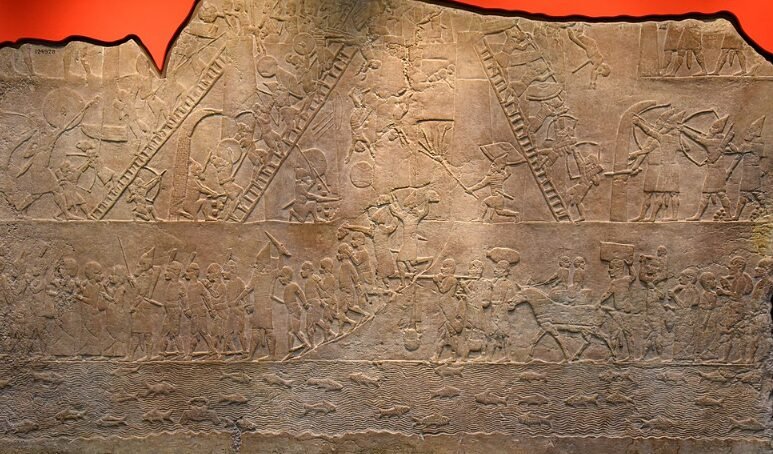
Assyrian siege of an Egyptian fort, likely from the 667 BCE war. Sculpted 645–635 BCE, under Ashurbanipal. British Museum.
What does the Rassam Cylinder reveal about Ashurbanipal’s beliefs regarding his military success?
The cylinder highlights Ashurbanipal’s belief that his victories were due to the blessings and protection of the Assyrian gods Ashur and Ishtar.
Why is the Rassam Cylinder valuable for understanding the 7th-century BCE political climate?
The cylinder provides insight into Assyria’s expansive control and the conflicts between empires, such as Assyria’s repeated confrontations with the Kushite rulers of Egypt.
A full translation by Daniel Luckenbill is available in Ancient Records of Assyria and Babylonia, and a transcription of the cuneiform text can be found on the Cuneiform Digital Library Initiative (CDLI).
Reliefs from Nineveh depict similar campaigns and enhance the historical context of Ashurbanipal’s conquests and Assyrian imperial expansion.





