Golden Ratio: Origin Story, Meaning, & Major Facts
The golden ratio, often symbolized by the Greek letter phi (φ), is a mathematical concept that has fascinated scholars, artists, and thinkers for centuries. It is an irrational number, approximately equal to 1.618, that arises when a line is divided into two parts in such a way that the ratio of the whole line to the longer segment equals the ratio of the longer segment to the shorter segment.
Beyond its mathematical properties, the golden ratio has been attributed with mystical and aesthetic qualities, appearing in art, nature, and architecture. It has played a role in diverse disciplines, from ancient Greek architecture to modern design, and has influenced the thinking of some of the greatest minds in history.
10 Most Famous Ancient Greek Sculptors and their Accomplishments
In this comprehensive exploration, World History Edu delves into the history and origin of the golden ratio, its significance across various fields, its mathematical meaning, and the key facts that make it one of the most astonishing numbers in the history of mathematics.
History of the Golden Ratio

Ancient Greek mathematicians first explored the golden ratio because of its frequent occurrence in geometry, especially in the construction of pentagons and pentagrams. Image: Golden ratio representation.
Early Mathematical Discoveries in Ancient Greece
The golden ratio has roots in ancient Greece, where mathematicians and philosophers were first drawn to its properties. Greek scholars were fascinated by geometry and sought to understand the world through shapes and proportions. The earliest known study of the golden ratio appears in the works of the mathematician Euclid around 300 BCE. In his seminal work, Elements, Euclid defines what we now call the golden ratio through his proposition on dividing a line in “extreme and mean ratio.” Euclid demonstrated that this ratio had applications in constructing geometric shapes like pentagons and decagons.
Before Euclid, some sources credit Pythagoras (c. 570–495 BCE) and his followers with being aware of the golden ratio, though no surviving fragments of their work confirm this directly. However, the Pythagoreans were known for their interest in mathematics and their fascination with ratios and harmony, particularly in music and geometry. It is possible that the golden ratio was part of their understanding of the natural world, although it was not formally described in their surviving teachings.
Euclid’s work provided the first rigorous geometric explanation of the golden ratio, which he defined in terms of dividing a line segment into two parts so that the ratio of the whole to the larger part equals the ratio of the larger part to the smaller. This relationship provided the foundation for later explorations of the golden ratio’s mathematical and aesthetic significance.
The Golden Ratio in Renaissance Art and Science
After the fall of the Roman Empire, much of the ancient Greek mathematical knowledge was preserved by scholars in the Islamic world. During the European Renaissance, these ideas were rediscovered and expanded upon.
The golden ratio’s reemergence as a concept of divine and aesthetic importance can largely be credited to the Italian mathematician Luca Pacioli. In 1509, Pacioli published De Divina Proportione, a treatise that explored the properties of the golden ratio. The work, illustrated by Leonardo da Vinci, discussed the ratio’s aesthetic properties and its role in the construction of ideal human proportions, solidifying its place in Renaissance art and architecture.
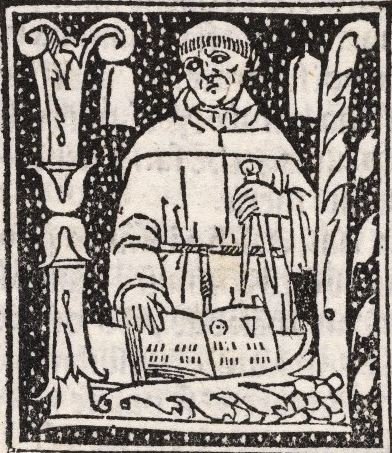
Luca Pacioli named his 1509 book Divina Proportione after the golden ratio, which Leonardo da Vinci illustrated, calling it the sectio aurea (“golden section”). Image: A woodcut depicting Luca Pacioli.
Pacioli referred to the golden ratio as the divine proportion (divina proportione) due to its seemingly perfect balance and its presence in natural forms. Leonardo da Vinci’s illustrations of geometric shapes and human anatomy, including the famous Vitruvian Man, are often cited as examples of the golden ratio in practice. However, while Leonardo was interested in proportion and symmetry, the extent to which he consciously applied the golden ratio to his works is debated.
Johannes Kepler, the German astronomer and mathematician, also recognized the significance of the golden ratio. In the early 17th century, Kepler connected the golden ratio to the geometry of pentagons and its occurrence in the Fibonacci sequence, a series of numbers in which each number is the sum of the two preceding ones. He regarded the golden ratio as one of geometry’s great treasures, alongside the Pythagorean theorem.
19th and 20th Century Popularization
The 19th century saw a growing interest in the golden ratio, particularly through the works of mathematicians such as German mathematician Martin Ohm, who coined the term “golden section” in 1835, and Adolf Ziesling, who promoted its application as a universal law of aesthetics and nature. Ohm’s formalization of the golden ratio as a concept helped bring it into the realm of scientific and aesthetic discourse, where it continued to inspire thinkers in art, architecture, and mathematics.
During the 20th century, the golden ratio gained even greater prominence through its association with modern art and design. The Swiss-French architect Le Corbusier, for instance, used the golden ratio in his architectural designs, believing it to be a key to achieving harmony and proportion in buildings. Le Corbusier’s Modulor system, a scale of proportions based on the human body, was influenced by the golden ratio and became a standard in modernist architecture.
Salvador Dalí, the famous surrealist painter, also incorporated the golden ratio into his work. In his 1955 painting The Sacrament of the Last Supper, Dalí framed the composition within a dodecahedron, a shape that contains elements of the golden ratio. This fusion of mathematics, geometry, and art reflects the enduring fascination with the golden ratio in modern aesthetics.
Origin Story of the Golden Ratio
The origin of the golden ratio can be traced back to the ancient Greeks, though its roots may extend even further. The ratio was likely discovered by Greek mathematicians as they explored the geometry of regular polygons and sought to find a balance between symmetry and proportion.
Euclid’s Elements marked the first formal definition of the golden ratio, but even before Euclid, the principles of this ratio may have been understood, at least intuitively, by earlier mathematicians like the Pythagoreans.
The term “golden ratio” itself, however, did not emerge until much later. Martin Ohm’s 1835 use of the term “golden section” helped popularize the ratio in modern times, while earlier figures like Pacioli and Leonardo da Vinci focused more on its divine or aesthetic qualities.
Throughout history, the golden ratio has been associated with balance, beauty, and harmony, often seen as a key to understanding the natural world and the structure of the universe.
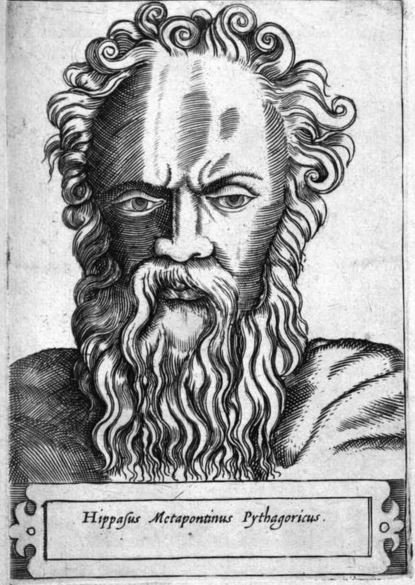
A 5th-century BCE mathematician, Hippasus, is credited with discovering that the golden ratio is irrational, which surprised Pythagoreans. Image: An engraving depicting Hippasus.
Meaning of the Golden Ratio
Mathematically, the golden ratio has a specific definition. It arises from the solution to the equation (a + b)/a = a/b, where “a” represents the longer segment of a divided line, and “b” represents the shorter segment. This equation is solved by the number φ (phi), which is approximately 1.6180339887…
The golden ratio has unique properties that make it special in mathematics. For example:
- Self-similarity: If you take a line segment divided according to the golden ratio and remove the longer part, the remaining segment will also be divided according to the golden ratio. This recursive property is one reason the golden ratio appears so frequently in nature.
- Fibonacci sequence connection: The ratio between successive numbers in the Fibonacci sequence approaches the golden ratio as the numbers increase. This connection highlights how the golden ratio naturally arises in growth patterns found in nature, such as the arrangement of leaves, the spirals of shells, and the branching of trees.
- Irrationality: The golden ratio is irrational, meaning it cannot be expressed as a fraction of two integers. It has a non-repeating, non-terminating decimal representation, which gives it a mystical quality in the minds of some thinkers.
The golden ratio is also often associated with aesthetics and beauty. Throughout history, it has been thought to represent ideal proportions in art and architecture. Some believe that structures and artworks designed according to the golden ratio are inherently more pleasing to the eye. This perception of balance and harmony is why the ratio has been applied not only to visual arts but also to music, design, and even spiritual and religious symbolism.
Major Facts about the Golden Ratio
- Definition and Mathematical Formula
The golden ratio is defined by the formula (a + b)/a = a/b, where “a” is the longer segment, and “b” is the shorter segment. The value of the golden ratio is approximately 1.6180339887, and it is represented by the Greek letter phi (φ).
- The Golden Ratio and Geometry
The golden ratio appears in various geometric constructions. It is intrinsic to the pentagon and its star-shaped counterpart, the pentagram. In a regular pentagon, the ratio of a diagonal to a side is equal to the golden ratio. The golden ratio is also found in dodecahedrons and icosahedrons, both of which have faces that are pentagons.
- Connection to the Fibonacci Sequence
The golden ratio is closely linked to the Fibonacci sequence, a series of numbers where each number is the sum of the two preceding numbers (e.g., 0, 1, 1, 2, 3, 5, 8, 13, etc.). As the Fibonacci numbers increase, the ratio between successive numbers approaches the golden ratio. This connection illustrates how the golden ratio naturally emerges in patterns of growth and nature.
- Nature and the Golden Ratio
The golden ratio appears in numerous natural phenomena. For instance, it can be seen in the arrangement of leaves around a stem, the pattern of seeds in a sunflower, and the spirals of shells. These patterns, which follow a logarithmic spiral, approximate the golden ratio, reflecting the efficient and aesthetically pleasing structures found in nature.
- Art and Architecture
The golden ratio has long been associated with beauty and harmony in art and architecture. In ancient Greece, some scholars believe that the Parthenon was designed according to the golden ratio, although this is still debated. In the Renaissance, artists like Leonardo da Vinci incorporated the golden ratio into their works, while architects like Le Corbusier applied it to modernist design principles.
- Renaissance Rediscovery
During the Renaissance, Luca Pacioli’s De Divina Proportione reintroduced the golden ratio as a principle of divine beauty and harmony. Leonardo da Vinci’s illustrations for the book helped popularize the concept, linking it to the aesthetic proportions of the human body and the geometry of natural forms.
- Golden Ratio in Modern Times
In the 20th century, the golden ratio continued to influence art, design, and architecture. Salvador Dalí’s The Sacrament of the Last Supper features the golden ratio, while architects like Le Corbusier used it in their designs to create aesthetically pleasing and harmonious spaces. Additionally, mathematicians and scientists have continued to study the golden ratio’s properties and applications, particularly in the fields of fractals, quasicrystals, and Penrose tiling.
- Applications in Modern Design and Technology
In modern times, the golden ratio has been applied to design, photography, and even user interfaces in technology. Some designers use the golden ratio to create visually balanced compositions, while others use it to structure web layouts and design elements in digital media. Though its use is sometimes controversial, many believe that the golden ratio helps create compositions that are naturally pleasing to the eye.
- Golden Ratio in Mysticism and Symbolism
Over the centuries, the golden ratio has taken on symbolic and mystical connotations. Its appearance in natural phenomena and its connection to beauty and proportion have led some to view it as a key to unlocking the mysteries of the universe. It has been associated with spiritual ideas of harmony and balance, and some religious iconography has incorporated the golden ratio as a symbol of divine order.

The golden ratio was studied intermittently over centuries. Mathematicians such as Abu Kamil (c. 850–930) and Fibonacci (c. 1170–1250) worked with it in geometry, though Fibonacci didn’t realize its connection to his famous sequence. Image: Statue of Fibonacci.
Conclusion
The golden ratio is one of the most fascinating and enduring mathematical concepts in human history. From its discovery in ancient Greece to its application in modern art and architecture, this ratio has captivated the imagination of scholars, artists, and thinkers alike.
Its unique mathematical properties, its presence in nature, and its perceived aesthetic appeal have made it a symbol of balance, harmony, and beauty across disciplines. Whether used intentionally or coincidentally, the golden ratio continues to influence the way we understand the world and the structures within it.
While some of the more mystical interpretations of the golden ratio may be overstated, its significance in mathematics, geometry, and the arts is undeniable.
Questions and Answers
Many of the greatest minds in history—from ancient mathematicians like Pythagoras and Euclid to modern physicists like Roger Penrose—have studied the golden ratio. It has fascinated people from various fields, including biologists, artists, musicians, and even mystics. Some scholars have even argued that no other number in the history of mathematics has inspired such wide-ranging interest.
Below are some frequently asked questions about the golden ratio as well as the debate surrounding its use in ancient Greek architecture, including whether they intentionally applied this famous mathematical proportion.
What is the golden ratio?
The golden ratio is a geometric concept where a line is divided into two segments such that the ratio of the whole line to the longer segment equals the ratio of the longer segment to the shorter segment. This value is approximately 1.618 and is represented by the Greek letter phi (φ).
Who is often credited with the first use of the golden ratio in geometry?
Pythagoras is often credited with the first use of the golden ratio, but no surviving fragments of his work mention it. The first explicit reference to the golden ratio in Greek science came from Euclid around 300 BCE.
Why is the golden ratio sometimes called the “divine” ratio?
The Italian mathematician Luca Pacioli first connected the golden ratio to the divine in 1509 in his book De Divinia Proportione, where he studied Leonardo da Vinci’s works and concluded that the ratio must have divine properties.

How did German psychologist Adolf Ziesling contribute to the popularization of the golden ratio?
In the 19th century, Adolf Ziesling proposed that the golden ratio acts as a “universal law” and pointed out its occurrence in the geometry of natural objects, such as crystals, leaves, and animal anatomy.
Is there clear evidence that the Greeks used the golden ratio in their architecture?
There is no clear evidence that the Greeks specifically used the golden ratio in their architecture. While the Greeks employed proportional systems in their designs, it is unclear whether they intentionally used the golden ratio or if any resemblance is coincidental.
What is the significance of the column-number ratio in Greek architecture?
The column-number ratio, which defined the number of columns on the front and sides of a temple, played a key role in determining the overall form of Greek temples. This ratio was applied to various elements, such as the stylobate and krepis.
Why is the Parthenon often associated with the golden ratio?
The Parthenon is often associated with the golden ratio due to its proportions, but closer analysis shows that it was likely designed using traditional Greek methods with a ratio closer to 1:2.25 rather than 1.618, the golden ratio.
The Parthenon is oriented northeast to southwest, while most Greek temples were oriented east to west. If the golden ratio had been a design goal, the temple’s orientation would have emphasized the narrow side, which it does not.





