Mexico City Metropolitan Cathedral
The Mexico City Metropolitan Cathedral stands as a remarkable testament to Mexico’s colonial history, blending various architectural styles and historical narratives. Situated on the Plaza de la Constitución (Zócalo), it was constructed over the sacred Aztec precinct near the Templo Mayor. The cathedral was built in stages between 1573 and 1813, replacing the original church erected soon after the Spanish conquest of Tenochtitlan. Spanish architect Claudio de Arciniega drew inspiration from Gothic cathedrals in Spain when designing the structure.
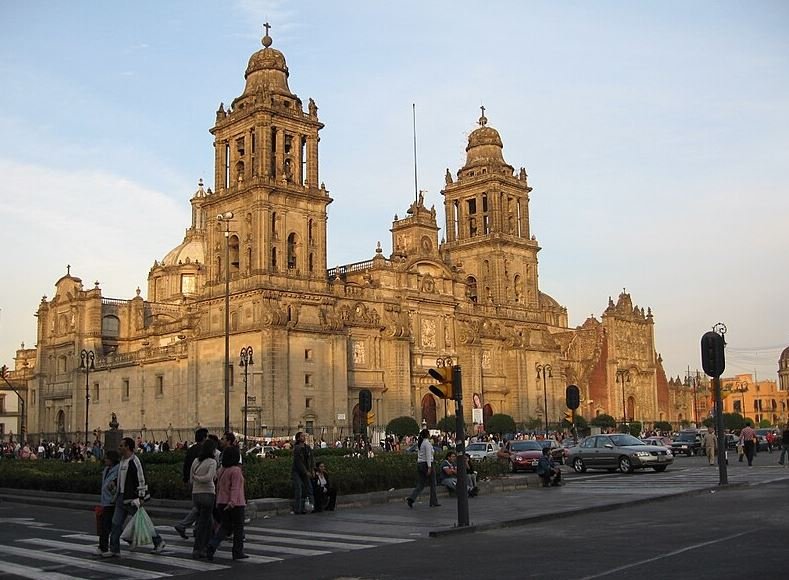
A 2006 photo of Mexico City Metropolitan Cathedral.
Architectural Design and Influences
The cathedral’s prolonged construction period, spanning more than 245 years, led to the incorporation of multiple architectural styles, including Gothic, Baroque, Churrigueresque, and Neoclassical elements. This mixture reflects the evolution of artistic trends during the colonial period. The extensive collaboration of architects, sculptors, painters, and artisans throughout the viceroyalty contributed to its intricate design.
Social and Historical Significance
The cathedral has played a crucial role in New Spain and independent Mexico’s history. It has hosted major events, including the coronations of Agustín I and Maximilian I, the burial of independence heroes such as Miguel Hidalgo y Costilla and José María Morelos, and conflicts during the Reform War and the Cristero War. The cathedral was also central to the celebrations of Mexico’s bicentennial independence.
Mexican War of Independence: Causes, Major Battles, & Outcome
Structural Composition
The cathedral’s grand dimensions include a width of 59 meters, a length of 128 meters, and a height of 67 meters. Its exterior features two bell towers, a central dome, and three main portals. The cathedral has four facades adorned with statues and intricate carvings.
The interior consists of five naves, 51 vaults, 74 arches, and 40 columns. The bell towers contain 25 bells, with the largest named Santa Maria de Guadalupe. The tabernacle, adjacent to the cathedral, houses the baptistery and serves to register parishioners.
Chapels and Altars
The cathedral contains sixteen chapels, each dedicated to different saints and religious guilds. The chapels feature ornate altars, paintings, sculptures, and religious relics. The most notable altars include:
- The Altar of Forgiveness – This altar, crafted by Jerónimo de Balbás, is located at the cathedral’s entrance and was named due to its association with the Spanish Inquisition.
- The Altar of the Kings – A masterpiece of Mexican Baroque, this altar features statues of canonized royalty and elaborate gilded carvings.
- The High Altar – Originally a prominent feature, it was reconstructed in the 1940s in a modernist style by architect Ernesto Gómez Gallardo.

The Altar of Forgiveness, as seen during the early 2010s.
The Choir and Organs
The choir, constructed between 1696 and 1697, contains 59 intricately carved mahogany reliefs. The railing enclosing the choir was crafted in Macao in 1722 and later installed in the cathedral. The two grand organs, dating back to the 18th century, are among the largest in the Americas. Both organs were damaged in a 1967 fire but were restored in subsequent decades.
A fire in 1967 damaged the interior of the cathedral, and sinking caused structural concerns, leading to restoration efforts in the 1990s.
The Crypts and Burials
The crypt beneath the cathedral houses the remains of numerous archbishops and historical figures. The burial site includes Juan de Zumárraga, the first archbishop of Mexico, and Emperor Agustín de Iturbide. The crypt contains bronze plaques marking the resting places of these significant figures.

Restoration Efforts
Due to Mexico City’s soft clay foundation, the cathedral has faced structural challenges, including subsidence and earthquakes. A major restoration effort began in the 1990s to stabilize the building’s foundation. Engineers placed concrete shafts beneath the cathedral, ensuring that it sinks uniformly rather than tilting dangerously. In 2000, after extensive conservation efforts, the cathedral was removed from the World Monuments Fund’s endangered list.
Cultural and Religious Importance
The cathedral remains a center of religious activity and national identity. It has been the site of key religious and political events, including coronations and government ceremonies. However, it has also seen political protests, such as the 2007 attack by sympathizers of the Party of the Democratic Revolution. Security measures have since been implemented to protect the building.
Frequently Asked Questions
Where is the Mexico City Metropolitan Cathedral located?
It is situated in the historic center of Mexico City, on the northern side of the Zócalo, atop the former Aztec sacred precinct near the Templo Mayor.
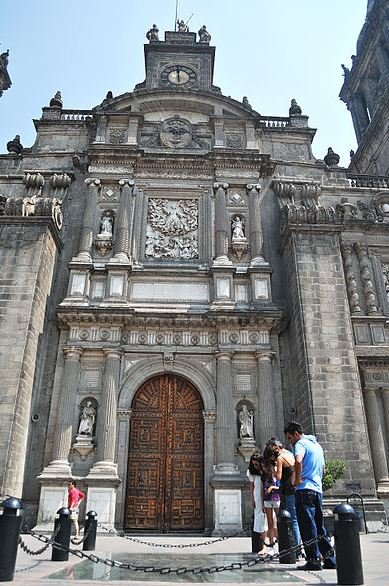
The main entrance to the Mexico City Metropolitan Cathedral.
When was the cathedral built?
Construction began in 1573 and was completed in 1813, taking nearly 250 years.
Who designed the cathedral?
Spanish architect Claudio de Arciniega designed it, drawing inspiration from Gothic cathedrals in Spain.
What architectural styles are present in the cathedral?
Due to its long construction period, it incorporates Gothic, Baroque, Churrigueresque, and Neoclassical styles.
What are the dimensions of the cathedral?
It measures approximately 128 meters (420 ft) in length, 59 meters (194 ft) in width, and 67 meters (220 ft) in height.
How many bells does the Mexico City Metropolitan Cathedral have?
It has 25 bells housed in two bell towers.
What significant events took place in the cathedral?
It hosted the coronations of Agustín I and Maximilian I of Mexico and was the burial site of key independence figures like Miguel Hidalgo.
Why is the cathedral sinking?
It is built on soft clay soil, causing uneven sinking, worsened by dropping water tables.
What is the Altar of the Kings?
A grand Churrigueresque-style altar, completed in 1737, dedicated to royal saints and the Virgin Mary.
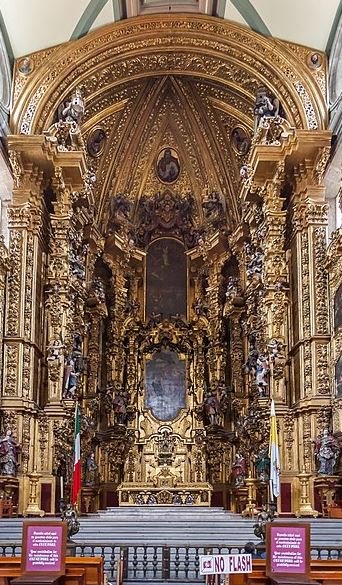
A view of the Altar of the Kings in the Cathedral.
What is the Tabernacle of the cathedral?
Built between 1749 and 1760, it houses archives, vestments, and serves as a place for baptisms and parish registration.
What relics were found during restoration?
In 2007, a time capsule from 1742 containing religious artifacts was discovered in a bell tower.
The Mexico City Metropolitan Cathedral symbolizes Mexico’s colonial past and religious influence, playing a central role in national events and social movements.
What is the difference between Cinco de Mayo and Mexico’s Independence Day?





