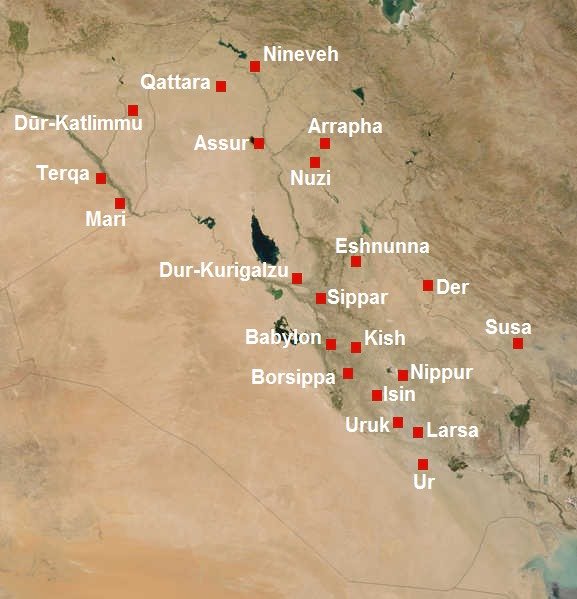
Mesopotamia (During the 2nd millennium BC).
Aššur, also spelled Ashur, was a significant city in ancient Mesopotamia and served as the capital of the Old Assyrian, Middle Assyrian, and early Neo-Assyrian Empires. Located on the western bank of the Tigris River in present-day Iraq, the city was a religious and political center for over 3,000 years. It played a crucial role in the development of Assyrian culture, governance, and military expansion.
Today, the site of Aššur is a UNESCO World Heritage Site, though it remains under threat due to modern conflicts and environmental risks.
Early Bronze Age and Founding of Aššur
The origins of Aššur date back to the Early Bronze Age, around the mid-3rd millennium BC. Archaeological evidence suggests that it was initially a small settlement under the cultural influence of Sumer. The earliest remnants of the city, including the foundations of the Ishtar temple and the Old Palace, indicate its religious and administrative importance. During this period, the Akkadian Empire incorporated Aššur into its dominion, and the city was governed by local rulers under Akkadian oversight.
Under the Third Dynasty of Ur (circa 2112–2005 BC), Aššur became a provincial center ruled by governors loyal to the Sumerian kings. However, following the collapse of the Ur-III dynasty, Aššur gained independence and gradually emerged as a dominant city-state in northern Mesopotamia.
Old Assyrian Period (2025–1364 BC)
The Old Assyrian period saw Aššur establish itself as a thriving trade hub, particularly in its interactions with Anatolia. The city’s rulers, such as Puzur-Ashur I and Erishum I, fortified its defenses and constructed temples dedicated to the god Ashur, after whom the city was named. Trade colonies, known as “karums,” were established in Anatolia, the most prominent being Karum Kanesh (modern Kültepe in Turkey). Assyrian merchants conducted extensive trade in textiles, tin, and silver, facilitating economic prosperity.
During this period, Shamshi-Adad I (1813–1781 BC) conquered Aššur and made it the religious capital of his Kingdom of Upper Mesopotamia. Despite external domination, Aššur maintained its religious significance. Following Shamshi-Adad’s death, the city fell under the influence of the Babylonian king Hammurabi, but it regained independence under native rulers such as Adasi (circa 1720 BC), who expelled foreign forces.
Middle Assyrian Period (1363–912 BC)
The Middle Assyrian period marked Aššur’s transformation into an imperial capital. Ashur-uballit I (1365–1330 BC) liberated Assyria from Mitanni rule and expanded its borders. The city’s temples, including those dedicated to Ashur and Ishtar, were rebuilt and enlarged, while palaces and fortifications reflected its growing power.
Tukulti-Ninurta I (1244–1208 BC) constructed a new temple to Ishtar and reinforced Aššur’s walls. The city’s cultural and administrative systems flourished, with laws codified in the Middle Assyrian Laws. The period saw military conquests against the Hittites, Babylonians, and other regional powers, consolidating Assyria’s influence.
Neo-Assyrian Period (911–609 BC)
The Neo-Assyrian Empire saw the shift of the political capital to other cities like Nimrud, Dur-Sharrukin, and Nineveh, yet Aššur remained the spiritual and religious heart of the empire. Kings such as Ashurnasirpal II (883–859 BC) and Tiglath-Pileser III (745–727 BC) expanded the empire’s territory while commissioning grand architectural projects in Aššur.
Despite its status, Aššur faced devastation in 614 BC when the Median king Cyaxares sacked the city. This event marked the beginning of the end for the Assyrian Empire, leading to its final destruction by the Babylonians and Medes in 609 BC.
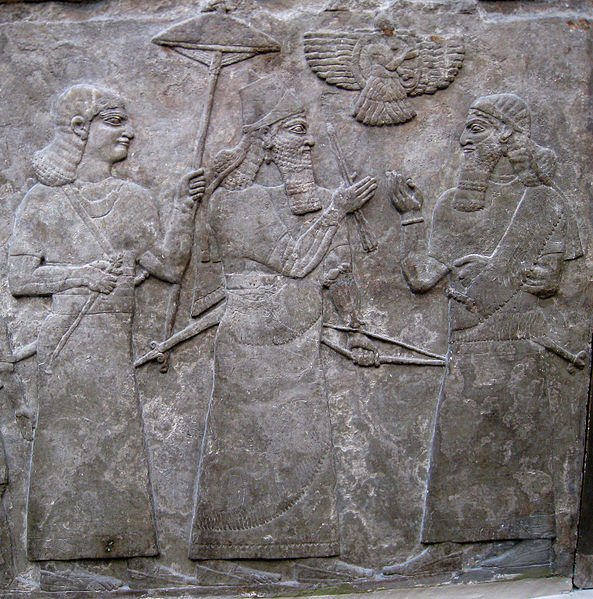
Relief of Ashurnasirpal II alongside an official.
Aššur was more than just a capital city; it was the religious and cultural heart of the Assyrian civilization.
Aššur Under Foreign Rule
Achaemenid Empire (549–330 BC)
Following the fall of the Neo-Assyrian Empire, Aššur came under Persian rule as part of the Achaemenid Empire. Known as Athura, the region retained its Assyrian identity while serving as a strategic and economic hub within the Persian administration. Assyrians contributed to Persian military campaigns and architectural projects, and the city continued to thrive as an agricultural and trading center.
Parthian and Roman Periods (150 BC–240 AD)
Under the Parthians, Aššur experienced a revival, with new administrative buildings and religious structures erected. The city remained culturally Assyrian, as evidenced by inscriptions in the Syriac script referencing Assyrian deities. Some historians speculate that Aššur may have enjoyed semi-independence during this period.
The Roman Empire briefly controlled parts of Mesopotamia, including Aššur, during Emperor Trajan‘s campaigns in AD 116. However, Roman presence in the region was short-lived, as subsequent emperors withdrew from Mesopotamia.
Final Decline and Destruction
Aššur met its final destruction around AD 240 when it was sacked by the Sasanian king Ardashir I. This event marked the end of the city’s long history as a religious and political center. While some remnants of Assyrian culture persisted in other cities, Aššur itself was largely abandoned.
Archaeological Discoveries
German archaeologists began exploring Aššur in 1898, with systematic excavations conducted by the Deutsche Orient-Gesellschaft (German Oriental Society) between 1903 and 1913. The discoveries included over 16,000 cuneiform tablets, monumental structures, and artifacts that provided insight into Assyrian governance, religion, and daily life. Some of these artifacts were taken to the Pergamon Museum in Berlin.
More recent excavations by Bavarian and German teams in the 1980s and 1990s have further enriched our understanding of Aššur’s history and urban development.

Threats to Aššur
Aššur was designated a UNESCO World Heritage Site in 2003 but was placed on the List of World Heritage in Danger due to a proposed dam project that would have submerged parts of the site. Though the project was halted, other threats emerged.
During the Iraq War and subsequent conflicts, the site was damaged, with reports indicating looting and illegal excavations. The most severe threat came in 2015 when the Islamic State of Iraq and the Levant (ISIL) occupied the area. ISIL had previously destroyed other ancient Assyrian sites like Nimrud and Hatra, raising fears for Aššur’s fate. Reports from 2016 suggested that parts of the city’s grand entrance arches were damaged, though not entirely destroyed.
Frequently asked questions
When was Aššur founded and how long was it inhabited?
The city was founded around the mid-3rd millennium BC and remained occupied for approximately 3,000 years until its destruction in the 3rd century AD.
What role did Aššur play in Assyrian religion?
Aššur was the spiritual heart of the Assyrian Empire, housing the temple of the god Ashur, whom the Assyrians considered their divine protector.
How did Aššur contribute to trade and commerce?
During the Old Assyrian period, Aššur became a key trading hub, establishing commercial colonies in Anatolia, such as Karum Kanesh, where Assyrian merchants exchanged textiles, tin, and silver.
Why did Aššur lose its status as the Assyrian capital?
Although it remained a religious center, the political capital was moved to cities like Nimrud, Dur-Sharrukin, and Nineveh due to military and strategic considerations.
Who were the major conquerors of Aššur?
The city was sacked by the Medes in 614 BC, later ruled by the Achaemenid and Parthian Empires, and finally destroyed by the Sasanians around AD 240.
What were some major archaeological discoveries in Aššur?
Excavations uncovered over 15,500 cuneiform tablets, temples, palaces, and statues, shedding light on Assyrian administration, culture, and religion.
How was Aššur threatened in modern times?
The site was placed on UNESCO’s List of World Heritage in Danger due to a proposed dam project and later faced damage during conflicts, especially under ISIL occupation.
What is the current status of Aššur?
Archaeological work has resumed, with efforts focusing on preservation and research despite ongoing threats from instability in the region.
Why is Aššur still important today?
As a key site of ancient Mesopotamian civilization, Aššur provides invaluable historical insights into early urbanism, trade, and empire-building, making its preservation crucial.





