Ancient Greek City of Lycosura
Lycosura, located in the region of Arcadia in the southern Peloponnese, holds a special place in ancient Greek history and religion. According to the ancient Greek writer Pausanias, Lycosura was considered the oldest city in the world, a title which, though not supported by archaeological evidence, highlights the city’s deep historical and cultural significance.
The city was closely associated with the worship of the chthonic goddess Despoina, whose cult was localized in the area and played a central role in the religious practices of the Arcadians. Although much about Lycosura remains shrouded in mystery, it is remembered today primarily for its sanctuary dedicated to Despoina, as well as its connection to some of the oldest religious traditions in ancient Greece.
Historical Context
Lycosura was located in the mountainous region of southern Arcadia, not far from Megalopolis, a city that would later overshadow it in terms of political and economic importance. The ancient Arcadian region was known for its rugged terrain, isolation, and conservative cultural practices. The Arcadians maintained a deep connection to their pastoral way of life and preserved religious traditions that, in many cases, harkened back to earlier periods of Greek history.
The city’s origin is linked to Lycaon, a mythological figure who was said to be the son of Pelasgus, one of the primordial inhabitants of Greece. According to Pausanias, Lycaon founded Lycosura and established it as a major religious center. In his description of the city, Pausanias claimed that Lycosura was “the oldest city in the world,” a statement reflecting the Arcadian belief in their own historical and religious primacy.
Lycosura’s political history is less prominent compared to its religious significance. The city was small and rural, and it never developed into a major political power. Its influence was largely overshadowed by the rise of nearby Megalopolis in the fourth century BCE, when many Arcadian cities were unified into this new urban center as part of a political project led by Theban general Epaminondas.
However, the citizens of Lycosura, unlike many of their neighbors, resisted this consolidation. Their refusal to relocate to Megalopolis was attributed to their reverence for the Sanctuary of Despoina, where they sought asylum during times of crisis. Due to the sanctity of the site, they were spared from the fate that befell other resistant cities like Trapezus, whose citizens were massacred or exiled.
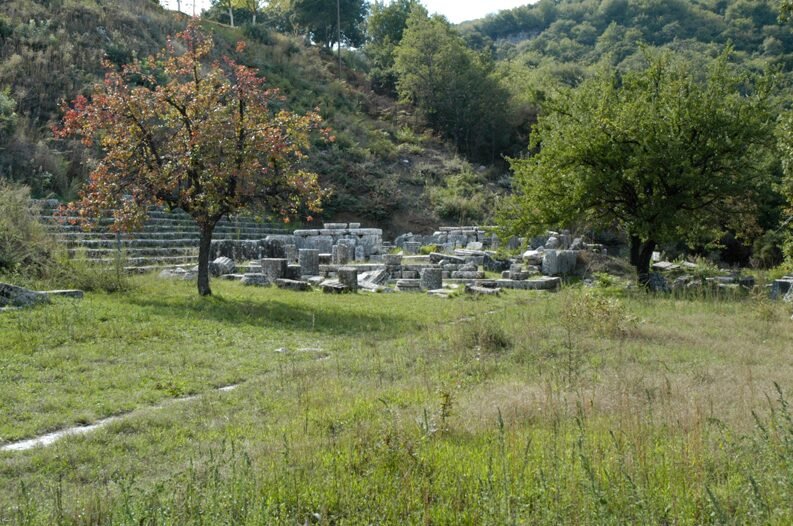
Image: Ruins of Lycosura.
Religious Significance: The Cult of Despoina
The worship of Despoina is one of the defining features of Lycosura. In Greek, “Despoina” (Δέσποινα) means “The Mistress,” and she was a chthonic goddess whose true name was kept secret, revealed only to those who had undergone initiation into her mysteries. This practice of concealing the goddess’s name highlights the esoteric nature of her cult.
Despoina was later associated with the figure of Kore, the daughter of Demeter and Zeus, better known by her Roman name, Persephone.
However, in Arcadian tradition, Despoina was believed to be the daughter of Poseidon Hippios (Poseidon in his horse aspect) and Demeter. This connection to Poseidon points to the distinct local character of Despoina’s worship, which differed from the more widespread myths surrounding Kore/Persephone.
Despoina’s sanctuary at Lycosura was one of the key religious centers of the region, and her cult remained relatively isolated, never gaining the pan-Hellenic status of other Greek deities. Nonetheless, her worship was of immense importance to the Arcadians, who saw her as a protector of their land and people. The rituals associated with Despoina’s cult were kept secret, in line with the practices of other Greek mystery religions, such as those at Eleusis or Samothrace.
One of the most notable features of Despoina’s sanctuary was the colossal cult statue group housed within the temple. This statue group, attributed to the sculptor Damophon of Messene by Pausanias, depicted Despoina and Demeter seated on an ornate throne, with Artemis and the Titan Anytus standing by their sides.
The statues were crafted using acrolithic techniques, which combined stone for the exposed parts of the figures with other materials, likely wood, for the remainder of the bodies. This monumental group was an impressive display of religious art and reflected the reverence in which the goddess was held.

Image: A statue portraying Zeus.
Archaeological Discoveries
Lycosura was excavated in 1889 by the Greek Archaeological Service, long before the development of modern stratigraphic excavation techniques. The findings at the site included the sanctuary of Despoina, along with several significant architectural and artistic remnants. Although much of the city itself remains unexcavated, the sanctuary has provided valuable insights into the religious life of the city.
The sanctuary of Despoina occupies a prominent position on the northeastern slope of a hill that rises to 632 meters above sea level. The site is located in a secluded, forested area, in keeping with the chthonic (underworld) nature of Despoina’s worship. The sanctuary consisted of several key structures, including the temple of Despoina, a stoa, an area of theater-like seating, and three altars. There was also a mysterious structure known as the Megaron, whose purpose remains a subject of debate among scholars.
The Temple of Despoina is the most significant structure at the site. Built in the Doric order, it featured a prostyle-hexastyle design, with six columns along the front façade. The temple’s floor plan measured 11.15 by 21.35 meters and included a pronaos (front porch) and a cella (main chamber).
The lower portions of the temple walls were constructed from limestone, while the upper parts were made of fired clay bricks, which were likely plastered. The columns and entablature were made from marble, adding to the temple’s grandeur. A unique feature of the temple was the presence of a doorway in the south wall, which opened onto a theater-like seating area to the south of the building.
Inside the cella, a massive stone podium at the rear of the chamber was designed to hold the colossal statue group of Despoina, Demeter, Artemis, and Anytus. A mosaic floor in front of the podium added to the temple’s elaborate decoration. Scholars generally agree that the temple dates to the fourth century BCE, though it underwent several repairs during the Roman period, reflecting its continued importance even after the rise of Rome.
To the south of the temple was the theater-like seating area, consisting of ten rows of stone seats. These rows, which ranged in length from 21 to 29 meters, were aligned parallel to the south wall of the temple. This arrangement has led scholars to speculate that the seating area may have been used for some form of ritual performance or communal gathering associated with the worship of Despoina. The theater-like structure and the side doorway in the temple suggest that the sanctuary may have hosted mystery rituals that were witnessed by initiates seated in the adjacent area.
To the northeast of the temple, a stoa (a covered walkway or portico) was built in the Doric order, measuring 14 by 64 meters. The stoa had a single story and an internal colonnade. It was likely used for displaying votive offerings and artworks, as was common in other Greek sanctuaries.
Pausanias mentioned that the stoa at Lycosura contained bas-relief sculptures depicting various mythological scenes, including Zeus and the Fates, Hercules wrestling Apollo for the Delphic tripod, nymphs and Pans, and the historian Polybios. Unfortunately, none of these reliefs have survived to the present day.
The Megaron, another significant structure at the sanctuary, remains enigmatic. Measuring 9.5 by 12 meters, the Megaron has been interpreted by some scholars as a monumental altar, similar to the Great Altar of Zeus at Pergamon.
The discovery of more than 140 terracotta figurines with animal heads in the area of the Megaron suggests that it may have been the site of important ritual activities related to the cult of Despoina. These figurines, many of which depict women with the heads of sheep or cows, bear a striking resemblance to the figures carved into the veil of Despoina in the colossal statue group.
In addition to the major architectural structures, several smaller altars were found in the sanctuary. These altars were dedicated to Despoina, Demeter, and Gaia, the Great Mother, further emphasizing the sanctuary’s role as a center for the worship of chthonic deities. Many votive offerings were discovered during the excavation, indicating the devotion of local worshippers to the goddess.
Beyond the main structures of the sanctuary, Pausanias noted the presence of a sacred grove dedicated to Despoina. This grove, located beyond the Megaron, was surrounded by stones and featured altars dedicated to Poseidon Hippios and other deities.
Further down the slope, a shrine to Pan could be accessed by a flight of stairs. This shrine contained altars to Ares, statues of Aphrodite, Apollo, and Athena, and a sanctuary of Athena. These features, however, have not been securely identified through archaeological excavation.
The city’s periphery also included structures of Hellenistic and Roman date, which were uncovered to the southwest of the temple. These remains may have included a nymphaeum (a fountain-house) and a complex of Roman thermae (baths). Parts of the city’s defensive walls have also been traced, though much of Lycosura remains unexplored archaeologically.
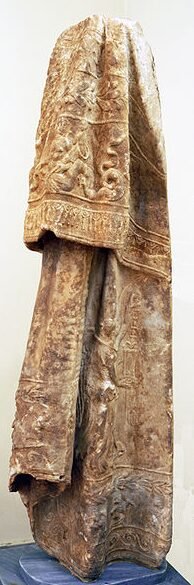
Image: Veil of Despoina
The Cultic Statues of Despoina and Demeter
The colossal cultic statues of Despoina, Demeter, Artemis, and Anytus, which stood at the heart of the temple, are some of the most significant finds from the sanctuary. Although the statues have not survived intact, fragments of the figures have been extensively studied, providing insight into the religious art of ancient Greece.
The central figures of Despoina and Demeter were seated on a highly ornate throne, made of Pentelic marble, a material prized for its quality and used in many important Greek monuments, including the Parthenon. The figures were much larger than life, towering over the smaller statues of Artemis and Anytus that stood to their sides. Despoina and Demeter were the focal points of the group, with Despoina likely representing the younger, more dynamic goddess, while Demeter embodied the older, more maternal deity.
The statues were created using acrolithic techniques, which involved crafting the exposed parts of the figures—such as the heads, arms, and feet—from stone, while the rest of the bodies were constructed from wood or other materials. This method allowed for the creation of large statues without the need for massive quantities of stone, and it also enabled the artists to add lifelike details, such as metal ornaments and diadems, to the figures.
One of the most intriguing aspects of the statues is the decoration of Despoina’s veil, which was adorned with several layers of sculpted ornamentation. The veil featured a frieze of animal-headed women, possibly representing mythological figures or dancers associated with the goddess’s cult.
Other decorative elements included bands of eagles and thunderbolts, olive sprays, and marine motifs, such as Nereids riding sea creatures. These marine themes likely referenced Despoina’s association with Poseidon, her father in Arcadian mythology.
The scale and complexity of the statue group have led scholars to attribute it to Damophon of Messene, a sculptor active in the second century BCE. Although Pausanias credited Damophon with creating the statues, modern scholars have questioned this attribution, given the discrepancies between Pausanias’ account and the surviving fragments of the statues. For example, Pausanias claimed that the statues were carved from a single block of marble, a statement that has been disproven by the evidence of acrolithic construction techniques.
Despite these uncertainties, the statues of Despoina and Demeter are an important example of Hellenistic religious art. Their size, craftsmanship, and decorative details reflect the deep reverence in which the Arcadians held their goddesses and provide valuable insights into the religious practices of the region.
Religious Practices and Rituals
The religious practices associated with the sanctuary of Despoina were likely similar to those found at other Greek mystery cults, such as Eleusis. Initiation into the mysteries of Despoina would have been required to learn the secret aspects of her worship, including her true name. Pausanias mentioned that major sacrifices were performed at the Megaron, where animals were offered to the goddess. Unlike typical Greek sacrifices, where the throat of the animal was cut, the sacrifices at Lycosura involved hacking off a limb, a distinctive and possibly ancient form of ritual offering.
The side doorway of the temple and the adjacent theater-like seating area suggest that the sanctuary may have been designed to accommodate public rituals or processions that involved the participation of the local community. It is possible that an epiphany of the goddess—her miraculous appearance—was staged as part of these rituals, similar to the mystery rituals at other Greek sanctuaries.
The figurines found in the area of the Megaron, many of which resemble the figures on Despoina’s veil, may provide further clues about the rituals performed at Lycosura. These terracotta figures, with their animal heads, suggest that the worship of Despoina may have involved symbolic representations of transformation or the crossing of boundaries between the human and animal worlds, themes often associated with chthonic deities.
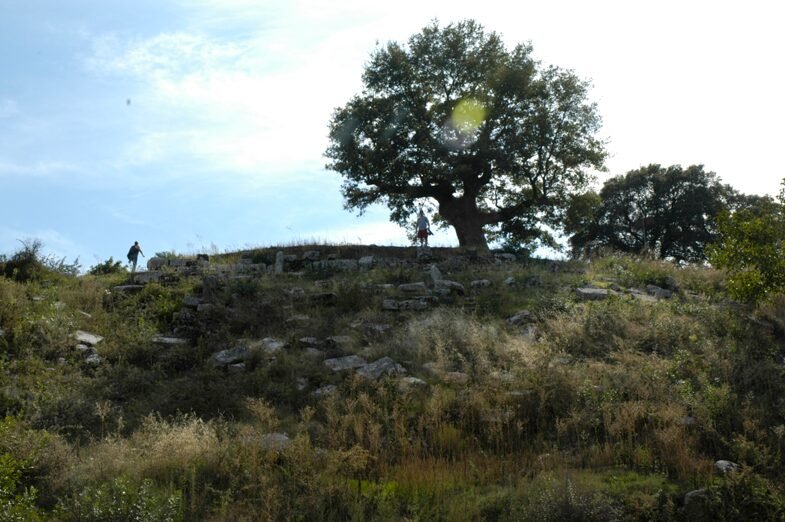
Image: The remnants of the Megaron.
Legacy and Importance
Although Lycosura never became a major political or economic center, its religious significance endures through its connection to the cult of Despoina. The sanctuary provides a unique glimpse into the religious life of ancient Arcadia, a region known for its preservation of ancient traditions and local cults. The worship of Despoina, with its secretive rites and local focus, stands in contrast to the more widely known cults of Olympian deities, offering an example of how local religious practices coexisted alongside the larger Greek pantheon.
The sanctuary of Despoina at Lycosura is also important for the study of ancient Greek mystery religions. While Eleusis and Samothrace have received more attention in scholarly research, Lycosura offers a complementary perspective on how mystery cults functioned in smaller, regional contexts. The architectural layout of the sanctuary, with its theater-like seating area and side doorway, suggests that mystery rituals at Lycosura may have involved staged performances or epiphanies witnessed by the initiates.
Frequently Asked Questions
According to Pausanias, who founded Lycosura, and what claim did he make about the city?
The Greek traveler and writer Pausanias, in the second century CE, provided the most detailed surviving account of Lycosura and the sanctuary of Despoina.
Pausanias wrote that Lycosura was founded by Lycaon, the son of Pelasgus. He claimed that it was the oldest city in the world.
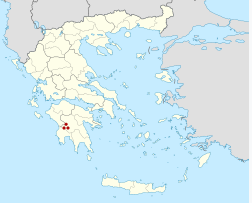
Image: A map highlighting Lycosura (red) within Greece.
What happened to the citizens of Lycosura during the founding of Megalopolis in 368 or 367 BCE?
When many cities in the region were united into Megalopolis, the citizens of Lycosura refused to relocate. Unlike the people of Trapezus who were massacred or exiled, those from Lycosura were spared because they sought refuge in the Sanctuary of Despoina.
The Sanctuary of Despoina was about 7.4 km from Megalopolis, which had political control over the sanctuary.
What significant discoveries were made at the Sanctuary of Despoina during the 1889 excavation?
The excavation of the Sanctuary of Despoina revealed a temple, a stoa, a theater-like seating area, three altars, and a structure known as the Megaron. Remains of the cult statues were also discovered.
The Temple of Despoina was built in the prostyle-hexastyle Doric order with six Doric columns on its front façade. The temple platform measured 11.15 by 21.35 meters and was divided into a pronaos and a cella. It featured limestone walls, marble columns, and an unusually tall Doric frieze.
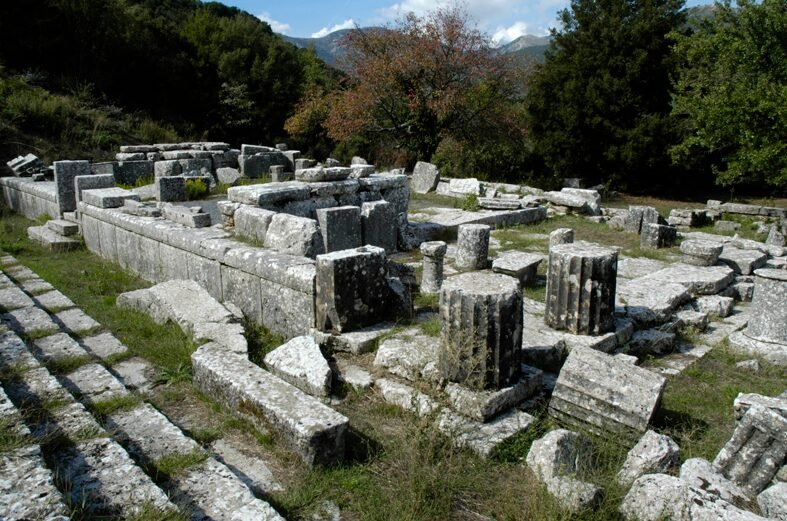
Image: Remains of the Temple of Despoina
What altars and deities did Pausanias note beyond the Megaron?
The Megaron, a poorly preserved structure at the sanctuary, was likely a monumental altar. Over 140 terracotta figurines with animal heads, resembling the figures on Despoina’s veil, were found around the Megaron.
Beyond the Megaron, Pausanias noted a sacred grove of Despoina and altars to Poseidon Hippios and other deities. A shrine to Pan was also accessible by stairs, along with altars to Ares and statues of Aphrodite, Apollo, and Athena.
What features of the colossal cult group of statues at the Sanctuary of Despoina are of particular interest to scholars?
The colossal statues, made using acrolithic techniques, included Despoina and Demeter seated on an ornate throne, flanked by Artemis and the Titan Anytus. The intricate veil of Despoina, decorated with layers of sculpted ornamentation, is of particular interest due to its depiction of marine deities, dancing figures, and intricate designs.
How did the sanctuary of Despoina differ from other religious sites in ancient Greece?
The sanctuary of Despoina had a unique side doorway and a theater-like seating area, which likely facilitated rituals for the mystery cult of Despoina. These features suggest that the sanctuary hosted special ceremonies, possibly an epiphany of the goddess.
At the Megaron, sacrifices to Despoina involved hacking off a limb from the animal, unlike typical sacrifices where the throat was cut. This unusual mode of sacrifice highlights the unique religious practices at Lycosura.





