The Greek Phalanx
The Greek phalanx was a highly effective and innovative military formation that played a crucial role in the success of ancient Greek armies, especially during the Classical period (circa 5th and 4th centuries BCE). Known for its tight, disciplined, and cohesive structure, the phalanx was used by Greek city-states, most notably Sparta and Athens, and later by Macedonian armies under Philip II and Alexander the Great. Its development and evolution had a profound impact on ancient warfare, as it maximized the strength and endurance of soldiers while minimizing individual vulnerabilities.

The Greek phalanx was a dense, close-rank military formation in which soldiers, known as hoplites, stood shoulder-to-shoulder armed with long spears and interlocking shields. Image: Greek phalanx facing Achaemenid forces.
Origins and Development
The phalanx was not a single invention, but rather an evolving concept of warfare that adapted over time. Its early origins trace back to the Homeric era, where loosely organized warrior groups engaged in battle. Over time, however, Greek military leaders realized that organized formations provided more advantages in combat. By the 7th century BCE, the phalanx had taken shape as a hoplite (heavily armed foot soldier) formation.
The defining feature of the phalanx was its use of tightly packed rows of soldiers, standing shoulder to shoulder, each equipped with a large shield (aspis or hoplon) and a long spear (doru). This arrangement allowed the soldiers to create a wall of shields that protected not only themselves but also their comrades to their left. As each soldier’s shield overlapped with the next, the collective defense became incredibly strong. Behind the first line, additional rows of hoplites would stand, their spears projecting over the shoulders of the soldiers in front, adding offensive strength and depth to the formation.
Did you know…?
The term “phalanx” comes from the Greek word for “finger,” highlighting its compact and cohesive structure.
Hoplite Equipment and Training
Hoplites, the backbone of the Greek phalanx, were usually citizen-soldiers rather than professional warriors, especially in city-states like Athens. Each hoplite was responsible for providing their own equipment, which included:
- Hoplon (shield): The round, heavy shield, about three feet in diameter, was made of wood covered with bronze. It was large enough to cover a soldier from chin to knee and had a unique grip system allowing the soldier to hold it on his left arm, while the outer rim covered part of the soldier to his left.
- Doru (spear): Typically 6 to 9 feet long, the spear was the primary weapon of the hoplite, used for thrusting rather than throwing. Soldiers in the second and third ranks could also extend their spears forward, contributing to the offensive capability of the phalanx.
- Xiphos (short sword): A secondary weapon used for close combat when spears broke or the fighting became too tight to use them effectively.
- Helmet, breastplate, and greaves: Armor made of bronze protected vital areas of the body. Helmets often covered the entire face, with slits for the eyes and mouth, while breastplates and greaves (leg armor) added further protection.
While the hoplites were citizen-soldiers, Greek city-states often held regular drills to maintain discipline and ensure that the phalanx could function as a cohesive unit. Soldiers were trained to fight in synchronization, as the success of the phalanx depended on the coordination and cooperation of the individuals within it.
Tactics and Battle Formation
The phalanx was typically arranged in lines or ranks, with each rank consisting of soldiers standing shoulder to shoulder. The front rank was composed of the strongest and most experienced soldiers, as they would be the first to engage the enemy. The depth of the phalanx could vary, depending on the specific tactics or the number of soldiers available. For example, a typical phalanx might be eight to twelve ranks deep, but in some cases, like the famous Theban phalanx at the Battle of Leuctra (371 BCE), it could be even deeper—up to fifty men deep.
In battle, the phalanx advanced as a single, solid mass, often in silence, until close contact with the enemy was imminent. The soldiers would then thrust their spears forward in unison, creating a wall of spears that was difficult for enemies to penetrate. The tight formation provided both offensive and defensive capabilities:
- Offensive strength: The spears of the soldiers in the first few ranks could all be used to strike at the enemy, while the soldiers in the back ranks provided support and could replace fallen comrades.
- Defensive strength: The overlapping shields created a nearly impenetrable wall, protecting the soldiers from frontal attacks. This shield wall, combined with the discipline of the hoplites, made the phalanx very resilient.
However, the phalanx was not without its weaknesses. Its greatest vulnerability was its lack of mobility. While it was highly effective in head-on confrontations on flat, open terrain, the phalanx could be easily outflanked by more mobile forces, such as cavalry or lighter infantry, if they could attack from the sides or rear. Additionally, rough terrain could disrupt the cohesion of the formation, making it less effective.
Notable Battles and the Role of the Phalanx
The Greek phalanx played a central role in many key battles throughout ancient Greek history. One of the earliest and most famous battles involving the phalanx was the Battle of Marathon (490 BCE), where the Athenians used their phalanx to defeat a numerically superior Persian force. The disciplined Greek hoplites were able to hold their formation and overwhelm the lightly armed Persian infantry, marking one of the earliest recorded uses of the phalanx in a decisive victory.
The Battle of Thermopylae (480 BCE) is another iconic example where the Greek phalanx was used to great effect. A small force of Greek hoplites, led by the Spartans, held off a vastly larger Persian army in a narrow pass for several days. The narrow terrain helped mitigate the phalanx’s vulnerability to flanking maneuvers, allowing the Greeks to inflict significant casualties on the Persians.
Perhaps the most famous and significant development in the evolution of the phalanx came under the leadership of Philip II of Macedon (r. 359–336 BCE) and his son, Alexander the Great. Philip reformed the traditional Greek phalanx by introducing longer spears (sarissas), which were approximately 18 to 22 feet long, compared to the 9-foot spears used by traditional hoplites. This gave the Macedonian phalanx a significant advantage in reach, allowing them to strike the enemy before the enemy could reach them.
At the same time, Philip and Alexander integrated the phalanx with other military units, such as light infantry, cavalry, and specialized troops, creating a more flexible and versatile army. This combined-arms approach addressed some of the traditional phalanx’s weaknesses, particularly its vulnerability to flanking. Under Alexander’s leadership, the Macedonian phalanx played a key role in his conquests, including his victories at Issus (333 BCE) and Gaugamela (331 BCE), which led to the collapse of the Persian Empire.
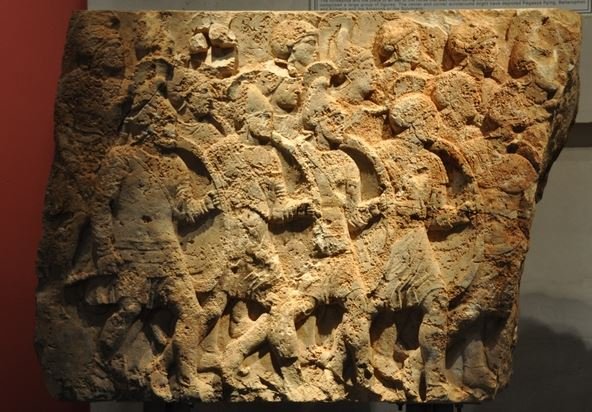
Image: Phalanx depicted in a frieze on the tomb of Pericles, ruler of Lycia.
Decline of the Phalanx
While the phalanx was incredibly effective for centuries, changes in military tactics and the rise of new armies led to its eventual decline. One major factor was the increasing importance of cavalry and more mobile infantry units in warfare. The Roman legions, in particular, proved highly effective against the phalanx in later centuries. The Roman military system was more flexible, with soldiers trained to fight both individually and in formation. Their ability to adapt to different terrains, use of a variety of weapons, and more mobile, manipular formations allowed them to outmaneuver and defeat the rigid Greek phalanx.
The decisive moment came at the Battle of Pydna (168 BCE), where a Roman army defeated the Macedonian phalanx of King Perseus. The battle highlighted the weaknesses of the phalanx when faced with a more flexible, well-organized force. The Romans exploited gaps in the Macedonian formation, and the phalanx, unable to turn quickly or break formation without losing its cohesion, was overwhelmed. After this defeat, the phalanx gradually fell out of favor as a dominant military formation, though it remained a symbol of Greek military prowess.
Frequently asked questions about the Greek Phalanx

What weapons and armor did hoplites use in the phalanx?
Hoplites, the soldiers who formed the phalanx, were heavily armed infantrymen. Their equipment typically included a doru, a spear measuring seven to eight feet long, and a large round shield called a hoplon. In addition, they wore a breastplate, helmet, and greaves to protect their bodies. Each hoplite was responsible for providing his own armor and weapons.
How did Philip II of Macedon revolutionize the phalanx?
Philip II of Macedon introduced several key changes to the phalanx. He professionalized his soldiers by providing regular training and issued them a smaller shield and a much longer spear called the sarissa, which could be up to 18 feet long. The sarissa allowed the phalanx to attack from a greater distance and helped conceal the formation’s movements. These innovations enhanced both the reach and effectiveness of the phalanx.
What was the key strength of the phalanx formation?
The strength of the phalanx lay in its discipline and endurance. Soldiers in the formation stood in a tight, rectangular arrangement with overlapping shields, forming a nearly impenetrable wall. The front lines thrust their spears forward while the soldiers in the back pushed from behind. This structure allowed the phalanx to advance slowly, absorb missile attacks, and overpower enemy forces in close combat.
What were some famous battles where the phalanx was successfully used?
One of the most famous battles where the phalanx was employed was the Battle of Marathon in 490 BCE, where the Greek hoplites crushed the lightly armed Persian infantry. Another notable use was during the Battle of Plataea in 480 BCE. Additionally, Theban general Epaminondas innovated the phalanx’s use during the Battle of Leuctra in 379 BCE, altering its formation and securing a significant victory against Sparta.
How did Philip II of Macedon and Alexander the Great improve upon the phalanx?
Philip II improved the phalanx by adopting longer spears (the sarissa) and smaller shields, giving his forces greater mobility and reach in battle. His tactics and the professionalization of the army were instrumental in his victories, such as at the Battle of Chaeronea in 338 BCE. Alexander the Great further refined the phalanx by integrating it with cavalry and other military units, enabling him to move large armies quickly and efficiently, contributing to his vast conquests.

Image: Philip II of Macedon
Why did the phalanx decline in use after Alexander the Great’s death?
After Alexander’s death, the phalanx’s effectiveness declined due to its rigid structure and vulnerability to more flexible tactics. At the Battle of Cynoscephalae in 197 BCE, the Roman legions easily defeated the Greek phalanx because of its inability to protect its flanks and its lack of maneuverability. The defeat marked the decline of the phalanx, as Greek commanders struggled to adapt to more modern forms of warfare.
How did the Roman legions differ from the phalanx, and why were they more successful?
The Roman legions were more flexible and adaptable than the Greek phalanx. The legions could move more independently, were divided into smaller, more maneuverable units, and could better respond to changing battlefield conditions. Their three-line formation gave them more versatility, which proved to be superior to the rigid, tightly packed structure of the phalanx.