What is Independence Hall, and why is it historically significant?
Independence Hall, located in Philadelphia, Pennsylvania, is one of the most historically significant buildings in the United States. It played a central role in the birth of the nation, serving as the site where both the Declaration of Independence and the U.S. Constitution were debated and adopted. The hall stands today as a symbol of freedom and democracy, and it has become an iconic landmark within the broader context of American history.
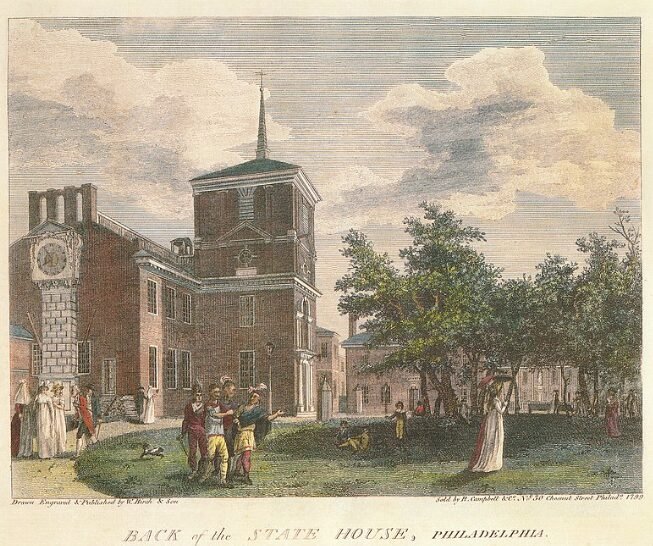
Independence Hall in 1799
Early History and Construction
The origins of Independence Hall date back to the mid-18th century. Initially, the building was commissioned by the Pennsylvania colonial government in the 1730s to serve as the Pennsylvania State House.
Construction began in 1732, but it was not fully completed until 1753. The building’s design was attributed to Edmund Woolley and Andrew Hamilton, two influential figures in Pennsylvania’s colonial administration. It was designed in the Georgian style, which was popular at the time, and its construction utilized red brick, a typical material for buildings in colonial America.
Though it was intended to be a government building for the Province of Pennsylvania, Independence Hall would later become the stage for some of the most important events in the history of the United States.
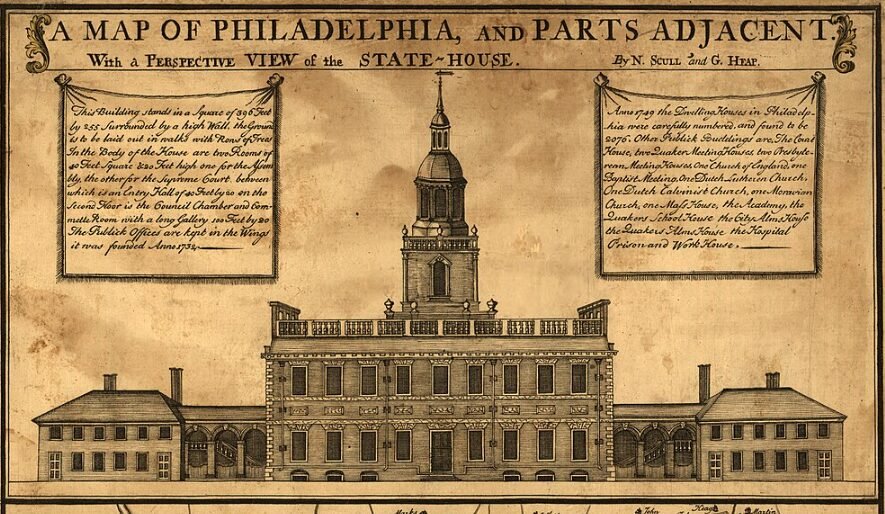
Independence Hall served as the first capitol of the Province of Pennsylvania during the colonial era, the first capital of the United States following independence, and the capital of Pennsylvania. Image: 1752 map of Philadelphia showing the State House and original bell tower without clock.
Role in the American Revolution
By the time of the American Revolution, Independence Hall had transitioned from its original function as the Pennsylvania State House into a pivotal meeting place for the colonies. It housed the Second Continental Congress from 1775 to 1783, during which the delegates from the Thirteen Colonies met to discuss and coordinate their efforts against British rule.
In 1775, just a few weeks after the outbreak of hostilities between the colonies and Great Britain, the Second Continental Congress convened at Independence Hall. One of the most notable actions taken during this session was the appointment of George Washington as commander-in-chief of the Continental Army. Washington’s appointment would prove vital in shaping the Revolutionary War, as his leadership became a cornerstone in the eventual victory of the colonies.

In 1775, the Second Continental Congress met at Independence Hall and appointed George Washington as commander-in-chief of the Continental Army. Image: The Committee of Five presents the draft of the Declaration of Independence to the Second Continental Congress
A year later, in 1776, Independence Hall became the site of one of the most significant moments in American history: the signing of the Declaration of Independence.
On July 4, 1776, after extensive debates and revisions, the Continental Congress formally adopted the Declaration, authored primarily by Thomas Jefferson. This document asserted the colonies’ independence from British rule, outlining the philosophical and practical reasons for the break and declaring that all men are created equal, with the right to life, liberty, and the pursuit of happiness. The Declaration was signed in Independence Hall, forever cementing the building’s place in American history.
Lord North: the British Prime Minister Who Lost the American Colonies
Role in the Creation of the U.S. Constitution
After the American Revolution ended and the United States won its independence, the nation faced another challenge—governance. The Articles of Confederation, the first constitution of the United States, proved ineffective at unifying the newly independent states. It lacked strong central authority, making it difficult to address national issues such as economic regulation, defense, and diplomacy.
In response to these issues, delegates from the states convened once again at Independence Hall in 1787 for what is now known as the Constitutional Convention. This gathering would result in the creation of the U.S. Constitution, the foundational document of the country’s government that still governs the nation today.
The Constitutional Convention took place from May to September 1787, with delegates debating numerous issues, including the balance of power between the federal government and the states, representation in Congress, and the role of the executive branch. These discussions led to several key compromises, including the Great Compromise, which established a bicameral legislature, and the Three-Fifths Compromise, which addressed how enslaved people would be counted for purposes of taxation and representation.
On September 17, 1787, the final draft of the Constitution was signed in Independence Hall. The U.S. Constitution established a federal system of government with checks and balances between the legislative, executive, and judicial branches. It remains the longest-standing written constitution in the world and has been amended only 27 times since its adoption.

On June 21, 1788, Independence Hall hosted the Philadelphia Convention, where the U.S. Constitution was drafted and ratified, making it the world’s longest-standing written and codified national constitution. Image: Scene at the Signing of the Constitution of the United States, by American artist Howard Chandler Christy (1940)
Ratification of the U.S. Constitution: History and Major Facts
Architectural Features and Changes Over Time
Independence Hall is an exemplary representation of Georgian architecture, with its symmetrical design, brick construction, and classical details. The building’s exterior is dominated by a central bell tower, which originally housed the Liberty Bell. The tower, though, underwent several renovations over the years due to damage from wear and time. In 1828, a major reconstruction project restored the tower to a form closely resembling its original appearance.
The interior of the hall includes the Assembly Room, where both the Declaration of Independence and the Constitution were debated and signed. This room is arguably the most important space in the building and remains largely preserved as it was in the 18th century, with period-appropriate furnishings and design elements.
The building also contains the Governor’s Council Chamber, the Long Gallery, and other rooms that played significant roles in the colonial and early national periods. Though the building was originally constructed to serve the Pennsylvania government, the significance of its role in national events has ensured that it remains in its original form, with preservation efforts ongoing since the 19th century.
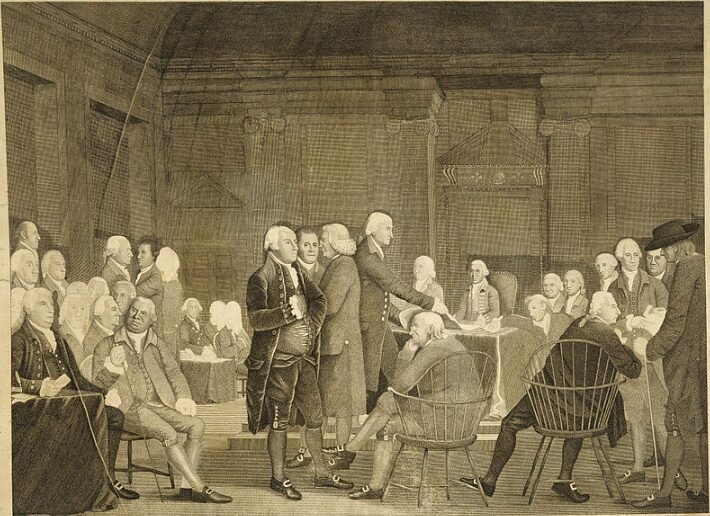
Independence Hall was designated a World Heritage Site in 1979 due to its historical importance in the founding of the United States. Image: Robert Edge Pine’s 1795 painting shows Congress Voting Independence in the Assembly Room.
Independence Hall as a Symbol
Independence Hall’s role in American history has transformed it into a symbol of freedom, democracy, and the founding principles of the United States. The events that took place within its walls are viewed as the embodiment of the American ideals of self-governance, equality, and liberty.
Perhaps the most iconic symbol associated with Independence Hall is the Liberty Bell, which originally hung in the building’s bell tower. The bell, cast in 1752, was used to call lawmakers to meetings and announce significant events. The bell cracked several times over the years, and it is now on display in a separate pavilion in Independence National Historical Park. Its inscription, “Proclaim Liberty Throughout All the Land Unto All the Inhabitants Thereof,” has made it an enduring symbol of freedom.
In 1979, Independence Hall was designated a UNESCO World Heritage Site, a recognition of its global importance as a site where democratic ideals were first put into practice. As part of Independence National Historical Park, the hall remains open to the public, serving as both a historical site and a place of reflection on the principles of freedom and governance.
Other Historical Events
Beyond its role in the creation of the Declaration of Independence and the Constitution, Independence Hall has hosted several other key events in American history. During the Revolutionary War, the building was briefly used as a makeshift hospital for soldiers.
Additionally, in 1915, former U.S. President William Howard Taft presided over a convention at Independence Hall to announce the formation of the League to Enforce Peace, an early effort to promote international cooperation and prevent future wars. This organization would eventually lead to the establishment of the League of Nations after World War I and, later, the United Nations after World War II.
Independence Hall was also the setting for numerous political conventions and public gatherings throughout the 19th and 20th centuries. It remains a place of historical commemoration and civic pride, drawing visitors from across the globe to learn about the founding of the United States and the principles that continue to guide the nation.

In 1915, former U.S. President William Howard Taft presided over a convention at Independence Hall, where he formally announced the formation of the League to Enforce Peace, which eventually led to the creation of the League of Nations in 1920 and the United Nations in 1945.
Preservation and Legacy
Preserving Independence Hall has been an ongoing effort since the 19th century. By the mid-1800s, concerns arose about the state of the building, and various restoration efforts were undertaken to preserve its historical integrity. In 1898, Independence Hall was transferred from the city of Philadelphia to the Commonwealth of Pennsylvania, ensuring that it would receive continued care and preservation as a historical site.
Independence National Historical Park was established in 1948 to protect and maintain Independence Hall and the surrounding historic buildings. Today, the National Park Service oversees the site, ensuring that visitors can continue to explore this iconic symbol of American history.
The legacy of Independence Hall extends far beyond the physical structure itself. The building represents the ideals upon which the United States was founded—liberty, democracy, and the rule of law. It stands as a reminder of the courage and foresight of the Founding Fathers and their commitment to creating a government that would serve the people. Independence Hall has also served as inspiration for democratic movements worldwide, influencing the development of constitutional democracies in other countries.
Major Facts about Independence Hall

The Assembly Room, where the Declaration of Independence and Constitution were authored and adopted
- Location and Construction: Independence Hall is located in Philadelphia, Pennsylvania. It was originally constructed between 1732 and 1753 as the Pennsylvania State House.
- Key Events:
- In 1776, the Declaration of Independence was debated and adopted at Independence Hall.
- From May to September 1787, the U.S. Constitution was debated and signed in the same building.
- Independence Hall was the meeting place for the Second Continental Congress from 1775 to 1783.
- Architectural Style: The building is designed in the Georgian architectural style, featuring symmetrical design elements and brick construction typical of the colonial period.
- Liberty Bell: The Liberty Bell originally hung in the tower of Independence Hall. It has become an enduring symbol of American freedom, despite its famous crack.
- UNESCO World Heritage Site: In 1979, Independence Hall was designated as a World Heritage Site, highlighting its global significance as a birthplace of democracy.
- National Historical Park: Independence Hall is part of Independence National Historical Park, which also includes the Liberty Bell Pavilion and other historical structures associated with the American Revolution and the nation’s founding.
- Restoration Efforts: Over the years, Independence Hall has undergone several restoration efforts to preserve its original design and structural integrity, ensuring that future generations can experience the building in its historical form.
- William Howard Taft and the League of Nations: In 1915, former U.S. President William Howard Taft announced the formation of the League to Enforce Peace at Independence Hall, a precursor to the League of Nations and the United Nations.
- Symbol of Democracy: Independence Hall remains a symbol of democracy and freedom. The events that took place within its walls—the signing of the Declaration of Independence and the U.S. Constitution—embody the ideals of self-governance, liberty, and justice.
- Visitors and Education: Independence Hall attracts millions of visitors each year, offering educational tours and historical exhibits that provide insight into the founding of the United States.
Conclusion
Independence Hall stands as one of the most significant landmarks in American history. From its construction in the mid-18th century to its role in the founding of the United States, the building has been at the heart of the nation’s journey toward independence, self-governance, and democracy.
The debates and decisions that took place within its walls shaped the course of American history and established the principles that continue to define the country today.
As a World Heritage Site and symbol of liberty, Independence Hall remains a place of historical reflection and inspiration, reminding both Americans and the world of the enduring value of freedom and democratic governance.
Frequently Asked Questions

Independence Hall is a historic civic building in Philadelphia, where the Declaration of Independence and the U.S. Constitution were debated and adopted by the Founding Fathers.
When was the construction of Independence Hall completed, and what was its original name?
The construction of Independence Hall was completed in 1753, and it was originally called the Pennsylvania State House.
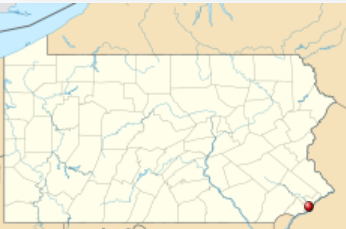
Location of Independence Hall – 520 Chestnut Street between 5th and 6th Streets, Philadelphia, Pennsylvania, U.S.
What role did Independence Hall play in the early history of the United States?
Independence Hall served as the meeting place for the Second Continental Congress between 1775 and 1781, where George Washington was appointed commander-in-chief and the Declaration of Independence was adopted. It was also the site of the Philadelphia Convention, where the U.S. Constitution was drafted and ratified in 1788.
Members of the Committee that Drafted the Declaration of Independence