Ancient Greek Poet Hipponax & His Portrayal of Women
Hipponax was an archaic Greek poet from Ephesus, active around the 6th century BCE, known for his biting, satirical poetry. His work often took aim at individuals and institutions, using scathing humor to ridicule societal norms, personal enemies, and even physical traits.
One of the recurring themes in Hipponax’s poetry, as in much of Greek literature, is the portrayal of women in a way that can be interpreted as misogynistic. His treatment of women reflects the broader gender dynamics and cultural attitudes of Ancient Greece.
Hipponax’s Life and Style
Hipponax’s life and work are marked by his sharp, abrasive style, which has been described as “iambic” poetry, a genre associated with invective and personal attack. Though not as well-preserved or as extensively documented as some other Greek poets, Hipponax’s surviving fragments show a poet unafraid to speak brutally, particularly in his critiques of people, including women.
Hipponax was from Ephesus, a Greek city on the western coast of what is now Turkey, and later moved to the nearby city of Clazomenae. He lived during a time of political and social upheaval, and his poetry reflects this instability, often mocking those in power. Hipponax was known for his personal feuds, particularly with the sculptor Bupalus, whom he accused of creating an unflattering statue of him. He also used his work to express his disdain for certain social behaviors and individuals, with a frequent focus on corrupt or immoral actions.
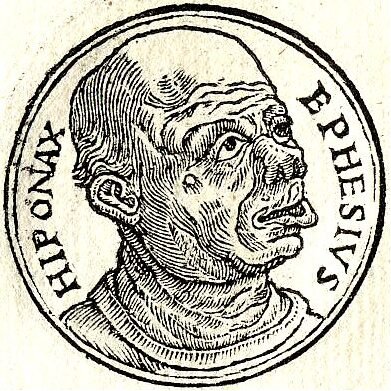
Hipponax, a 6th-century BCE Greek iambic poet from Ephesus, was known for his biting satire and vulgar depictions of Ionian life, targeting not just sculptors Bupalus and Athenis but also women.
Misogyny in Ancient Greece
Misogyny, or the hatred and devaluation of women, was a widespread phenomenon in ancient Greek society. Greek literature, philosophy, and legal traditions often portrayed women as morally and intellectually inferior to men.
Aristotle, for example, considered women biologically defective and naturally subordinate to men. Women in classical Athens were largely excluded from public life, with their roles confined to the household and their legal rights severely restricted. These attitudes are also evident in Greek myths, where women are often depicted as dangerous, deceitful, or inferior to men.
In literature, female characters were frequently reduced to stereotypes, with women either demonized as harbingers of chaos (such as Medea or Clytemnestra) or idealized in their subordination, like Penelope, the faithful wife of Odysseus. Greek comedy and satire, especially in the works of Aristophanes, often employed misogynistic tropes for humor, reflecting the cultural attitudes of the time. Hipponax fits within this broader tradition, though his iambic poetry adds a more personal, biting tone to the portrayal of women.
READ MORE: Challenges women faced in Greek mythology
Hipponax’s Misogyny in Poetry
While much of Hipponax’s work is fragmentary, what remains contains clear instances of misogynistic sentiment. His poetry often depicts women as deceitful, manipulative, and immoral. In line with other Greek writers, he reinforces the notion that women are dangerous and untrustworthy. Here are a few key aspects of Hipponax’s portrayal of women:
Negative Stereotypes: Hipponax frequently presents women as morally inferior, using language that emphasizes their supposed deceitfulness or sexual promiscuity. For example, one of his fragments discusses women’s tendency toward deception, reflecting a broader cultural belief that women were naturally untrustworthy.
Harsh and Graphic Language: Hipponax was known for his crude and often vulgar language, which he did not hesitate to use in his depictions of women. He was explicit in his criticisms, employing bodily imagery and sexual innuendo to degrade the women he mocked. This aligns with his overall style of poetry, which was abrasive and insulting, using humor at the expense of his targets.
Personal Attacks: Like many Greek poets of the iambic tradition, Hipponax directed his misogynistic sentiments at specific women, using them as targets for his broader critiques. His work often blends personal animosity with general misogynistic attitudes, attacking individual women in a way that amplifies the dehumanizing stereotypes common in ancient Greek literature.
Prostitutes and the Public Image of Women: One of the common targets in Hipponax’s work was prostitutes. In ancient Greece, prostitutes, especially the lower-class ones, were often depicted as the embodiment of moral decay. By attacking women in this role, Hipponax not only reinforced societal contempt for these women but also expanded this judgment to women in general.

Broader Context of Misogyny in Ancient Greek Culture
Hipponax’s poetry fits into the larger framework of misogyny that pervaded much of Greek society and literature. Women in ancient Greece were often associated with disorder, danger, and moral weakness, themes that are echoed in the works of philosophers, dramatists, and poets alike.
Women in Mythology: Greek myths are filled with female figures who embody traits like deception, treachery, and chaos. Figures like Pandora, the first woman according to Greek myth, were portrayed as the source of all human suffering. Other myths feature women who disrupt social order, like Helen of Troy, whose abduction (or elopement) led to the Trojan War. These myths reflect and reinforce the belief that women, by nature, bring disorder and must be controlled by male authority.
Philosophical Views on Women: Greek philosophers like Plato and Aristotle had significant influence on the intellectual climate of ancient Greece, and their views on women were largely negative. Aristotle, in particular, held that women were biologically and morally inferior to men. He argued that women’s primary role was reproduction, and they lacked the rational capacities that defined men as superior beings. This philosophical stance lent legitimacy to the misogynistic attitudes found in Greek literature and social practices.

Image: Aristotle
Social Exclusion of Women: In classical Athens, women were excluded from public life and confined to the domestic sphere. They were not allowed to vote, hold political office, or even participate in most religious ceremonies. A woman’s primary role was to manage the household and bear children. This social marginalization was justified by the belief that women were intellectually and morally weaker than men.
Women in Greek Comedy: Like Hipponax’s poetry, Greek comedy often employed misogynistic humor. Aristophanes, for example, frequently used female characters as the butt of jokes, reinforcing the idea that women were foolish, deceitful, or overly sexual. This comedic portrayal of women further perpetuated the societal norms that marginalized them.
“If Only We Could Reproduce Without Woman…!” and other infamous misogynistic lines
Hipponax’s poem “If Only We Could Reproduce Without Woman…!” is highlighted as an example of the negative attitudes toward women in ancient Greece. It portrays women as worthless, with their only value being their ability to reproduce and maintain a household, reflecting how poorly women were regarded at the time.
Another infamous line by Hipponax is “Two days are sweetest for a woman: the day a man marries her, and the day he carries her out dead”? This line is a particularly offensive statement from Hipponax, reflecting his disdain for women. It suggests that women are only valuable to men when they are married or dead, highlighting the extreme misogyny in his views. This line also represents a broader cultural belief in ancient Greece that women had little intrinsic worth beyond their utility to men.
Interpreting Hipponax’s Misogyny
While Hipponax’s poetry can clearly be seen as misogynistic by modern standards, it is important to contextualize his work within the broader traditions of Greek literature and the social norms of his time. His portrayal of women was not unique but rather a reflection of a deeply ingrained cultural perspective that viewed women as inferior to men in both private and public spheres.
In many ways, Hipponax’s harsh treatment of women in his poetry is an extension of his broader approach to social critique. His poetry targeted individuals, both men and women, using humor and invective to attack those he disliked or disapproved of. His treatment of women, therefore, was part of his wider style of ridiculing those he saw as corrupt or morally deficient.
At the same time, the fact that women were frequent targets of his critique reflects the broader misogynistic climate of ancient Greek society. Hipponax, like many of his contemporaries, used his work to reinforce negative stereotypes about women, contributing to the cultural devaluation of women that was so pervasive in his time.
Conclusion
Hipponax’s poetry, though fragmentary, offers a window into the misogynistic attitudes of ancient Greek society. His work is characterized by its biting, satirical style, and women were frequent targets of his harsh invective. By portraying women as deceitful, immoral, and inferior to men, Hipponax reflected and reinforced the cultural norms of his time, which saw women as naturally subordinate to men.
While Hipponax’s poetry is often viewed through the lens of humor and satire, it is essential to recognize the ways in which it perpetuates harmful stereotypes about women. His misogyny, like that of many Greek poets and philosophers, was not simply a product of individual prejudice but rather a reflection of the deeply entrenched gender hierarchy of ancient Greek society.
Frequently asked questions
How were women generally regarded in the ancient world?
Women in the ancient world were often regarded with disdain and valued only slightly more than a man’s cattle or tools. Sometimes they were not granted even that level of respect.
However, in cultures like Mesopotamia and Egypt, women were still afforded some rights and a degree of respect despite the presence of misogynistic attitudes.
How did Hipponax’s portrayal of women differ from other cultures of the time?
Hipponax took misogyny to an extreme, setting a new standard for derogatory portrayals of women.
While other cultures, like Babylon, Assyria and Egypt, showed women some respect, Hipponax’s work was notably more harsh and degrading in its treatment of women.
What was Hipponax’s reputation as a poet, and how did it influence his writing about women?
Hipponax was known for his satirical and venomous writing, often targeting individuals with biting humor. However, his treatment of women went beyond satire, showing deep-seated misogyny. His harsh views often overshadowed any potential humor in his work, making his portrayal of women more about degradation than satire.
How might modern readers interpret Hipponax’s views on women?
Some modern readers may dismiss Hipponax’s views as relics of the past, while others might even accept some of the stereotypes he perpetuates about women. However, these stereotypes are exaggerated and cruel, and the same negative traits could easily be applied to men, revealing the unfairness of such blanket judgments.
How does Hipponax use animal imagery to depict women, and what are the implications of these comparisons?
Hipponax uses animal imagery to portray women negatively, comparing them to pigs (dirty and self-disrespecting), foxes (sly and untrustworthy), and dogs (noisy and difficult to silence). These comparisons are harsh and dehumanizing, emphasizing his contempt for women and reinforcing misogynistic stereotypes.

Image: Bupalus and Athenis
What is the only positive representation of women in Hipponax’s work, and how is it undermined?
The only positive representation of women in Hipponax’s work is symbolized by the bee, which represents a loving and devoted wife who bears handsome children. However, Hipponax undermines this portrayal by cynically suggesting that such women are nearly impossible to find, and even reminds the reader that bees are known for their sting, continuing his negative view of women.
How does Hipponax conclude his portrayal of women in his writing?
Hipponax concludes that women are a great burden imposed by Zeus on men, stating that they are the “greatest pain of all.” Despite his misogyny, he acknowledges that women are here to stay, and men must accept them, no matter how insufferable he believes them to be.
What does Hipponax’s work reveal about ancient Greek attitudes toward women?
Hipponax’s work reflects the deep-seated gender biases and societal contempt for women in ancient Greece. His extreme misogyny highlights the cultural belief that women were inferior and existed solely for men’s use, reinforcing gender inequality and negative stereotypes.





