Family in Ancient Greek Literature
Ancient Greek authors frequently used family as a lens through which to examine personal motivations, moral dilemmas, and the broader social dynamics of their time. Family, or “oikos” in Greek, was central not only to the individual’s identity but also to the continuity of social and moral order.
From the great epics of Homer to the tragedies of Aeschylus, Sophocles, and Euripides, familial relationships—whether harmonious or fraught with conflict—formed the core of many of the most important stories of ancient Greece. These works explore the powerful roles that loyalty, duty, love, vengeance, and fate play in family dynamics and their far-reaching implications.
The Role of Family in Homeric Epics
Homer’s epic poems, The Iliad and The Odyssey, are two of the earliest and most influential works of ancient Greek literature. In these texts, the family is not just a social unit but a central source of identity, motivation, and conflict.
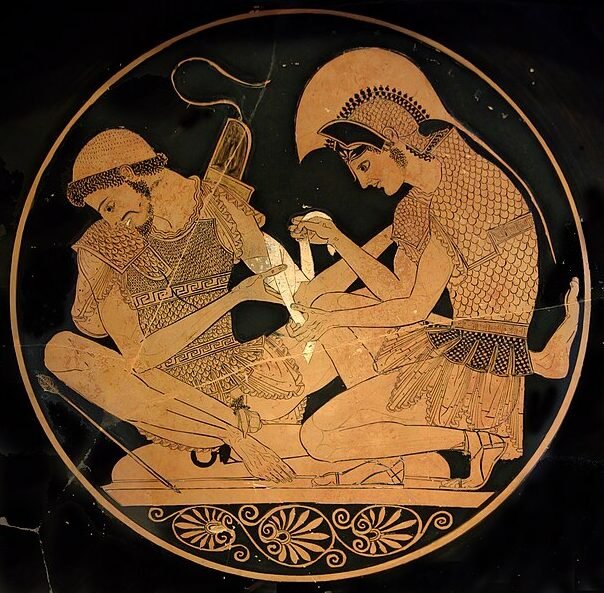
Whether in the context of heroism, tragedy, or the everyday struggles of life, the family is portrayed as both a source of strength and a potential cause of suffering. Image: Achilles caring for the injured Patroclus
The Iliad: Family and Honor
In The Iliad, the concept of family honor motivates many of the main characters’ actions. Achilles, one of the epic’s central figures, is driven by his desire to preserve his honor and that of his family. His anger at Agamemnon for taking away Briseis, a war prize, is not only personal but tied to his sense of familial and social identity. In Greek culture, a man’s status and honor were closely linked to his family’s reputation. Achilles’ decision to withdraw from battle following this insult reflects his belief that his personal and familial honor has been disrespected.
Similarly, Hector, the Trojan prince and leader of the Trojan army, is portrayed as a man deeply committed to his family. One of the most poignant scenes in The Iliad is Hector’s farewell to his wife, Andromache, and their infant son. Hector knows that his duty as a warrior requires him to fight for Troy, even though it will likely lead to his death and leave his family vulnerable. This conflict between personal duty to family and the broader obligations of warfare is a recurring theme in Greek literature. Hector’s concern for his family’s future, as well as his fear that his son will grow up fatherless, reflects the importance of family in defining personal and communal values.
Trojan War: the 10-year-long, bloody war between Troy and Greece
The Odyssey: Family as Motivation
In The Odyssey, family serves as the central motivation for Odysseus’ long and arduous journey home. The epic opens with Odysseus far from Ithaca, his kingdom, longing to return to his wife, Penelope, and son, Telemachus. Odysseus’ desire to reunite with his family drives him through numerous trials and hardships, from facing the wrath of the sea god Poseidon to outwitting the Cyclops, Polyphemus. His yearning for home and family represents a universal human desire for stability, continuity, and belonging.
Cyclopes in Greek Mythology: Origin Story & Other Major Myths
Penelope, meanwhile, embodies the ideal of familial loyalty. For twenty years, she remains faithful to Odysseus, despite the pressure from suitors who seek to marry her and take control of his kingdom. She cleverly delays choosing a new husband by weaving and then unraveling a burial shroud for Odysseus’ father, Laertes. This act of loyalty underscores her commitment to maintaining the family’s honor and continuity. Telemachus, too, seeks to protect his family’s name and legacy by searching for news of his father. The familial bond, in this sense, is portrayed as something that endures despite time, distance, and hardship.
Family in Greek Tragedy
Greek tragedy frequently explores the darker side of family dynamics, particularly the ways in which familial obligations can lead to tragedy and destruction. The tension between individual desires and familial duty is often at the heart of the conflict in these plays, as characters struggle to balance personal ambitions with their responsibilities to their kin.
Aeschylus’ Oresteia: The Burden of Family Curses
Aeschylus’ Oresteia trilogy is a powerful exploration of family loyalty, revenge, and justice. The story revolves around the House of Atreus, one of the most cursed families in Greek mythology. The cycle of violence begins when Agamemnon, the king of Mycenae, sacrifices his daughter, Iphigenia, to appease the gods and ensure a successful voyage to Troy. Upon his return from the Trojan War, Agamemnon is murdered by his wife, Clytemnestra, in revenge for their daughter’s death. Their son, Orestes, is then faced with the agonizing choice of avenging his father’s death by killing his mother, thus continuing the cycle of bloodshed.
The Oresteia reflects the profound tension between personal justice and familial duty. Orestes is caught between conflicting obligations: loyalty to his father and the taboo against matricide. In the end, it is only through divine intervention that the cycle of vengeance is broken, and a new legal system is established to resolve familial conflicts. The trilogy highlights the inescapable nature of family ties and the way they can drive individuals toward destructive actions. At the same time, it suggests that family conflicts are not only personal but have broader social and political implications.
Sophocles’ Antigone: Loyalty to Family vs. Loyalty to the State
Sophocles’ Antigone is another tragedy that explores the tension between familial loyalty and the demands of the state. Antigone, the play’s protagonist, defies the orders of King Creon by burying her brother Polynices, who has been declared a traitor. For Antigone, the duty to her family, particularly the obligation to ensure proper burial rites for her brother, outweighs her duty to the state.
Antigone’s actions reflect the ancient Greek belief in the sanctity of familial obligations, particularly those involving the dead. By burying her brother, she honors not only his memory but also the gods, who were believed to preside over such rituals. Her defiance of Creon’s orders, however, leads to tragedy, as she is sentenced to death for her disobedience. The play explores the conflict between personal loyalty to family and the broader demands of civic duty, a theme that resonated deeply in a society where individuals were often torn between competing obligations.
Euripides’ Medea: The Destructive Power of Family Betrayal
In Euripides’ Medea, the theme of family betrayal takes center stage. Medea, a foreign princess who has helped her husband Jason achieve great success, is betrayed when the hero Jason decides to marry another woman. Medea’s response to this betrayal is shocking and extreme: she kills their two children as an act of revenge against Jason.
Medea explores the darker side of familial relationships, where love and loyalty can turn into hatred and vengeance. Medea’s actions challenge traditional notions of maternal devotion and the sanctity of family bonds. In her view, the betrayal of her husband is so profound that it justifies the destruction of their family. The play forces the audience to confront uncomfortable questions about the limits of familial obligation and the destructive potential of unchecked emotions within the family unit.

Jason and Medea – as depicted by English painter John William Waterhouse, 1907.
Most Notable Members of the Argonauts, including the hero Jason
The Heroic Family in Greek Mythology
In Greek mythology, family often serves as both a source of motivation and conflict for heroes. Many of the great Greek heroes, such as Heracles, Perseus, and Theseus, are defined by their familial relationships and obligations. In many cases, their heroic deeds are motivated by a desire to protect or restore their families’ honor.
Heracles and the Burden of Family
Heracles, one of the most famous Greek heroes, is a figure whose life is profoundly shaped by his family relationships. His twelve labors, which form the core of his myth, are a form of penance for a crime he committed against his own family. In a fit of madness caused by the goddess Hera, Heracles kills his wife and children. His labors are an attempt to atone for this crime and restore his honor.
Heracles’ story reflects the ancient Greek belief in the possibility of redemption through great deeds. His actions are motivated not only by personal ambition but also by a desire to right the wrongs he has committed against his family. The theme of familial responsibility and the consequences of failing in that responsibility are central to Heracles’ narrative.
Similarities between Phoenician Deity Melqart and Greek demigod Heracles
Perseus and the Protection of Family
Perseus, another famous Greek hero, is motivated by a desire to protect his mother, Danaë. When King Polydectes, the ruler of the island where Perseus and Danaë are living, tries to force Danaë into marriage, Perseus embarks on a dangerous quest to slay the Gorgon Medusa. His success in this task not only saves his mother but also restores their family’s honor.
Like Heracles, Perseus’ actions are motivated by a sense of duty to his family. His heroism is not just about personal glory but about fulfilling his obligations to protect and defend his family. This theme of familial protection is common in Greek mythology, where heroes often embark on dangerous quests to save or avenge their loved ones.

Perseus with the Severed Head of Medusa
The Role of Women in the Greek Family
Women in ancient Greek literature are often portrayed in relation to their roles within the family. While men are typically depicted as warriors or leaders, women are shown as the preservers of the household, responsible for maintaining the family’s moral and social integrity. This is particularly evident in the portrayals of wives and mothers, who are often depicted as central figures in ensuring the continuity of the family line.
The Loyal Wife: Penelope in The Odyssey
Penelope, the wife of Odysseus, is one of the most famous examples of a loyal wife in ancient Greek literature. Throughout Odysseus’ twenty-year absence, Penelope remains faithful to him, despite the advances of numerous suitors who seek to marry her and take control of Ithaca. Her cleverness in delaying the suitors by weaving and unweaving a shroud for Odysseus’ father demonstrates her commitment to preserving her husband’s household and legacy.
Penelope’s role in The Odyssey reflects the importance of women in maintaining the family’s honor and continuity. While Odysseus is away, it is Penelope who ensures that the family’s wealth and reputation remain intact. Her loyalty and intelligence are crucial to the eventual reunification of the family.
The Mourning Mother: Andromache in The Iliad
Andromache, the wife of Hector, represents the ideal of the mourning mother in The Iliad. After Hector’s death at the hands of Achilles, Andromache laments not only for her husband but also for their son, Astyanax, who will grow up without a father. Her sorrow reflects the vulnerability of the family in times of war and the importance of the father’s role in protecting and providing for the household.
Andromache’s grief is a reminder of the personal cost of war, particularly for women and children. Her role in the epic emphasizes the centrality of family to the human experience, as well as the devastating consequences of its destruction.
Family and Fate
In ancient Greek literature, family is often portrayed as intertwined with fate. Many characters are bound by familial curses or prophecies that dictate their actions and outcomes. The inescapability of fate is a common theme, with characters struggling against the forces of destiny that often center on their family relationships.
The House of Atreus: A Family Cursed by the Gods
The House of Atreus, featured prominently in Aeschylus’ Oresteia and other Greek tragedies, is one of the most infamous examples of a family cursed by the gods. The cycle of violence and revenge that plagues this family is portrayed as a divine punishment for the sins of previous generations. The curse on the House of Atreus begins with the crime of Tantalus, who serves his own son, Pelops, as a meal to the gods. This act of sacrilege sets off a chain of events that leads to murder, betrayal, and revenge across multiple generations.
The story of the House of Atreus reflects the ancient Greek belief in the power of familial curses and the inescapability of fate. No matter how hard individual members of the family try to escape their destiny, they are ultimately bound by the actions of their ancestors. This theme underscores the idea that family ties are not only a source of support and identity but also a potential source of tragedy and suffering.
The Conflict Between Family and the State
A recurring theme in ancient Greek literature is the conflict between familial loyalty and civic duty. Characters are often faced with difficult choices between fulfilling their obligations to their family and adhering to the laws or expectations of the state.
Creon vs. Antigone: The Clash of Family and State
In Sophocles’ Antigone, this conflict is personified in the characters of Antigone and Creon. Antigone’s decision to bury her brother Polynices in defiance of Creon’s orders reflects her belief that familial obligations, particularly those related to burial rites, are more important than the laws of the state. For Antigone, loyalty to her family and the gods outweighs her duty to obey Creon’s decree.
Creon, on the other hand, represents the authority of the state and the need for order and stability. His refusal to allow Polynices to be buried is motivated by a desire to maintain control and assert the power of the law. The tragic consequences of this conflict highlight the difficulty of reconciling personal and familial loyalty with civic duty.
Conclusion
Whether portrayed as a source of honor and identity, as in the Homeric epics, or as a cause of conflict and tragedy, as in the works of the tragedians, family is central to the narratives and characters of Greek literature.
Familial relationships shape the actions of individuals, drive the plot of many of the greatest Greek works, and reflect broader concerns about loyalty, justice, and the human condition.
Frequently asked questions

How is the theme of family central to ancient Greek literature, as seen in Medea and Antigone?
Family is a central theme in ancient Greek literature, shaping character motivations and driving narratives. In Medea, family loyalty is twisted into a form of vengeance, while in Antigone, family duty leads to defiance against the state. Both plays highlight the cultural significance of family ties, which are portrayed as sacred and more important than personal desires or societal laws.
In Medea, how does Medea’s familial connection to Helios impact the outcome of the play?
Medea’s connection to Helios, her grandfather, is crucial in the outcome of the play. Despite committing grievous acts, including the murder of her children, Medea is ultimately saved by Helios. He provides her with a chariot for escape, demonstrating that her familial bond with a god overrides her offenses, which otherwise would have resulted in divine punishment.
What internal conflict does Medea experience after killing her children, and how does it reflect the complex value of family?
Medea expresses deep internal conflict after killing her children, acknowledging both her love for them and the painful necessity she feels in her revenge against Jason. This reflects the complex value of family in Greek culture, where loyalty to family can be perverted into destructive actions, yet familial ties remain powerful, as seen in Medea’s ultimate rescue by her divine relative.
How does Antigone’s loyalty to her brother Polynices demonstrate the importance of family in Sophocles’ play?
Antigone’s loyalty to her brother Polynices drives her to defy King Creon’s decree and bury him, even at the cost of her own life. This act of defiance highlights her belief that family obligations, particularly sacred burial rites, are more important than obedience to the state. Antigone’s actions reflect the profound value placed on family in Greek culture, where familial duty often supersedes political authority.
What argument does Antigone use to justify her defiance of Creon’s laws?
Antigone justifies her defiance of Creon’s laws by arguing that her duty to her family, especially her brother Polynices, and the gods is more important than any mortal law. She believes the gods honor the dead and that failing to bury Polynices would dishonor both her family and the divine order. Her familial loyalty and commitment to the gods’ laws take precedence over Creon’s decree.
How does Antigone’s willingness to sacrifice her life for her brother emphasize the Greek value of family?
Antigone’s willingness to sacrifice her life to ensure Polynices receives proper burial rites underscores the immense value placed on family in Greek culture. For her, failing to honor her brother would be a betrayal of both her family and the gods. Her actions emphasize that family loyalty is paramount, even in the face of death and political consequences.
What overarching message about family ties do both Medea and Antigone convey?
Both Medea and Antigone convey the message that family ties are sacred and can surpass personal desires, societal laws, or even divine justice. In Medea, family bonds with a god save the protagonist despite her crimes, while in Antigone, family loyalty leads to a tragic defiance of the state. These plays reflect the deep cultural belief in the primacy of family in ancient Greece.
How does Medea illustrate the potential for family loyalty to be both a source of protection and destruction?
Medea illustrates the dual nature of family loyalty by showing how Medea’s love for her children turns into vengeful destruction, leading her to murder them. However, despite this destructive act, her familial connection to Helios provides her with protection and an escape from divine punishment. This shows that family loyalty can both destroy and protect, depending on the circumstances.
In Antigone, how does Sophocles explore the conflict between family loyalty and civic duty?
Sophocles explores the conflict between family loyalty and civic duty in Antigone by pitting Antigone’s determination to bury her brother Polynices against Creon’s decree that forbids it. Antigone prioritizes her family duties over her obedience to the state, while Creon represents the authority of law and order. This conflict leads to tragic consequences, emphasizing the tension between personal obligations to family and public duties to society.
History and Major Facts about the Three Most Acclaimed Greek Tragedians





