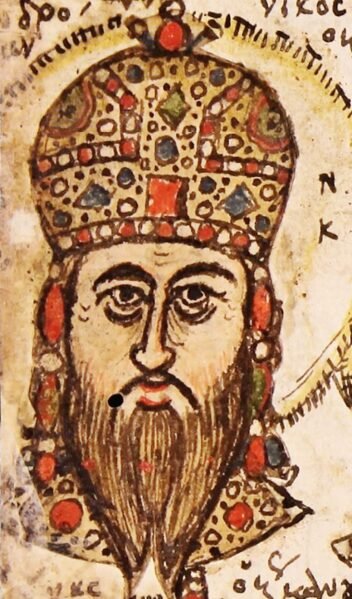
Both rebellions were swiftly crushed. Murad I captured his son and executed him, while John V, eager to demonstrate loyalty to the Ottomans, had Andronikos IV arrested, imprisoned, and partially blinded (in one eye, rather than the usual Byzantine punishment of full blinding). With Andronikos IV incapacitated, his position as heir was revoked, and Manuel II replaced him.
This moment marked a turning point in Byzantine politics, as the rivalry between Andronikos IV and Manuel II would continue to shape the empire’s future. Though imprisoned, Andronikos IV remained determined to regain his position, and his opportunity came just three years later.
READ MORE: 10 Greatest Ottoman Sultans and their Accomplishments
Usurpation and Short-Lived Reign (1376–1379)
In 1376, Andronikos IV escaped imprisonment with the help of the Genoese and fled to the Ottoman court, where he negotiated an alliance with Murad I. In exchange for military assistance, he promised to cede the vital fortress of Gallipoli back to the Ottomans. This offer was significant, as Gallipoli was a key stronghold that allowed for easier Ottoman incursions into Europe.
With Ottoman support, Andronikos IV successfully overthrew John V in July 1376 and seized the throne. He imprisoned both his father and Manuel II, crowning himself emperor and naming his son, John VII Palaiologos, as co-emperor. However, his rule quickly turned unstable due to his overreliance on Genoese support. His decision to award Tenedos to the Genoese provoked a reaction from Venice, which then backed his father’s restoration.
In 1379, John V and Manuel II escaped from imprisonment and sought refuge with Murad I. The Ottomans, now dissatisfied with Andronikos IV’s leadership, switched their allegiance back to John V. With additional military support from Venice, John V regained Constantinople, forcing Andronikos IV to flee to the Genoese-controlled district of Galata.
Final Years and Death (1381–1385)
Despite his earlier betrayals, Andronikos IV was not completely removed from power. In May 1381, an uneasy reconciliation was reached, and John V reinstated Andronikos IV as co-emperor and heir. He was also given control over the town of Selymbria (modern-day Silivri), effectively ruling as a semi-independent prince.
However, Andronikos IV remained resentful and attempted another rebellion in 1385. Before he could mount a serious challenge, he died on either June 25 or June 28, 1385, in Selymbria. His death prevented further conflict, but his son, John VII, would later attempt his own usurpation against Manuel II.
Legacy and Historical Significance
Andronikos IV Palaiologos (Greek: Ἀνδρόνικος Κομνηνὸς Παλαιολόγος) is remembered as a figure whose actions contributed to the decline of the Byzantine Empire. His repeated betrayals and civil conflicts not only weakened the imperial administration but also facilitated Ottoman expansion. By ceding Gallipoli, he enabled the Ottomans to maintain a foothold in Europe, accelerating their eventual conquest of Byzantine territories.
His reign was emblematic of the Byzantine Empire’s late-stage decline, characterized by internal strife, external dependence, and diminishing resources. The struggles between John V, Andronikos IV, and Manuel II reflected the empire’s inability to maintain political stability in the face of mounting external threats.
Family and Descendants
Andronikos IV married Keratsa of Bulgaria in 1356, strengthening ties with the Bulgarian Empire. Their only known son, John VII Palaiologos, later played a role in Byzantine politics, briefly usurping the throne from Manuel II in 1390 before being ousted. John VII eventually reconciled with Manuel II and served as regent of Constantinople during the early 15th century.