Anglo-Spanish War (1585-1604): History, Causes and Major Outcomes
The Anglo-Spanish War (1585-1604) was a significant conflict between England, under Queen Elizabeth I, and Spain, led by King Philip II. It spanned nearly two decades and was marked by a series of naval battles, privateering expeditions, and colonial confrontations. This war was a critical episode in the broader struggle for dominance between the Protestant and Catholic powers of Europe during the late 16th and early 17th centuries.
READ MORE: Major Accomplishments of Queen Elizabeth I
Background and Causes of the War

The Protestant Reformation in the 16th century reshaped Europe’s religious landscape. England’s shift to Protestantism under Henry VIII and Elizabeth I led to tensions with Catholic Spain. Philip II, a staunch Catholic, viewed the English Reformation as a threat and saw himself as the defender of Catholicism in Europe. Image: Philip II’s Armada and the English fleet face off in the summer of 1588
The Anglo-Spanish War was rooted in a complex web of political, religious, economic, and personal factors that had been building for decades. Several key issues contributed to the conflict:
Religious Tensions: Protestant England vs. Catholic Spain
The religious divide between Protestant England and Catholic Spain played a major role in the hostilities. After the English Reformation in the early 16th century, England broke away from the Roman Catholic Church, establishing Protestantism as its state religion. This shift created a deep-seated animosity between Catholic Spain, the leading power of the Catholic world, and Protestant England. King Philip II of Spain was a staunch Catholic and viewed the Protestant Queen Elizabeth I as a heretic and illegitimate ruler. Spain had ambitions to restore Catholicism in England and saw an opportunity to intervene.
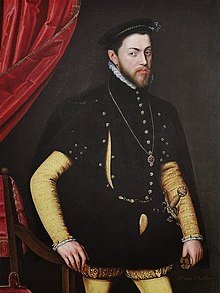
Philip II of Spain reigned from 1556-1559. Image: Philip II wearing the order of the garter by Flemish portraitist Jooris van der Straeten, c. 1554
Support for the Dutch Revolt
Another significant cause was England’s support for the Dutch Revolt against Spanish rule in the Low Countries (present-day Belgium, Luxembourg, and the Netherlands). The Dutch provinces had been in rebellion against Spanish rule since 1568, partly due to religious oppression, heavy taxation, and centralization of authority by Philip II. England, which had strong commercial interests in the region, provided financial and military support to the Protestant rebels, including sending troops and supplies. This English involvement angered Philip II, who saw it as interference in Spain’s internal affairs and a direct challenge to Spanish authority.
Piracy and Privateering
English privateering against Spanish shipping also contributed to the conflict. English seafarers, often with the tacit approval of Queen Elizabeth I, attacked Spanish treasure ships returning from the Americas. Notable figures like Sir Francis Drake and Sir John Hawkins led these privateering expeditions, capturing vast amounts of Spanish treasure. These actions were seen by Spain as acts of piracy and an affront to its sovereignty, further straining relations between the two nations.

England supported the Dutch Revolt against Spanish rule in the 1580s. Elizabeth I’s decision to aid the Protestant Dutch rebels angered Philip II and further strained their relations. Image: Elizabeth I- The Pelican Portrait by Nicholas Hilliard.
Commercial Rivalry and Colonial Competition
England and Spain were also locked in a struggle for dominance over trade routes and colonial territories in the New World. Spain had established a vast empire in the Americas, and England, eager to expand its influence, sought to challenge Spanish control. English expeditions to establish colonies in North America, such as the failed Roanoke Colony, were perceived by Spain as direct threats to its colonial interests. Moreover, English merchants and explorers sought to open up trade in regions dominated by the Spanish, leading to conflicts in the Caribbean and along the Atlantic seaboard.
Personal and Political Grievances
Personal grievances also played a role in the deteriorating relations between England and Spain. For example, the execution of Mary, Queen of Scots, in 1587 was seen as a direct affront by Catholic Europe, including Spain. Mary was a Catholic and had been seen by many as the legitimate queen of England. Philip II felt compelled to avenge her death and restore Catholic rule in England. Additionally, political maneuvering, such as Elizabeth I’s refusal to marry Philip II after the death of his previous wife (her half-sister, Mary I of England), added personal animosity to the broader geopolitical tensions.
Course of the War
The war can be divided into several key phases, characterized by a series of notable events and military campaigns:
Initial Hostilities (1585-1588)
The Anglo-Spanish War began unofficially in 1585 when Queen Elizabeth I authorized the seizure of Spanish ships in English ports and began funding English privateering operations against Spanish interests. This period saw an escalation of maritime conflict, with both nations preparing for a larger confrontation.
-
- Treaty of Nonsuch (1585): The signing of the Treaty of Nonsuch in August 1585 marked the official entry of England into the Dutch Revolt. Elizabeth I agreed to provide military assistance to the Dutch rebels, including 6,000 troops under the command of Robert Dudley, Earl of Leicester. This direct intervention by England was seen by Spain as an act of war.
- English Raids on Spanish Shipping: English privateers, led by figures like Sir Francis Drake, conducted a series of daring raids against Spanish shipping. In 1587, Drake executed his famous “Singeing of the King of Spain’s Beard,” a surprise attack on the Spanish port of Cádiz, where he destroyed a large portion of the Spanish fleet preparing for the Armada. This raid delayed Spain’s invasion plans by a year.

Sir Francis Drake led a pre-emptive strike against the Spanish naval fleet stationed at Cadiz, delaying the Armada’s invasion of England by a year.
The Spanish Armada (1588)
The most famous and pivotal event of the war occurred in 1588 with the attempted invasion of England by the Spanish Armada. The Armada was a fleet of around 130 ships, commanded by the Duke of Medina Sidonia, sent by King Philip II to overthrow Queen Elizabeth I and restore Catholic rule.
-
- The Battle of Gravelines: The Armada set sail in May 1588, intending to join forces with the Spanish army stationed in the Netherlands, invade England, and capture London. However, the English fleet, led by Lord Charles Howard and Sir Francis Drake, engaged the Armada in a series of skirmishes in the English Channel. The decisive battle occurred off the coast of Gravelines on July 29, 1588, where the English used fire ships and superior maneuverability to break the Spanish formation. The Armada was forced to retreat and sail around the northern coast of Scotland and Ireland, suffering heavy losses due to storms and navigational errors. Less than half of the original fleet returned to Spain.
- Aftermath of the Armada’s Defeat: The defeat of the Spanish Armada was a significant turning point in the war, bolstering English morale and weakening Spain’s naval dominance. It marked the beginning of the decline of Spanish power and the rise of England as a major maritime force.

The Battle of Gravelines, 8 August 1558, by Nicholas Hilliard
Privateering and Counter-Attacks (1589-1596)
Following the defeat of the Armada, England intensified its privateering campaigns against Spanish shipping and colonial possessions.
-
- Drake-Norris Expedition (1589): In 1589, Elizabeth I authorized a large-scale naval expedition led by Sir Francis Drake and Sir John Norris to invade Portugal, which was under Spanish control, and to capture Lisbon. However, the expedition was poorly planned and executed, resulting in failure and heavy English losses. Despite this setback, English privateering continued unabated.
- Privateering Campaigns: English privateers, including Drake, Hawkins, and others, continued to attack Spanish treasure ships and ports in the Caribbean and along the Atlantic. These privateering campaigns were highly lucrative, capturing vast amounts of Spanish silver and gold and disrupting Spain’s transatlantic trade. The most notable of these raids included the capture of the Spanish treasure fleet at the Battle of Flores (1591) and the sack of Cádiz in 1596 by the Earl of Essex and Sir Walter Raleigh.
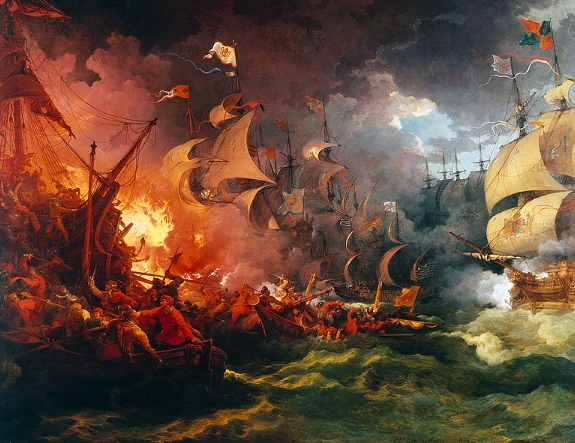
The failure of the Spanish Armada in 1588 marked the decline of Spain’s naval dominance and the rise of the English navy as a formidable force.
Stalemate and Continued Skirmishes (1597-1602)
By the late 1590s, both England and Spain were increasingly exhausted by the prolonged conflict. However, fighting continued sporadically, mainly at sea and in colonial theaters.
-
- Failed Spanish Invasions and Counter-Raids: Spain attempted several more invasions of England, including a failed Armada in 1596 and another in 1597, both of which were thwarted by storms and the English navy. Meanwhile, English forces launched additional raids against Spanish coastal towns, such as the failed Essex-Raleigh expedition in 1597.
- The Irish Conflict: The war also extended to Ireland, where Spain attempted to support Irish rebels against English rule during the Nine Years’ War (1594-1603). In 1601, a Spanish expeditionary force landed at Kinsale to support the Irish, but they were defeated by English forces under Lord Mountjoy in the Battle of Kinsale. This defeat effectively ended Spanish attempts to destabilize English rule in Ireland.
Peace Negotiations and Treaty of London (1604)
By the early 1600s, both Spain and England were seeking a way out of the conflict. The war had been costly for both sides, draining their treasuries and exhausting their resources. In 1603, the accession of James I to the English throne provided a fresh opportunity for peace. James, who was more inclined toward diplomacy than war, opened negotiations with Spain.
-
- Treaty of London (1604): The Treaty of London, signed on August 18, 1604, officially ended the war. Under the terms of the treaty, both sides agreed to cease hostilities, and England abandoned its support for the Dutch rebels, although it retained the right to trade in Spanish territories. The treaty marked the end of open warfare but did not resolve all the underlying issues between the two nations.
Major Outcomes and Consequences of the War
The Anglo-Spanish War had significant and far-reaching consequences for both England and Spain, as well as for the broader geopolitical landscape of Europe and the New World.
Decline of Spanish Naval Power
One of the most significant outcomes of the war was the decline of Spanish naval dominance. The defeat of the Spanish Armada in 1588 marked the beginning of the end for Spain’s maritime supremacy. Although Spain remained a powerful nation, it never fully recovered its naval strength, and its influence over European and global affairs gradually waned.
Rise of England as a Maritime Power
The war marked the emergence of England as a major maritime power. The English navy, bolstered by its victories against the Spanish fleet, grew in strength and confidence. This newfound naval power would pave the way for England’s future expansion and colonization efforts in the 17th century, laying the foundation for the British Empire.
Impact on the Dutch Revolt
The Anglo-Spanish War had a direct impact on the course of the Eighty Years’ War (Dutch Revolt). English support for the Dutch rebels, both militarily and financially, helped sustain their fight against Spanish rule. The defeat of the Spanish Armada and continued English privateering efforts weakened Spain’s ability to maintain control over the Dutch provinces. Ultimately, the war contributed to the eventual recognition of Dutch independence in the Treaty of Westphalia in 1648.
Economic Consequences
The war was financially draining for both England and Spain. The costs of maintaining large fleets, financing military campaigns, and sustaining prolonged conflict strained their economies. Spain, in particular, faced severe economic difficulties due to the disruption of its treasure fleets and the decline of its transatlantic trade. The financial strain contributed to a series of economic crises in Spain during the early 17th century.
Shifts in Colonial Dynamics
The war had a significant impact on colonial dynamics in the New World. English privateering disrupted Spanish trade routes and weakened Spanish control over its colonies. The war also provided an impetus for England to explore and establish its own colonies, ultimately leading to the founding of the Jamestown settlement in Virginia in 1607. The rivalry between England and Spain in the Americas continued to shape colonial competition for centuries.
Religious and Political Ramifications
The war underscored the deep religious and political divisions in Europe during the late 16th century. The conflict between Protestant England and Catholic Spain was part of a broader struggle between Protestant and Catholic powers. The war helped solidify Protestantism in England and contributed to the wider Protestant Reformation across Europe. It also marked a shift in the balance of power, with Protestant states like England and the Dutch Republic increasingly challenging the dominance of Catholic Spain and the Habsburg Empire.
Legacy of Privateering and Naval Warfare
The Anglo-Spanish War popularized privateering as a form of warfare and established new precedents for naval conflict. The use of privateers like Drake and Hawkins demonstrated the effectiveness of fast, lightly armed ships in disrupting enemy supply lines and commerce. This approach would influence naval tactics and strategies in future conflicts, including the wars of the 17th and 18th centuries.

The Anglo-Spanish War fortified England’s Protestant identity. The failure of Catholic Spain to subdue Protestant England was viewed by many as divine intervention, further consolidating the Protestant Reformation in England. Image: The famous Queen Elizabeth I’s the Armada Portrait at Woburn Abbey, Bedfordshire
Conclusion
The Anglo-Spanish War (1585-1604) was a transformative conflict that reshaped the political, religious, and economic landscape of Europe and the New World. Rooted in religious, political, and economic rivalries, the war saw significant military engagements, including the defeat of the Spanish Armada and numerous privateering campaigns. The conflict ended with the Treaty of London in 1604, but its effects were long-lasting, marking the decline of Spanish dominance, the rise of England as a maritime power, and the ongoing struggle for control over colonial territories and trade routes. The war’s legacy continues to be felt in the history of European expansion, naval warfare, and the complex interplay of religion and politics in the early modern world.
The Anglo-Spanish War, spanning from 1585 to 1604, was a series of conflicts fought between England, led by Queen Elizabeth I, and Spain under King Philip II. This prolonged war arose from religious, political, and economic tensions and profoundly affected Europe’s balance of power. Its culmination was marked by the Treaty of London in 1604.
Did you know…?
At the Siege of Calais (1596), English military expedition aimed to capture the strategic port of Calais from the Spanish. However, the siege ended with the English withdrawal, marking another setback.

Image: Engraving the Siege of Calais of 1596 – collection Rijksmuseum Amsterdam
Frequently Asked Questions about the Anglo-Spanish War (1585-1604)

The war was caused by a combination of religious tensions due to the Protestant Reformation in England, economic and colonial rivalry in the New World, and political tensions, particularly England’s support for the Dutch Revolt against Spanish rule.
What was the significance of the Spanish Armada?
The Spanish Armada, in 1588, was a massive fleet sent by King Philip II of Spain to invade England. Its failure marked a significant decline in Spain’s naval dominance and showcased the prowess of the English navy.

Why did the English attack Cadiz in 1587?
Sir Francis Drake led a pre-emptive strike on Cadiz in 1587, intending to damage the Spanish fleet and delay the imminent invasion of England by the Armada. The raid was successful, postponing the Armada’s plans by a year.

An English counter-attack on Spain, led by Sir Francis Drake and Sir John Norreys. Intended as a strike on the Spanish heartland and to support the Portuguese uprising against Spanish rule, it ended in failure.
How did the war impact colonization efforts in the Americas?
The war highlighted and intensified the colonial rivalry between England and Spain. Following the war, English colonization efforts, especially in North America, accelerated, laying the foundation for significant English colonies.
Why was the Battle of Kinsale in 1601 significant?
The Battle of Kinsale in Ireland saw Spanish forces attempting to support Irish rebels against English rule. The English victory marked a decline in Spanish influence in Ireland and further consolidated English rule.
Was the war continuous for the entire 19 years?
No, the war was marked by several significant engagements, raids, and naval skirmishes, interspersed with periods of relative calm. It was not a continuous conflict.
What was the outcome of the English Armada in 1589?
The English Armada was a counter-attack on Spain, intending to strike at the Spanish heartland and support the Portuguese against Spanish rule. The expedition ended in failure, with significant losses for the English.

Map of the English Armada campaigns (April – July, 1589)
How did the war influence religious dynamics in Europe?
The war fortified England’s Protestant identity against Catholic Spain. Spain’s failure to subdue Protestant England was viewed as divine intervention by many, strengthening the Protestant Reformation’s hold in England.
Who succeeded the main monarchs involved by the end of the war?
By the war’s conclusion, King James I had succeeded Queen Elizabeth I in England, while Philip III followed King Philip II in Spain.
What was the Treaty of London?
The Treaty of London, signed in 1604, formally ended the Anglo-Spanish War. Both nations, exhausted by the prolonged conflict, sought to stabilize their economies and normalize relations. The treaty generally favored England, acknowledging its rights to trade and colonization in the Americas.