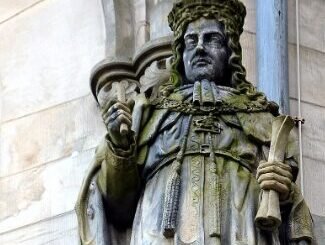
George IV of England (reign: 1820-1830)
King George IV ruled over United Kingdom of Great Britain and Ireland from 1820 until his death in 1830. As a result of his father’s (George III) declining mental health, he became Prince Regent in 1811.
Driven by his passion for art and French furniture, he added to the Royal Collection some of its most valuable pieces. George IV was applauded by some for his charm and style yet scorned by many for his extreme extravagance.
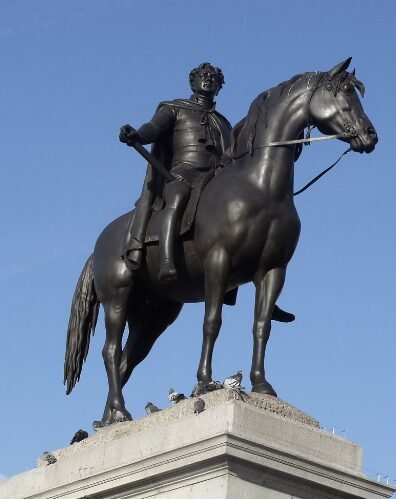
Early Years
The would-be King George IV was the eldest of the 14 children of King George III and Queen Charlotte Sophia of Mecklenburg-Strelitz. Born in St. James Palace, he was made Prince of Wales within days of his arrival in the world. A studious and brilliant boy, he learned to speak several languages fluently, including his native English. He also nurtured a passion for art and French furniture and interiors that continued into adulthood.

George (left) with his mother, Queen Charlotte, and younger brother, Frederick. Portrait by Scottish portrait painter Allan Ramsay, 1764
At age 18, George moved into his own household at Carlton House where he spent an incredible amount of money in remodels and refurnishes. Among his friends during this time were various artists, Whig politicians and actresses who were collectively known as the “Carlton House set.”
Relationship with George III
George’s relationship with his overbearing father was strained. The bad blood which worsened over the years became one of many trans-generational dysfunctional Hanoverian relationships between fathers and sons. The prince’s lifestyle did not help matters. He conducted his love life indiscriminately leaving numerous mistresses in his trail. He was also known to be vain, extravagant and would ran up bills and debts through gambling and more.
Marriage
In 1784, George met the twice widowed Maria Fitzherbert. This was in the era of the 1772 Royal Marriages Act which forbade those in direct line to the throne from getting married before the age of 25, unless they had the approval of the monarch. This made Maria an unsuitable match. Yet, the young indulgent prince loved her dearly and married her secretly in December, 1785. Without any legal basis, however, the marriage was considered invalid.
In a bid to persuade Parliament to offset his debts, the prince went ahead to legally marry his cousin, Caroline of Brunswick, in 1795. Both the wedding and marriage turned out to be an absolute disaster. The two lived separate lives and endured a loveless union. Their first child and heir, Princess Charlotte, arrived in 1796. Shortly after, the couple separated and Caroline went back to Italy where she lived.
Despite his animosity towards his ex-wife, George grew very fond of their daughter. Years later, with her father’s consent, Princess Caroline married her first choice of husband, Prince Leopald. In 1817, the princess died during childbirth, crushing her father’s hope of her future role as queen.
Regency
From 1788, George III began showing serious signs of a mental illness which caused unstable and erratic behavior from time to time. In 1810, things took a turn for the worse. George III was consequently deemed unfit to rule.
During the last 10 years of his reign, the prince was made Regent under the Regency Act to oversee the daily affairs of Britain. Not surprisingly, George’s regency featured instances of fiscal extravagance. In addition to being an avid collector of contemporary paintings and prints, he had a preoccupation with elaborate and expensive clothing that earned him the alias, “The First Gentleman of England” but also racked up bills.
This era witnessed various challenges in Britain. For instance, the nation was at war with the Emperor of France, Napoleon. In 1815, together with its allies, Britian defeated Napoleon in the Battle of Waterloo.
The infamous Peterloo Massacre occurred under George’s leadership. About 60,000 people had congregated at St. Peter’s Field in Manchester and demanded the right to vote, freedom from oppression and reform of parliamentary representation. More than 10 people were killed with many others injured when volunteer soldiers charged into the protesters. The protests had started when the then Prime Minister Robert Sparks began to execute the corn laws which imposed tariffs on food imports.

Portrait by British portrait painter Sir William Beechey, 1798
The Reign of King George IV

George IV’s coronation ceremony, 19 July 1821
George’s regency continued into his ascension to the throne in 1820. His coronation took place at Westminster Abbey the following year.
Like he did as regent, the king made Parliament an essential part of his reign, allowing them to debate and settle most state matters.
- Foreign Relations
Britain also achieved multiple successes with regards to foreign relations under George IV.
It was during his tenure that Britain helped Greece to gain independence from the Ottoman Empire.
The nation was also successful with their intervention in the Portuguese Civil War, and had gained power in India because the British East India Company had won many privileges against the Burmese Empire.
- Contribution to Art & Architecture
The king was a champion of British contemporary art, promoting the works of such artists as Thomas Gainsborough, David Wilkie, Canova and Francis Chantrey.
In the early 1800s, George employed the services of Thomas Lawrence in making various portraits of the allied European military and political figures who helped achieve victory against Napoleon and played a key role in ensuring the subsequent peace. These portraits were displayed in the Waterloo Chamber at Windsor Castle.
George IV did not only collect art but also showed a keenness in developing the spaces for the display of his priceless collection. He led in the remodeling and transformation of Buckingham House into a palace. Much of the Windsor Castle with its Gothic style, architecture and the renovated Round Tower were overseen by the king and architect, Sir Jeffry Wyatville.
Tired of the neoclassical design of the Brighton Pavilion, the king commissioned famed interior decorator Frederick Crace to redecorate its interiors to a style heavily influenced by Chinese and Indian themes. Architect John Nash was tasked with the the redesigning of the entire building. He introduced the elaborate Music and Banqueting Room. Over the years, the Brighton Pavilion served as a reminder of George IV’s ever-evolving taste and profligacy. Nash also worked on other major architectural projects such as, Regent Street and Her Majesty’s Theatre.
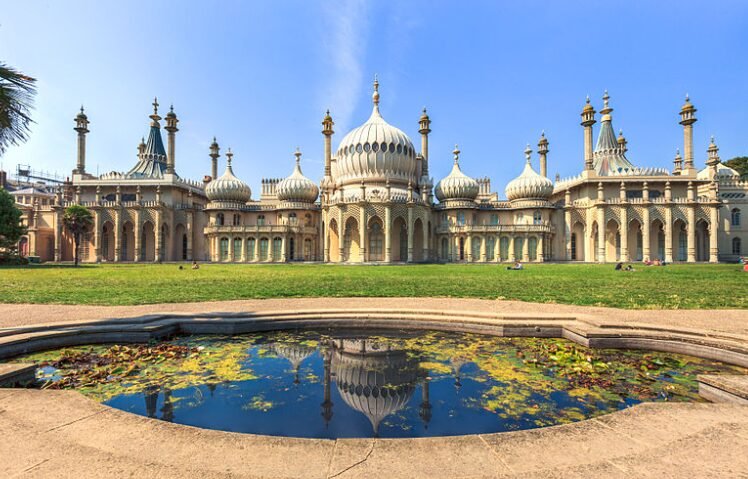
The Royal Pavilion, a Grade I listed former royal residence in Brighton, England, was built in stages from 1787 as a seaside retreat for George IV, featuring John Nash’s Indo-Saracenic design.
Legacy
Though many admired George IV’s taste in art, not everyone was impressed by the opulence, especially in the face of his increasing debts. One of such was the author William Thackeray who wrote, “… I try to take him to pieces, and find stockings, padding, stays, a coat with frogs and a fur collar, a star and a blue ribbon, a pocket handkerchief prodigiously scented … a huge black stock, underwaistcoat, more underwaistcoats and then nothing.”
Worthy of praise, however, George IV’s cultural and literal achievements.
George IV commissioned the purchase of the Elgin Marbles and the founding of the Royal Society of Literature. He donated many valuable books to the British Library and helped fund the projects of various artists, musicians and scientists.
The could have built a more honorable reputation around his education and vast talents but his bouts of self indulgence seemed to have succeeded in drowning his admirable qualities.
Declining Health & Death
George IV’s decadent lifestyle greatly affected his health. In his final years, he showed signs of increasing physical and mental deterioration. By 1830, his condition had grown worse. He lost sight in one eye and became overweight. He also developed an enlarged heart and a large tumor in his bladder.
The king eventually gave up the ghost in the wee hours of June 26, 1830 at age 67. He was buried in St. George’s Chapel at Windsor Castle. He was succeeded by his younger brother, William, Duke of Clarence, who reigned as William IV.
Questions and Answers

King George IV is portrayed wearing his coronation robes, adorned with the four collars of chivalric orders: the Golden Fleece, the Royal Guelphic Order, the Order of the Bath, and the Order of the Garter. Portrait by English portrait painter Thomas Lawrence, 1821
Who was George IV?
George IV (George Augustus Frederick) was King of the United Kingdom of Great Britain and Ireland, and King of Hanover, ruling from 29 January 1820 until his death on 26 June 1830. Before becoming king, he served as Prince Regent for his father, King George III, from 5 February 1811, due to his father’s mental illness.
What was George IV known for during his regency and reign?
George IV was known for his extravagant lifestyle and significant influence on the fashions of the Regency era. He was a patron of the arts, leisure, and culture, and contributed to the architectural landscape by commissioning the Royal Pavilion in Brighton, remodeling Buckingham Palace, and rebuilding Windsor Castle. His charm and cultured demeanor earned him the title “the first gentleman of England,” but his excessive lifestyle and poor personal relationships led to public disapproval.

Image: Portrait miniature by English portrait painter Richard Cosway, c. 1780–82
What were some of the controversies surrounding George IV’s personal life?
George IV faced controversy due to his extravagant lifestyle, strained relationships with his parents, and his wife, Caroline of Brunswick. He excluded Caroline from his coronation and attempted to divorce her through the unpopular Pains and Penalties Bill, which ultimately failed. His personal behavior and scandals led to a decline in the public’s perception of the monarchy.

Miniature by English portrait painter Richard Cosway, 1792
How was George IV’s reign perceived by his ministers?
George IV’s ministers considered him self-indulgent, erratic, and unreliable. He was heavily influenced by his personal favorites, which further complicated his rule. His reign was marked by scandal and financial mismanagement.
Who effectively led the government during much of George IV’s regency and reign?
During much of George IV’s regency and reign, the government was effectively led by Lord Liverpool, the Prime Minister of the United Kingdom. Liverpool’s government presided over Britain’s victory over Napoleon and the negotiation of a peace settlement with France.
What significant policy was George IV forced to accept after Lord Liverpool’s retirement?
After Lord Liverpool’s retirement, George IV was compelled to accept Catholic emancipation, a policy he had long opposed.
What happened to George IV’s legitimate heirs?
George IV’s only legitimate child, Princess Charlotte, died in 1817, leading to a succession crisis. His younger brother, Prince Frederick, who was also childless, passed away in 1827. Consequently, George IV was succeeded by his next surviving brother, William IV, upon his death in 1830.
How is George IV’s reign remembered today?
George IV’s reign is often remembered for its excesses, personal controversies, and the diminishing of the monarchy’s moral authority despite his contributions to culture and architecture.