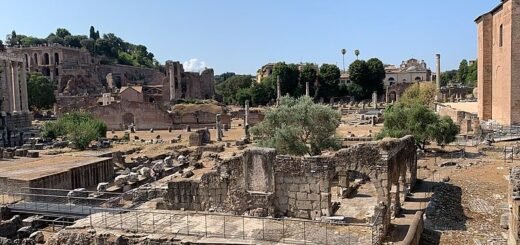
Arch of Janus
The Arch of Janus was an ancient Roman structure that stood as one of the most mysterious and distinctive monuments in Rome. Situated near the Forum Boarium, the ancient cattle market, it has intrigued historians, architects, and scholars for centuries.
READ MORE: Most Famous Fora of Ancient Rome
Here’s a deep dive into the Arch of Janus, covering its architectural style, purpose, historical context, conservation, and what makes it so enigmatic.
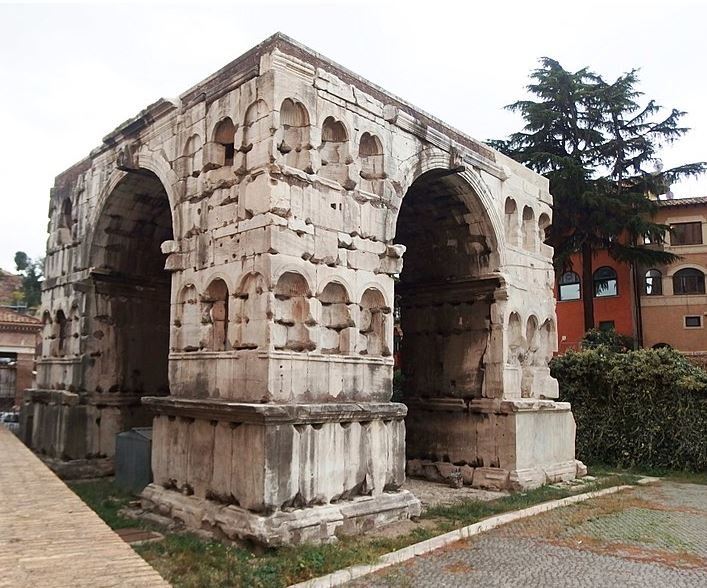
A diagonal view of the Arch of Janus.
Historical Background of the Arch of Janus
The Arch of Janus dates back to the 4th century CE and is unique for its four-sided structure, which differs from other arches in Rome. The exact date of construction remains uncertain, but scholars generally believe it was built during the reign of Emperor Constantine or shortly thereafter.
The arch’s name, “Janus,” reflects the Roman god associated with gates, doorways, beginnings, and transitions. Interestingly, Janus is often depicted with two faces, symbolizing his ability to look into the past and the future. Despite the name, the arch doesn’t have any known connection to the god Janus. Its association likely arose because of its four-way form, symbolizing a crossroads, which aligns with the god’s domain over passages and transitions.
Why did Roman Emperor Constantine the Great convert to Christianity?
Architectural Style and Features
The Arch of Janus stands out due to its quadrifrons style—meaning four fronts—featuring arches on all four sides. This type of structure is extremely rare in Roman architecture, making the Arch of Janus unique. The monument is roughly 16 meters high, with a width and depth of about 12 meters, and is built entirely out of white marble blocks. Originally, it would have been much more ornate, adorned with inscriptions, carvings, and possibly a statue on top.
The Arch of Janus’s unique four-sided design, lack of inscriptions, and ambiguous purpose have made it a subject of fascination for centuries.
The vaulted ceiling inside each archway has intricate coffers (decorative sunken panels), which were a common feature in Roman architecture, designed both to reduce the weight of the structure and to add aesthetic appeal. These arches allowed people to pass through from any direction, marking a crossroad within the busy commercial district.
Purpose of the Arch
Despite its grandeur, the precise purpose of the Arch of Janus remains unclear. Unlike other triumphal arches, which celebrated military victories or honored emperors, the Arch of Janus has no visible inscriptions or decorative reliefs that would shed light on its original intention. Scholars have proposed various theories about its purpose.
Given its location at the crossroads, the arch could have served as a boundary marker within Rome’s urban layout. Some historians believe it might have marked the boundary between the regions of the Forum Boarium and the Velabrum.
Some scholars speculate that the Arch of Janus may be the “Arch of the Deified Constantine,” mentioned in the Catalogues.
The arch’s proximity to the Forum Boarium suggests it might have functioned as a checkpoint or gateway within this bustling market area. Merchants, traders, and cattle drivers would pass through it regularly, possibly seeing it as a landmark for conducting business.
Another theory is that the arch was built to honor Constantine or another ruler in recognition of a specific event or achievement. The lack of inscriptions, however, has made it difficult to verify this.
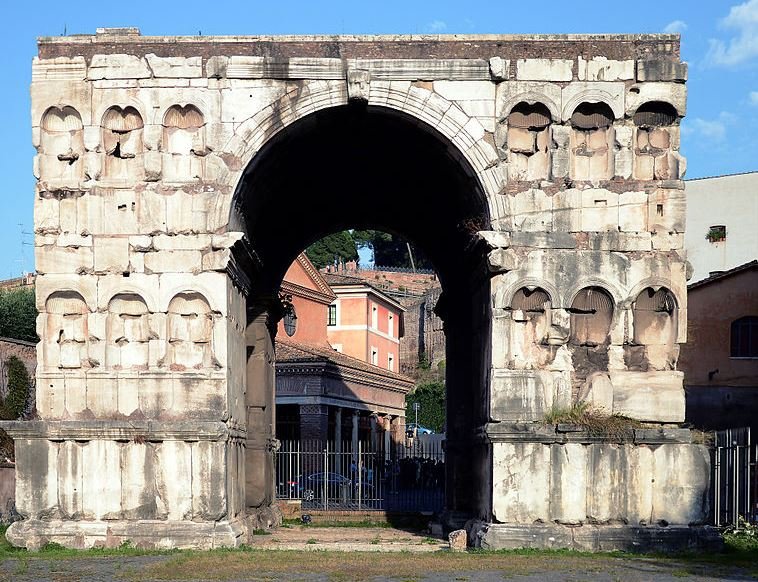
Front view of the Arch of Janus.
Historical Significance and Symbolism
The Arch of Janus represents an era of transition in Roman history. Built during the later Roman Empire, it reflects the changes in the city’s urban layout and the evolving role of public monuments. Unlike earlier Roman triumphal arches, which celebrated grand victories and imperial conquests, the Arch of Janus is a practical structure with a more ambiguous purpose.
The Arch of Janus may have had a rectangular attic or possibly a pyramid on its upper story.
Its design might also be symbolic. The four-sided arch represents a crossroad or intersection of paths, which aligns with the Roman concept of Janus as a god of beginnings and transitions. Some historians speculate that the Arch of Janus could symbolize Rome’s pivotal role as a crossroads for trade, ideas, and cultures.
Restoration and Conservation
The Arch of Janus has survived for centuries, but not without challenges. Over the years, it faced degradation, looting, and structural issues. In the medieval period, it was incorporated into the Fortress of the Frangipane family, who used it as a defensive structure. This adaptive reuse likely saved the arch from complete destruction, although it also altered its original form.
In modern times, various restoration efforts have aimed to stabilize the structure and preserve it for future generations. Excavations around the site have unearthed valuable information about the arch’s construction and the surrounding area. Ongoing conservation efforts focus on preventing further degradation of the marble and mitigating damage caused by pollution and weathering.
Mysteries Surrounding the Arch
The Arch of Janus is unique not only because of its four-sided design but also due to its lack of inscriptions or reliefs, which makes it an enigma in the study of Roman monuments. Scholars continue to debate:
- Who Commissioned It? There’s no clear indication of who ordered the construction of the arch. Without inscriptions, it’s impossible to attribute it to a specific emperor or official, which is rare for Roman monuments.
- What Was Its Purpose? The absence of any decorative or narrative elements that would typically indicate the arch’s purpose has left historians puzzled. Was it a commemorative monument, a religious symbol, or simply a gateway?
- Why Is It Named After Janus? Despite the name, the arch has no explicit connection to the god Janus. The name might have been given later, inspired by the structure’s four-sided design.
Cultural and Touristic Impact
Today, the Arch of Janus attracts tourists, historians, and architecture enthusiasts interested in Roman history. Although less famous than other monuments like the Colosseum or the Pantheon, it offers a glimpse into the lesser-known aspects of Roman urban design and religious symbolism. For visitors, the Arch of Janus is a reminder of Rome’s layered history, where ancient structures blend with medieval adaptations and modern conservation efforts.
Comparison to Other Roman Arches
The Arch of Janus differs significantly from other Roman arches, such as the Arch of Titus or the Arch of Constantine. While those monuments celebrated military achievements and prominently featured reliefs depicting battles and victories, the Arch of Janus lacks such iconography. Its four-way design is also unique; most Roman arches have only one or two entry points.
This architectural departure raises questions about its origin and function. Some scholars believe it could have been influenced by Eastern Roman provinces, where quadrifrons structures were more common. This theory suggests that Rome’s later architecture might have been shaped by influences from its vast empire.
Janus and the Roman Concept of Time
The association of the arch with Janus, the god of transitions, is particularly fitting for a monument located at a crossroads. In Roman mythology, Janus was seen as the guardian of gates and transitions, overseeing beginnings and endings. Romans would often invoke Janus at the start of important events, believing he controlled the threshold between past and future.
The Arch of Janus, therefore, can be viewed as a physical manifestation of this idea—a threshold that connects different directions, allowing movement and flow between them. Although the arch might not have been built to honor Janus directly, its name and structure evoke this central Roman belief about time and change.
The Future of the Arch of Janus
As a UNESCO World Heritage Site, the Arch of Janus is protected and preserved as part of Rome’s cultural heritage. Future conservation efforts aim to stabilize the structure further and possibly uncover more clues about its original purpose. Advances in archaeological technology and historical research may eventually solve some of the mysteries surrounding this enigmatic monument.
Questions and Answers
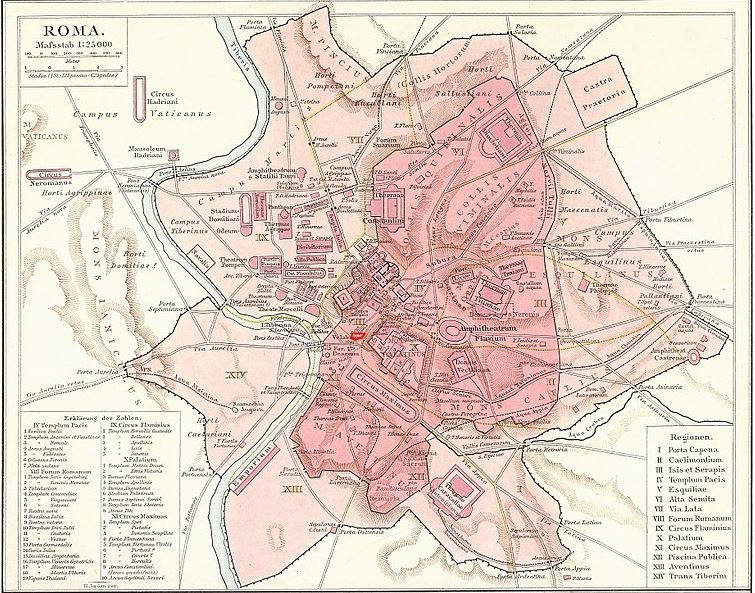
Map of Rome showing the location of the Arch of Janus.
When was the Arch of Janus built?
The Arch of Janus was built in the 4th century CE.
Where is the Arch of Janus located in Rome?
It is located in the Forum Boarium, an ancient cattle market area in Rome.
What purpose did the Arch of Janus likely serve?
Unlike other arches that commemorated victories, it most likely served as a boundary marker.
Over what significant Roman structure does the Arch of Janus stand?
It stands over the Cloaca Maxima, an ancient Roman drain that flowed into the Tiber River.
What clues suggest the Arch of Janus was built in the 4th century?
Pottery fragments within its concrete vaults indicate a 4th-century construction.
Were the materials used in constructing the Arch of Janus entirely new?
No, the marble blocks appear to have been repurposed from earlier structures.
What was likely displayed in the niches of the Arch of Janus?
The niches likely held statues, though none have survived.
What features were once present alongside each niche?
Small columns once flanked each niche, but these are now missing.
What figures are carved into the keystones of the Arch of Janus?
The north side keystone depicts Minerva, while the east side keystone depicts Roma.
What purpose did the staircase within the northwest pier serve?
The staircase likely allowed access to upper levels and chambers within the pier.
How was the Arch of Janus repurposed in the Middle Ages?
It was used as a fortress during the medieval period.
What happened to the Arch of Janus in 1830?
A superstructure of brick and concrete was removed, believed mistakenly to be a part of medieval fortifications.
Why does the Arch of Janus have a pock-marked appearance?
The removal of iron pins that held the marble blocks together during the medieval period resulted in its pock-marked look.