The Arch of Titus
The Arch of Titus in Rome is a magnificent example of ancient Roman architecture, art, and imperial propaganda. Constructed around 81 CE, this triumphal arch commemorates Emperor Titus’s victory in the Jewish War, specifically the Siege of Jerusalem in 70 CE.
Situated on the Via Sacra, the main street of ancient Rome leading into the Roman Forum, the Arch of Titus stands not only as a testament to Titus’s military achievements but also as a celebration of Rome’s dominance and the divine favor bestowed upon the Flavian dynasty.
Here’s an overview of the Arch of Titus’s architectural features, historical context, artistic significance, and cultural symbolism.

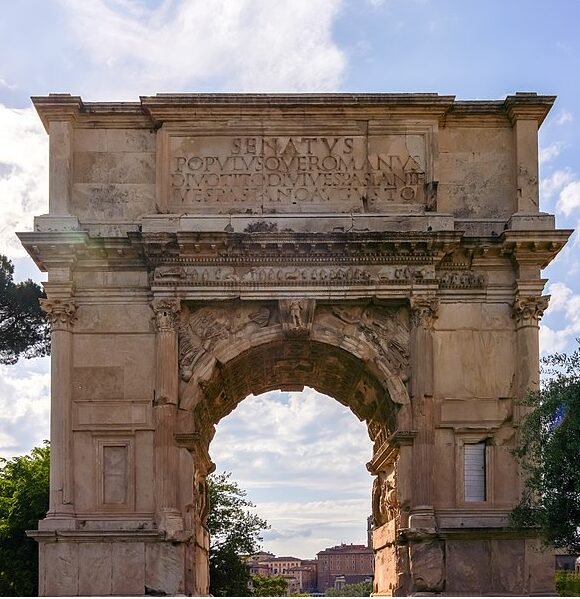
Front view of The Arch of Titus.
Historical Background
The Arch of Titus was erected after the death of Emperor Titus by his younger brother and successor, Emperor Domitian, to honor Titus’s accomplishments and deify him. This was an era when the Roman Empire was at its peak, and military conquests were glorified as a way to reinforce the power of the emperor and the state. The arch served as a visible reminder of the might of Rome and its emperors, as well as their divine right to rule.
The Jewish War was a significant conflict in the Roman Empire, fought between 66 and 73 CE. It culminated in the destruction of the Second Temple in Jerusalem, which had deep cultural and religious repercussions for the Jewish people. For Rome, however, it was an important victory that displayed the strength of its military and the unwavering authority of its leaders. Titus, who had led the siege, was celebrated as a great military commander, and his triumph became a source of pride for the empire.
Architectural Features
The Arch of Titus is a single-bayed arch, which means it has only one central passageway, as opposed to later triumphal arches that often had three. It stands about 15.4 meters (50 feet) high, with a width of around 13.5 meters (44 feet).
The arch is constructed from pentelic marble, a type of white marble with a slight yellow tint, which gives the structure a warm and majestic appearance. The design of the arch is relatively simple yet grand, featuring Corinthian and Composite columns that add elegance and height.
At the center of the arch, visitors can see a barrel vault, an architectural feature that adds both stability and beauty. The design is topped with an entablature, including a frieze and an inscription. The inscription on the arch’s attic (the upper part of the structure) is a dedication by the Senate and the people of Rome to the deified Titus, acknowledging his achievements and his deification by the Roman state.
Sculptural Reliefs
One of the most remarkable aspects of the Arch of Titus is its sculptural decoration, particularly the relief panels on the interior of the archway. These panels depict scenes from the triumphal procession that Titus held after his victory in the Jewish War. The reliefs are exceptional examples of Roman art, capturing both the realism and drama that characterized Roman sculpture.
The two primary relief panels each illustrate a distinct aspect of the triumph. The south panel shows Roman soldiers carrying spoils from the Temple in Jerusalem, including the Menorah, the Table of Showbread, and the sacred trumpets. This panel is significant for its historical accuracy and detail; the depiction of these religious artifacts offers insight into the objects that were treasured in the Jewish Temple and taken as trophies by the Romans. The soldiers are depicted with expressions of pride and determination, emphasizing Rome’s superiority and the humiliation of the conquered.
On the north panel, Titus is depicted in a triumphal chariot, crowned with a laurel wreath by the goddess Victory. This panel emphasizes the divine favor and protection that the Roman emperors believed they had from the gods. Titus is shown as a godlike figure, surrounded by personifications of Valor and Honor, adding a supernatural aspect to the depiction of his achievements.
The combination of realism in the spoils scene and idealism in the triumphal chariot scene reflects a key characteristic of Roman art: the blending of real events with elements of mythology and idealized representation. The reliefs served not only as historical documentation but also as propaganda, reinforcing the idea of Roman dominance and the sanctity of the emperor.
Symbolism and Propaganda
The Arch of Titus is steeped in symbolism. For the Romans, triumphal arches were not merely architectural structures but also powerful political statements. They commemorated military victories and symbolized the emperor’s power and the empire’s might. The arch thus served as a public reminder of the successful suppression of the Jewish revolt and the consolidation of Roman power in the eastern provinces.
The depiction of Titus in a divine context was also significant. Roman emperors often sought to be associated with divinity, both during their lives and posthumously. By presenting Titus as a deified figure, the arch reinforced the idea that he was more than a mere mortal. It also suggested that the Flavian dynasty, to which Titus belonged, was blessed by the gods and destined to rule. This form of imperial propaganda was important in establishing and maintaining the authority of the emperor, especially at a time when Rome had recently experienced political upheaval.
Influence on Later Architecture
The Arch of Titus had a lasting impact on Roman architecture and the design of triumphal arches in subsequent centuries. Its design influenced later Roman arches, including the Arch of Constantine, which was built in 315 CE to commemorate Emperor Constantine’s victory at the Battle of Milvian Bridge. The Arch of Constantine borrows stylistic elements from the Arch of Titus, such as the use of relief panels to depict scenes of victory and the incorporation of Corinthian columns.
Beyond Rome, the Arch of Titus has inspired numerous structures around the world. The most famous example is the Arc de Triomphe in Paris, which was built in the 19th century to celebrate the victories of the French army under Napoleon. Like the Arch of Titus, the Arc de Triomphe uses relief sculptures to depict scenes of triumph and glory.
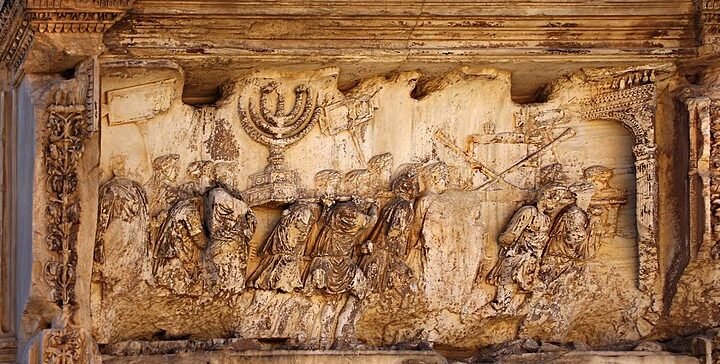
Relief on the inner side of the The Arch of Titus.
Religious Significance and Controversies
For the Jewish people, the Arch of Titus holds a painful significance. The depiction of the spoils from the Temple in Jerusalem is a reminder of the destruction of the Second Temple, an event that marked a major turning point in Jewish history. As a result, the arch has been a symbol of both Roman oppression and Jewish resilience. There is a tradition that Jews avoided walking under the arch for centuries as a mark of respect for those who suffered in the war and as a rejection of the triumph it represented.
In modern times, the Arch of Titus has become a symbol of both ancient Rome’s power and the complexities of history. For many, it is a reminder of the Jewish people’s survival and continuity despite historical hardships. In 1947, shortly after the establishment of the state of Israel, a group of Jews symbolically walked through the arch in reverse, turning an ancient symbol of defeat into one of resilience and rebirth.
Preservation and Restoration
The Arch of Titus has undergone various restorations over the centuries. During the Middle Ages, parts of the arch were incorporated into a fortification, and some of its original features were lost or damaged.
In the 19th century, Pope Pius VII oversaw a significant restoration project that aimed to preserve the arch and restore some of its original splendor. During this restoration, missing parts of the arch were reconstructed in travertine, a type of limestone that distinguishes the new additions from the original marble.
The arch is now a protected historical monument and a popular tourist attraction, drawing visitors from around the world who are fascinated by its beauty and historical significance.
Questions and Answers about the Arch of Titus
The Arch of Titus features the “Spoils of Jerusalem” relief on its inner passageway.
Who commissioned the Arch of Titus, and when was it built?
The Arch of Titus was commissioned by Emperor Domitian around 81 CE.
Where is the Arch of Titus located?
It is located at the foot of the Palatine Hill along the Via Sacra in the Roman Forum, Rome.
What historical events does the Arch of Titus commemorate?
It commemorates the military victories of Emperor Vespasian and his son Titus during the Jewish War in Judea (70-71 CE), which included the capture of Jerusalem and the looting of the Temple.
What does the arch symbolize about Emperor Titus?
The arch symbolizes the divinity of Emperor Titus, honoring his deified status after his death.
What materials were used to construct the Arch of Titus?
The main structure is built from Pentelic marble, while the attic portion is made from Luna marble.
What is significant about the inscription on the arch?
The inscription on the eastern side reads, “The Senate and People of Rome, to Divus Titus, son of Divus Vespasian, Vespasian Augustus.” The use of “Divus” signifies that Titus was deified posthumously. Another inscription on the western side marks the restoration by Pope Pius VII in 1821.

What items are shown as part of the spoils from Jerusalem on the relief panel?
The relief shows a seven-branched menorah, silver trumpets, and potentially the Ark of the Covenant.
Who are the figures depicted alongside Titus in the relief panel?
The goddess Victory crowns Titus, while the goddess Roma holds the bridle of one of the horses. Two other figures represent the people of Rome and the Senate.
READ MORE: 14 Major Ancient Roman Gods and Goddesses
How did Roman sculptors create a sense of depth in the relief panels?
They achieved depth by using three-quarter views for figures, scaling background figures to appear farther away, carving central figures in higher relief, and curving the panel inward.
What decorative elements run along the arch and its vaulted interior?
A frieze runs around the entire arch showing the triumphal procession, while the vaulted interior is decorated with coffering and an image of Titus’s apotheosis, where he is carried to the heavens by an eagle.
What was originally on top of the Arch of Titus?
The arch was originally topped by a large bronze quadriga (a four-horse chariot).
How did the arch change in the medieval period?
During the medieval period, the arch became part of fortifications built by the Frangipani family, which caused some damage.
What restoration work was done on the arch in the 19th century?
In the 19th century, the arch was significantly restored with travertine limestone for the piers and attic, and the entire structure was dismantled and reassembled to preserve it.
FACT CHECK: At World History Edu, we strive for utmost accuracy and objectivity. But if you come across something that doesn’t look right, don’t hesitate to leave a comment below.





