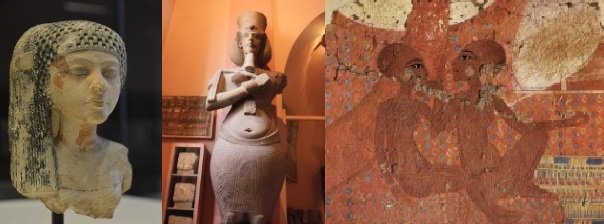
Art from the Amarna Period
The Amarna Period represents a brief yet revolutionary phase in ancient Egyptian art and culture that took place during the reign of Pharaoh Akhenaten (circa 1353–1336 BCE) in the 18th Dynasty. This era was named after the new capital city Akhetaten—modern-day Amarna—which Akhenaten built and dedicated to the worship of the sun disk Aten. The Amarna Period is particularly notable for its radical departure from traditional Egyptian artistic conventions, reflecting sweeping changes in religious ideology, royal imagery, and conceptions of human form and divinity.
While short-lived, the artistic innovations of the Amarna Period left a profound mark on the visual history of Egypt and continue to fascinate historians and art scholars today.
Contextualizing the Amarna Period
To fully grasp the nature of Amarna art, one must first understand the sociopolitical and religious upheaval that defined Akhenaten’s reign. Prior to Akhenaten, Egyptian religion was deeply polytheistic, centering around a pantheon of gods led by Amun-Ra, the king of the gods. The state religion, heavily entrenched in Thebes and supported by a powerful priesthood, played a pivotal role in legitimizing royal authority and ensuring the continuity of the cosmos through elaborate rituals.
Akhenaten disrupted this religious framework by instituting a radical monotheistic (or henotheistic) faith centered on Aten, the visible sun disk. In doing so, he sidelined the established clergy, especially the powerful priesthood of Amun, and centralized religious and political power in himself.
The king presented himself as the sole intermediary between the people and Aten, creating a new cosmology that found its expression not just in temple architecture and inscriptions but most vividly in art. This ideological shift served as the foundation for the distinctive style of the Amarna Period, which broke away from nearly two millennia of artistic tradition.
Stylistic Innovations and Naturalism
One of the most striking features of Amarna art is its shift toward naturalism and expressive form. Previous Egyptian art was characterized by idealization, particularly in royal and divine representations.
Pharaohs were depicted as eternally youthful, muscular, and perfectly proportioned, embodying divine perfection and order. In contrast, Amarna art embraced a more fluid, exaggerated, and naturalistic aesthetic. Human figures, including those of the royal family, were rendered with elongated limbs, narrow torsos, wide hips, and exaggerated facial features such as heavy-lidded eyes, protruding lips, and elongated skulls.
Akhenaten himself was portrayed in an unprecedented manner. Far from the godlike ideal of past rulers, his images show a strangely androgynous figure with a sagging stomach, slender limbs, drooping chin, and feminized hips. This portrayal has led to much scholarly debate. Some have speculated that Akhenaten may have suffered from a genetic disorder, such as Marfan syndrome, though there is no concrete medical evidence. Others argue that the king’s unusual depiction was symbolic rather than literal, perhaps representing his unique role as a god-king embodying both male and female principles of creation. In any case, the shift in royal representation was intentional and ideologically driven, not merely aesthetic.
This departure from artistic convention extended beyond royal portraiture. Scenes in private tombs, for example, began to feature intimate, domestic moments previously unseen in Egyptian art. Akhenaten, Queen Nefertiti, and their daughters are shown engaging in affectionate family interactions—kissing, cuddling, and playing under the life-giving rays of Aten. The rays themselves are often depicted as long arms ending in hands that offer ankhs (symbols of life) directly to the royal family. These visual motifs underscore the central theological concept that divine power flowed directly from Aten to Akhenaten and his family, reinforcing their unique, divinely ordained status.
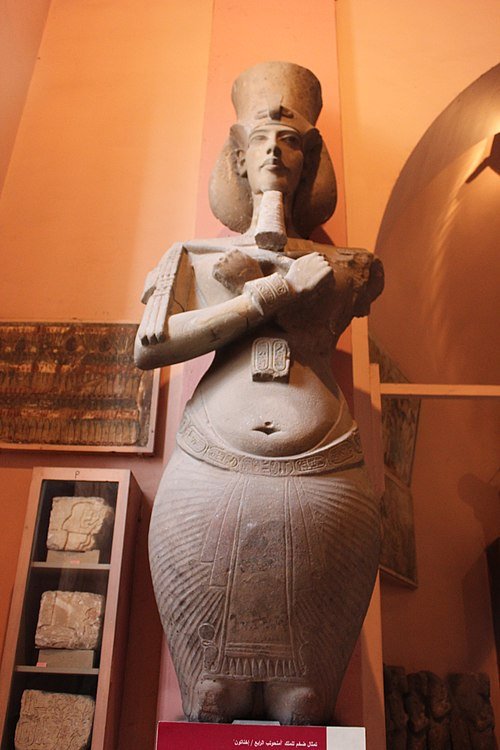
Akhenaten, Pharaoh of Egypt, displayed at the Egyptian Museum in Cairo.
Royal Imagery and the Divine Family
Central to Amarna art was the deification of the royal family. In this period, Akhenaten and Nefertiti were not merely representatives of the gods—they were portrayed as divine themselves. The art communicates this theological shift by showing the royal couple engaging directly with Aten, receiving life and light without the mediation of priests or other deities. Their daughters, often shown in the art, complete this divine tableau, reinforcing the notion of a sacred family unit that functioned as both religious and political authority.
The famous limestone reliefs and painted scenes from the tombs of high officials such as Meryre, Huya, and Panehsy in Amarna often portray the royal family in both public and private spheres. These images emphasize the continuity of divine favor, portraying Aten’s rays reaching out with hands to touch and bless the family. This iconography served a dual function: to convey theological messages about the source of divine power and to legitimize the unprecedented religious reforms of Akhenaten.
Akhenaten and Nefertiti were depicted in forms resembling the creation deities Shu and Tefnut. This visual alignment placed them in a divine triad with Aten, reinforcing their roles as sacred intermediaries between god and humanity.
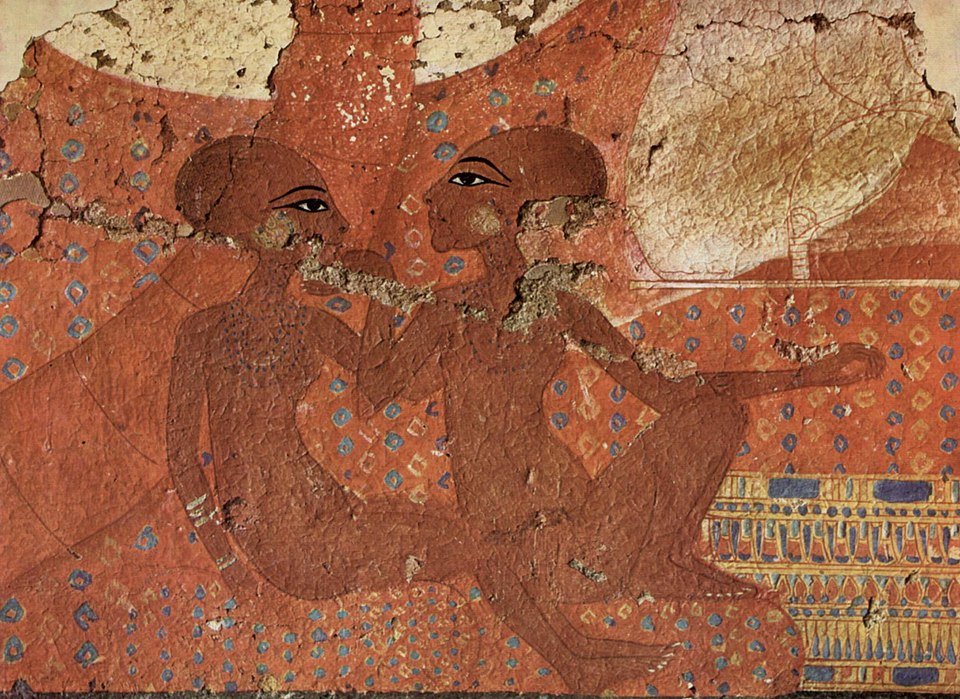
Akhenaten’s daughters, Nofernoferuaton and Nofernoferure.
The prominence of Queen Nefertiti in Amarna art is another significant departure from previous norms. Nefertiti is shown almost as frequently as Akhenaten, sometimes wearing the crown of a pharaoh or participating in religious rituals previously reserved for kings. Her celebrated bust, discovered in 1912 by the German archaeologist Ludwig Borchardt, is one of the most iconic artifacts of ancient Egyptian art. The bust exhibits the refined elegance of Amarna craftsmanship, combining idealized beauty with a realism that suggests an individual personality. It is a striking embodiment of the new aesthetic values of the period.
Temple Reliefs and Architectural Art
The architectural innovations of Akhenaten also influenced the art produced during his reign. In contrast to the massive stone temples of Thebes, the buildings in Akhetaten were made from smaller, quickly assembled sandstone blocks called talatat. These modular blocks facilitated rapid construction but also resulted in a different scale and style of relief carving. Talatat reliefs depict vibrant scenes of daily life, religious rituals, and royal processions, often with a dynamic energy and attention to natural detail that is rare in earlier Egyptian art.
Decorative schemes within the temples emphasized the omnipresence of Aten’s rays and the privileged relationship between Aten and the royal family. The sun disk is typically placed at the center or top of the scene, its life-giving rays descending in orderly lines toward the king and queen. This cosmic composition visually reinforced the idea that all blessings emanated from Aten through the divine couple to the rest of creation.
The temples of Akhetaten did not house statues of gods in dark sanctuaries, as in traditional Egyptian temples. Instead, they were open to the sunlight, with large courtyards and colonnades that allowed Aten’s rays to shine freely. This architectural openness was mirrored in the clarity and exposure of the accompanying reliefs, which celebrated light, life, and movement rather than eternal stillness.
Non-Royal Art and Tomb Decoration
While royal art dominated the Amarna aesthetic, non-royal tombs and domestic art also underwent transformation during this period. High officials who relocated to Akhetaten with the court had their tombs decorated with scenes not only of their official duties but also of their interactions with the royal family. These scenes helped to reinforce their status and proximity to power in the new religious order.
Interestingly, the art in these tombs sometimes blends traditional forms with Amarna stylistic features. Figures may still be shown in conventional postures, but the compositions include the sun disk and intimate family moments reminiscent of royal iconography. This blending reflects a transitional moment in Egyptian art, in which established norms were adapting to new ideological imperatives.
Moreover, scenes of daily life—harvests, banquets, boat travel, and music—received a level of detail and emotional engagement that was rare before. There is a notable vibrancy in the portrayal of movement and gesture. Musicians are shown playing lyres with energetic poses, dancers appear mid-twirl, and servants carry baskets with bent knees and tilted heads. These elements imbue the art with a sense of temporality and human presence that had been largely absent in earlier Egyptian depictions.
Sculptural Techniques and Materials
Amarna sculpture, both in relief and in the round, demonstrates a technical finesse that rivals earlier periods despite its stylistic divergence. Artists experimented with new techniques and subjects while still adhering to high standards of craftsmanship. The royal workshops at Akhetaten produced a large number of unfinished sculptures, busts, and relief fragments, many of which were discovered in the atelier of the sculptor Thutmose, where the bust of Nefertiti was also found.
These works show evidence of a standardized artistic process, with gridlines and measuring systems used to maintain proportional consistency, albeit with the exaggerated proportions typical of the Amarna style. The sculptors employed a range of materials, including limestone, quartzite, and painted stucco. Many statues and busts were vividly painted, further enhancing their lifelike quality.
Whether through the androgynous portrayals of the king, the affectionate family scenes, the radiant presence of Aten, or the fluid naturalism of everyday life, Amarna art offers a rich visual tapestry that reveals both the aspirations and tensions of its time.
One remarkable aspect of Amarna sculpture is the portrayal of children, particularly the daughters of Akhenaten and Nefertiti. They are depicted with elongated skulls, large eyes, and playful expressions. These features have sometimes been interpreted as stylized rather than pathological, emphasizing their divine nature as offspring of the god-king and queen. Their dynamic postures and interaction with their parents introduce a rare tenderness into Egyptian royal art.
Symbolism and Ideological Messaging
Art in the Amarna Period was not created solely for aesthetic purposes; it was a vehicle for communicating Akhenaten’s religious revolution. Every image, from monumental temple reliefs to small talatat blocks, was saturated with symbolic meaning. The ubiquitous presence of Aten’s rays, the intimate family scenes, and the emphasis on the royal couple’s divine status all served to articulate a coherent, theologically grounded worldview.
Symbolism also permeated the use of space and composition. The central placement of the sun disk, often positioned directly above the heads of Akhenaten and Nefertiti, reinforced the vertical flow of divine energy. The physical positioning of the royal family within artistic scenes—often seated beneath Aten while others look on in reverence—visually expressed their superior status in the cosmic hierarchy. Even the act of receiving ankhs from Aten’s rays, frequently repeated across various media, was a visual mantra reiterating the king’s unique access to divine life-force.
Decline and Legacy
Despite its artistic vitality, the Amarna Period was fleeting. After Akhenaten’s death, his successor—initially known as Tutankhaten, later Tutankhamun—reversed the religious reforms, restoring the traditional gods and returning the capital to Thebes. The Amarna style quickly fell out of favor, and many of Akhenaten’s monuments were defaced, dismantled, or reused in later construction. Talatat blocks were repurposed in temples for Ramesses II and others, hiding them from view for centuries.
Nonetheless, the artistic legacy of the Amarna Period survived through fragments, statues, and tomb reliefs. These remnants reveal a moment in Egyptian history when art was infused with emotional expressiveness, ideological fervor, and radical experimentation. Later Egyptian art returned to more conventional styles, but the Amarna interlude remained a singular chapter—a bold artistic and theological experiment that challenged the very foundations of Egyptian tradition.
In modern times, Amarna art has inspired numerous reinterpretations and analyses. Some scholars view it as evidence of proto-monotheism and early individualism, while others emphasize its political dimensions, arguing that Akhenaten’s reforms were as much about consolidating power as they were about religious conviction. Art historians continue to debate whether the style should be seen as expressive realism or calculated idealism. Regardless of interpretation, the art of the Amarna Period occupies a unique and pivotal place in the visual history of ancient Egypt.
Questions and answers
Who was Akhenaten, and what made his reign stand out in ancient Egyptian history?
Akhenaten was a pharaoh who ruled Egypt from 1353 to 1336 BCE. His reign is notable for a dramatic transformation of Egyptian religion, culture, and art. He elevated the worship of Aten, the sun disk, above all traditional gods, which led to major changes in architecture and artistic expression.
What changes did Akhenaten make to Egypt’s religious system?
Akhenaten rejected the traditional Egyptian pantheon and declared Aten the sole state deity. He closed temples dedicated to other gods, especially Amun, and shifted state support to the worship of Aten, whom he considered the only true divine power.
Why did Akhenaten change his name from Amenhotep IV?
He changed his name to Akhenaten, meaning “Effective for the Aten,” to reflect his devotion to the sun disk Aten and to signify his new religious direction.
What was the significance of Akhetaten, the new capital city?
Akhetaten, modern-day Amarna, was a purpose-built capital constructed to honor Aten. It symbolized a fresh religious and political order, separate from Egypt’s traditional centers like Thebes and Memphis.
How did architecture during Akhenaten’s reign reflect his religious reforms?
Temples such as the Gempaaten and the Great Aten Temple were designed as open-air structures that allowed sunlight to flood in, aligning with the worship of Aten. These temples lacked traditional enclosed sanctuaries and featured open courtyards and numerous altars.
What artistic changes occurred during the Amarna Period?
Amarna art broke with traditional Egyptian idealism. Akhenaten was portrayed with exaggerated features such as an elongated head, narrow eyes, wide hips, and a sagging belly. These depictions reflected spiritual symbolism rather than physical reality.
Why did Akhenaten’s depictions appear androgynous or unusual?
Most scholars believe the androgynous features were symbolic, representing the pharaoh’s alignment with the genderless and formless nature of Aten, rather than literal portrayals of his appearance.
Who were the major artists of Akhenaten’s reign, and how did their styles differ?
Two main sculptors were Bak and Thutmose. Bak introduced the most radical and stylized forms early in Akhenaten’s reign. Thutmose, who came later, favored a more naturalistic and refined style, as seen in his famous bust of Nefertiti.
How was the royal family portrayed in Amarna art?
Akhenaten, Nefertiti, and their daughters were frequently depicted in tender, familial scenes—hugging, playing, or relaxing together. These images were intimate and emotional, a stark contrast to earlier stiff and formal royal depictions.
What does Nefertiti’s depiction reveal about her role in Akhenaten’s reign?
Nefertiti was shown at equal scale with Akhenaten, symbolizing her shared power. She eventually became his co-regent and may have ruled briefly after his death. Her portrayal reinforced her political and spiritual significance.
How did the portrayal of gods change in tombs and monuments during this period?
Traditional gods were replaced by depictions of Akhenaten, Nefertiti, and their children. The royal family was now considered divine and worthy of worship, effectively serving as substitutes for the older pantheon.
What happened after Akhenaten’s death?
His successor—possibly Nefertiti under another name—ruled briefly before his son, Tutankhaten, took the throne. Tutankhaten restored the old religion, changed his name to Tutankhamun, and moved the capital back to Memphis, reversing Akhenaten’s reforms.
What was the ultimate fate of Akhenaten’s legacy?
Within a few decades, his religious revolution was dismantled, his city abandoned, and his memory erased. Later pharaohs, including Ay and Horemheb, worked to restore Egypt’s traditional order, effectively wiping away nearly all traces of the Amarna Period.
READ ALSO: Most Famous Pharaohs of Ancient Egypt





