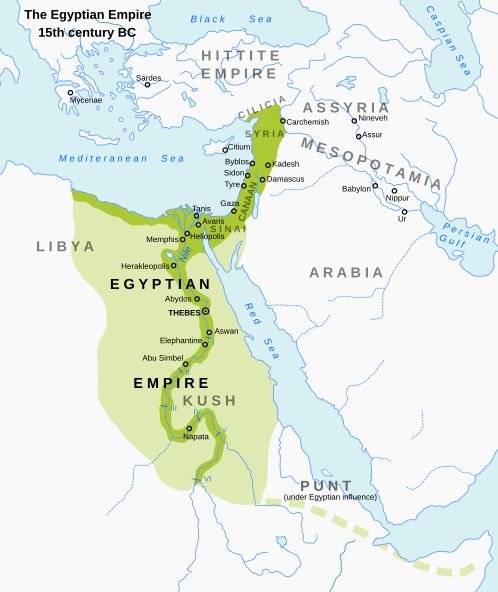
The Eighteenth Dynasty’s empire at its peak territorial expansion
The Eighteenth Dynasty of Egypt, often referred to as the Thutmoside Dynasty, marked the beginning of the New Kingdom (c. 1550–1292 BCE). It was a period of unprecedented military expansion, religious transformation, and cultural flourishing. Some of Egypt’s most renowned pharaohs, including Hatshepsut, Akhenaten, and Tutankhamun, reigned during this time. The dynasty is also notable for two queens who ruled as sole pharaohs, Hatshepsut and Neferneferuaten, an unusual distinction in Egyptian history.
Foundation and Early Rule
The dynasty was founded by Ahmose I, the brother or son of Kamose, the last ruler of the Seventeenth Dynasty. Ahmose I is credited with expelling the Hyksos, foreign rulers who had controlled Lower Egypt, and reuniting Egypt. His reign signified the end of the Second Intermediate Period and the beginning of the New Kingdom. Ahmose’s wife, Queen Ahmose-Nefertari, was highly venerated and later deified. After Ahmose I, his son Amenhotep I ruled, focusing on maintaining stability rather than military conquest.
Territorial Expansion under Thutmose I and Thutmose III
With no direct heir, Amenhotep I was succeeded by Thutmose I, who significantly expanded Egypt’s borders. His conquests stretched to Carchemish on the Euphrates River in the north and to Kanisah Kurgus beyond the fourth cataract of the Nile in the south. This expansion laid the groundwork for Egypt’s status as a dominant power.
Thutmose I was succeeded by his son Thutmose II, but his reign was brief. His wife, Hatshepsut, took control as regent for her stepson Thutmose III before declaring herself pharaoh. Her rule lasted over two decades, and she is remembered for her extensive building projects, including the famous Mortuary Temple at Deir el-Bahari.
The Eighteenth Dynasty represents the zenith of ancient Egypt’s power, influence, and cultural development.
Following Hatshepsut’s death, Thutmose III ascended as one of Egypt’s most powerful military leaders. He conducted numerous campaigns, expanding Egyptian territory to its greatest extent. His reign saw the submission of northern Canaan and parts of Syria, making Egypt a true empire. Thutmose III also established diplomatic relationships with other major powers, including the Mitanni kingdom.
The Golden Age under Amenhotep III
The reign of Amenhotep III (c. 1388–1351 BCE) is considered a period of great prosperity, stability, and cultural advancement. His rule was marked by diplomatic marriages to foreign princesses, further securing Egypt’s influence. Amenhotep III commissioned over 250 statues and extensive building projects, including the Colossi of Memnon and Karnak Temple expansions. His wife, Queen Tiye, played a significant role in state affairs, which was unusual for women at the time.
Religious Revolution: Akhenaten and the Amarna Period
Amenhotep III’s successor, Amenhotep IV, later changed his name to Akhenaten and introduced Atenism, a monotheistic worship of the sun disk Aten. This dramatic shift saw the closure of traditional temples, the relocation of the capital to Akhetaten (modern Amarna), and the alienation of the powerful Amun priesthood.
The Amarna Period, led by Akhenaten, was a religious and artistic revolution where the pharaoh promoted monotheistic worship of Aten.
Akhenaten’s rule is characterized by radical religious, artistic, and political transformations. His wife, Nefertiti, was deeply involved in his rule, and their images suggest she may have wielded significant power. However, after Akhenaten’s death, his religious reforms were reversed, and traditional polytheistic worship was restored.

Nefertiti was the great royal wife and queen consort of Pharaoh Akhenaten.
Tutankhamun and the Restoration of Tradition
Following Akhenaten, Egypt entered a brief period of uncertainty. His immediate successors, Smenkhkare and Neferneferuaten, had short-lived reigns. Eventually, Tutankhaten took the throne and changed his name to Tutankhamun, signaling the reinstatement of Amun worship.
Though Tutankhamun is most famous for his intact tomb discovered by British archeologist Howard Carter in 1922, his reign was relatively short. He was guided by advisors, including Ay and Horemheb, who played key roles in undoing the Amarna period’s religious changes.
Challenges and Controversies Surrounding the Discovery of Tutankhamun’s Tomb
The Last Pharaohs of the Eighteenth Dynasty
After Tutankhamun’s untimely death, Ay, his advisor, seized power and likely married his widow, Ankhesenamun, to legitimize his rule. However, his reign was brief, and he was succeeded by Horemheb, a military general who embarked on a campaign to erase the legacy of Akhenaten and his successors. Horemheb was the final ruler of the Eighteenth Dynasty, appointing his vizier, Ramesses I, as his successor, thus founding the Nineteenth Dynasty.
Foreign Relations and Military Conquests
Throughout its rule, the Eighteenth Dynasty maintained a powerful military presence. Pharaohs such as Thutmose III and Amenhotep II led campaigns into Canaan, Syria, and Nubia, ensuring Egyptian dominance. The empire extracted tribute from vassal states, including gold, ivory, and horses. Egyptian pharaohs also formed diplomatic marriages with foreign princesses to strengthen alliances, particularly with the Mitanni, Babylonians, and Hittites.
History of Nubia: How significant was the region in ancient times?
Relations with Nubia
The Eighteenth Dynasty had a profound impact on Nubia (Kush), incorporating the region under Egyptian control. Egyptian influence extended southward to Jebel Barkal, where temples to Amun were built. The Viceroy of Kush governed on behalf of the pharaoh, securing trade and military dominance. Nubian rulers, in return, sent gold, exotic animals, and resources as tribute.
Art, Culture, and Architecture
The Eighteenth Dynasty’s art and architecture reflect its wealth and power. Major architectural projects include:
- The Karnak and Luxor temples
- Hatshepsut’s Mortuary Temple
- The royal tombs in the Valley of the Kings
The period also saw innovations in artistic styles, particularly during the Amarna Period, where figures were depicted in a more naturalistic and exaggerated manner.
Religious Developments
Although Akhenaten attempted to shift to monotheism, traditional Egyptian polytheism persisted. The most important deity remained Amun, with Karnak Temple serving as the spiritual center. Pharaohs were considered divine, reinforcing their role as intermediaries between gods and people.
The End of the Eighteenth Dynasty
With Horemheb’s reign concluding the dynasty, Egypt transitioned into the Nineteenth Dynasty, led by Ramesses I. The Eighteenth Dynasty’s legacy endured through its military conquests, architectural achievements, and religious transformations, setting the stage for the powerful Ramesside pharaohs who followed.
Ancient Egyptian Kings of the New Kingdom and their Accomplishments
Frequently Asked Questions
Who founded the Eighteenth Dynasty of Egypt?
Ahmose I, who expelled the Hyksos and reunified Egypt, established the Eighteenth Dynasty, marking the start of the New Kingdom.
Why is the Eighteenth Dynasty significant?
It was a period of great military expansion, prosperity, and cultural development, producing some of Egypt’s most famous rulers.
Who were the most famous pharaohs of the Eighteenth Dynasty?
Notable rulers include Hatshepsut, Thutmose III, Amenhotep III, Akhenaten, Tutankhamun, and Horemheb.
What role did Hatshepsut play in the dynasty?
Hatshepsut was a female pharaoh who ruled for over 20 years, expanding trade and commissioning major construction projects.
How did Hatshepsut’s successors attempt to erase her legacy?
How did Thutmose III shape Egypt’s empire?
Thutmose III led military campaigns that extended Egypt’s influence into Canaan, Syria, and Nubia, making it a dominant power.
Why is Akhenaten considered a controversial ruler?
He abandoned traditional polytheism, moved the capital to Akhetaten, and focused on the worship of a single deity, Aten, causing unrest.
What was Tutankhamun’s significance?
Tutankhamun reversed Akhenaten’s religious reforms and restored Amun’s worship, but he is most famous for his tomb’s discovery in 1922.
Who were the last rulers of the Eighteenth Dynasty?
Ay and Horemheb were the final rulers, with Horemheb dismantling the remnants of the Amarna reforms and appointing Ramesses I as his successor.
How did the Eighteenth Dynasty interact with Nubia?
Egypt conquered and ruled Nubia, controlling its resources like gold, and built temples to solidify its influence.
What were the diplomatic strategies of the Eighteenth Dynasty?
Pharaohs engaged in diplomatic marriages with Mitanni and Babylonian royalty to secure alliances and maintain Egypt’s dominance.
What architectural achievements define the Eighteenth Dynasty?
Major projects include Hatshepsut’s mortuary temple, expansions at Karnak and Luxor, and Amenhotep III’s massive statues and temples.
How did the dynasty influence later Egyptian rule?
The military successes, administrative reforms, and artistic innovations of the Eighteenth Dynasty shaped the policies and culture of later dynasties.





