Atenism in Ancient Egypt
Atenism, also known as the Amarna religion, was a radical religious movement introduced by Pharaoh Akhenaten during the 14th century BCE in ancient Egypt. This monotheistic or monolatristic faith centered on the worship of Aten, the sun disc, as the sole deity. Atenism marked a sharp departure from traditional Egyptian polytheism, which had dominated religious life for millennia. Despite its brief dominance as Egypt’s state religion, Atenism was ultimately abandoned following Akhenaten’s death, leading to the restoration of Egypt’s traditional religious practices.
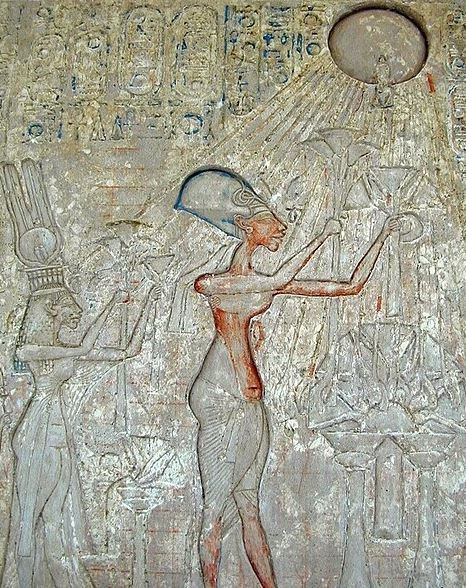
A limestone relief from Amarna, dating to approximately 1372–1355 BC, depicting Akhenaten, Nefertiti, and their children in devotion to Aten.
READ MORE: Most Famous Pharaohs of Ancient Egypt
Origins of Atenism
Atenism did not emerge in isolation but had roots in earlier Egyptian religious traditions. The term “Aten” first appears in inscriptions from the Fifth Dynasty (c. 24th century BCE), referring to the solar disc.
Over time, Aten evolved as an aspect of the sun god Ra, and by the reign of Amenhotep III, Akhenaten’s father, its significance had grown.
Amenhotep III’s interest in solar deities is evident in his naming of his royal barge Spirit of the Aten and in the increasing prominence of solar worship within his reign. However, it was his successor, Amenhotep IV, later known as Akhenaten, who elevated Aten to an exclusive position in Egyptian theology.
Akhenaten’s Religious Reforms
Upon ascending the throne, Amenhotep IV initially allowed traditional religious practices to continue. However, by the fifth year of his reign, he had begun emphasizing Aten above all other gods. This shift culminated in a profound theological transformation, in which Aten was no longer regarded as merely a powerful deity but as the singular god of Egypt.
Akhenaten underscored his radical religious reforms by adopting a new name—meaning “Spirit of Aten”—and relocating the capital from Thebes to a newly established city, Akhetaten (modern-day Amarna).
Atenism stands as one of the most fascinating and controversial religious experiments in history.
One of the most striking features of Atenism was its rejection of traditional Egyptian religious imagery. Unlike earlier gods, who were often depicted in human or animal forms, Aten was represented solely as a solar disc emitting rays ending in hands, symbolizing divine beneficence. This marked a radical break from Egypt’s long-established artistic conventions and religious iconography.
The Establishment of Akhetaten
Akhenaten’s devotion to Aten was further reflected in the construction of Akhetaten, designed explicitly as the center of Aten worship.
Located in Middle Egypt, this city housed grand temples dedicated to Aten and featured a unique open-air architectural style, allowing sunlight to permeate the sacred spaces. The construction of Akhetaten served not only a religious purpose but also a political one: by moving the capital, Akhenaten distanced himself from the powerful priesthood of Amun in Thebes, consolidating both religious and political authority under his rule.
Akhetaten became a hub of Atenist culture, and its art and inscriptions depict Akhenaten, his queen Nefertiti, and their children engaging in acts of devotion to Aten. The pharaoh and his family were portrayed as the only legitimate intermediaries between Aten and the Egyptian people, reinforcing the centrality of royal authority in the new religious framework.
The Great Hymn to the Aten
One of the most significant pieces of evidence for Atenist theology is the Great Hymn to the Aten, an extensive poetic text praising Aten as the creator and sustainer of all life. This hymn, inscribed in the tomb of Ay (a close adviser to Akhenaten and later pharaoh), emphasizes Aten’s universality and benevolence. It portrays Aten as the sole provider of light and sustenance, whose rays nurture all living beings, regardless of nationality or status. Some scholars see thematic parallels between this hymn and later monotheistic religious texts, such as the Psalms of the Hebrew Bible.

A depiction of Aten.
Contrasts with Traditional Egyptian Religion
Atenism represented a dramatic rupture from Egypt’s polytheistic traditions. Prior to Akhenaten’s reforms, Egyptian religion was deeply pluralistic, with numerous gods and goddesses presiding over various aspects of life. Each city had its own patron deity, and worship was conducted through elaborate rituals, sacrifices, and temple ceremonies.
Under Atenism, however, Akhenaten dismantled this system. The worship of other gods, particularly Amun, was actively suppressed, and temples dedicated to them were either closed or repurposed for Atenist use. The powerful priesthood of Amun, which had wielded significant political influence, found itself sidelined. Akhenaten’s theological reforms thus had profound implications not only for religious practice but also for the structure of Egyptian society.

The statue of the head of Akhenaten.
Art and Iconography of the Amarna Period
The artistic conventions of the Amarna Period, which coincided with Atenism, were markedly different from those of earlier Egyptian art.
Traditional depictions of pharaohs as rigid, idealized figures gave way to more naturalistic and exaggerated portrayals.
Akhenaten and his family were often depicted with elongated limbs, exaggerated facial features, and androgynous physiques—an artistic departure that has led some scholars to speculate about possible medical conditions, such as Marfan syndrome.
Scenes from this period frequently depict Akhenaten and Nefertiti in intimate, affectionate poses with their children, under the nurturing rays of Aten. This emphasis on familial devotion was a unique feature of Amarna art and may have been intended to reinforce the idea of the royal family as the divine conduits of Aten’s blessings.
The Decline of Atenism
Despite Akhenaten’s fervent devotion to Aten, his religious revolution was short-lived. Toward the end of his reign, Egypt faced political instability and economic difficulties, exacerbated by Akhenaten’s neglect of foreign affairs. The suppression of traditional gods also alienated many Egyptians, particularly the powerful Amun priesthood and the military elite.
Following Akhenaten’s death, his successor, likely Smenkhkare or Neferneferuaten, attempted to maintain Atenism but faced increasing resistance. Eventually, Tutankhaten, who became pharaoh, changed his name to Tutankhamun (“Living Image of Amun”) and restored the old gods. The capital was moved back to Thebes, and temples dedicated to Aten were abandoned or dismantled.
The final blow came during the reign of Horemheb, who actively sought to erase all traces of the Amarna period. Akhenaten’s name was omitted from official records, and efforts were made to destroy monuments associated with him. Over time, Atenism was forgotten, buried under centuries of renewed polytheistic tradition.
What is the meaning of the Latin phrase “Damnatio memoriae”?

Atenism’s Legacy
Although Atenism was ultimately erased from Egyptian history, its influence has intrigued scholars for centuries. Some researchers have drawn comparisons between Atenist theology and later monotheistic traditions, particularly Judaism.
Renowned Austrian psychoanalyst and nerologist Sigmund Freud, in his book Moses and Monotheism, even speculated that Moses might have been influenced by Atenist ideas. While such theories remain speculative, they highlight the uniqueness of Akhenaten’s religious vision.
Additionally, the radical artistic and cultural shifts of the Amarna period have left an enduring mark on the study of Egyptian history.
The artistic realism and emotive expressions of this era remain unparalleled in ancient Egyptian art. The Great Hymn to the Aten also continues to be examined for its literary and theological significance.
Frequently Asked Questions
Why did Akhenaten introduce Atenism?
Akhenaten likely introduced Atenism to centralize religious and political power, reducing the influence of the Amun priesthood and establishing himself as the sole intermediary between Aten and the people.

Akhenaten, Nefertiti, and their children portrayed beneath the life-giving rays of Aten.
How did Atenism differ from traditional Egyptian religion?
Unlike Egypt’s long-standing polytheistic traditions, Atenism focused on a single god, eliminated idol worship, and emphasized a direct connection between Aten and the royal family.
What role did Akhetaten play in Atenism?
Akhetaten (modern-day Amarna) was the new capital city Akhenaten built to serve as the religious and political center of Aten worship, symbolizing a complete break from previous traditions.
READ MORE: Ancient Egyptian Symbols and their Meanings
What was the significance of the Great Hymn to the Aten?
The Great Hymn to the Aten was a poetic text praising Aten as the sole creator and sustainer of life, reflecting the core beliefs of Atenism and its theological distinctiveness.
Why did Atenism decline after Akhenaten’s death?
Atenism collapsed due to political instability, economic difficulties, and strong resistance from traditionalists, leading Akhenaten’s successors, notably Tutankhamun, to restore Egypt’s polytheistic practices.
How did later pharaohs react to Atenism?
Pharaohs after Akhenaten, especially Horemheb, actively erased Atenist influences, destroying temples, defacing inscriptions, and omitting Akhenaten’s name from official records.
What is Atenism’s historical significance?
Despite its short-lived existence, Atenism remains a unique experiment in monotheistic worship, influencing later religious thought and artistic developments in Egyptian history.





