Aurelian Walls: What are they, and where can the best-preserved sections be found?
The Aurelian Walls were constructed between 271 AD and 275 AD during the reign of Emperor Aurelian. The structures are an enduring testament to Rome’s architectural ingenuity and strategic foresight. These city walls replaced the earlier Servian Wall of the 4th century BC, encompassing a much larger area to include all seven hills of Rome, the Campus Martius, and the Trastevere district on the right bank of the Tiber. Their construction marked a critical moment in the city’s history, reflecting the political and military challenges of the 3rd century AD.

A view of the interior section of the Aurelian walls.
READ MORE: Underground Sites in Rome
Historical Context
By the 3rd century AD, the expansion of Rome had far outgrown the boundaries set by the Servian Wall. For centuries, the city remained unfortified, its security assured by the Pax Romana and the might of the Roman legions.
However, the Crisis of the Third Century, characterized by civil wars, invasions, and economic instability, exposed Rome’s vulnerability. The defeat of Roman forces at Placentia in 270 AD and subsequent incursions by the Juthungi and Vandals underscored the need for robust defenses. Aurelian’s decision to construct the walls was both a strategic and symbolic act, demonstrating his resolve to protect Rome and reaffirm his authority.
Construction
The Aurelian Walls stretched approximately 19 kilometers (12 miles) and enclosed an area of 13.7 square kilometers (5.3 square miles). Built of brick-faced concrete, the walls were initially 3.5 meters (11 feet) thick and 8 meters (26 feet) high. Square towers punctuated the structure at intervals of 100 Roman feet (29.6 meters or 97 feet), enabling effective surveillance and defense.
In the 4th century, the walls underwent significant modifications under Emperor Maxentius and later Emperor Honorius. Their height was doubled to 16 meters (52 feet), and the number of towers increased to 383. Additional features included 7,020 crenellations, 18 main gates, 5 postern gates, and 116 latrines, ensuring both defensive strength and functionality.
A unique aspect of the construction was the incorporation of pre-existing buildings, such as the Amphitheatrum Castrense, the Castra Praetoria, the Pyramid of Cestius, and sections of the Aqua Claudia aqueduct. This approach expedited the project and reduced costs. It is estimated that about one-sixth of the walls comprised these earlier structures.
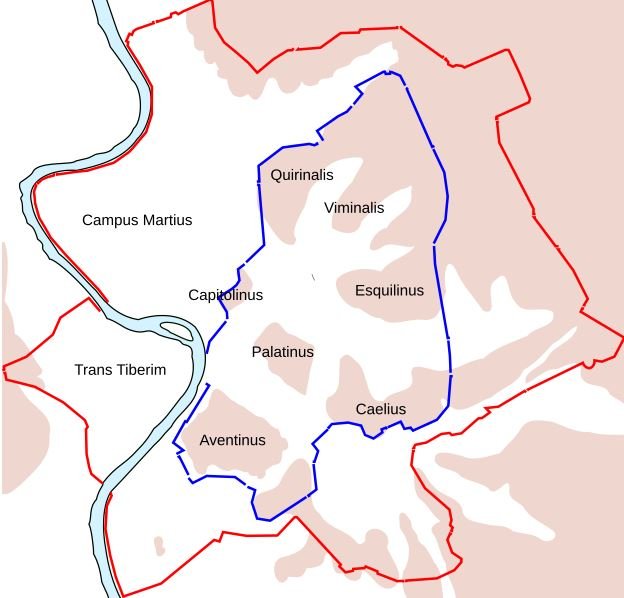
A map of ancient Rome showcasing the Aurelian walls (marked with a red line) and its highlighted gates.
Defensive Role and Limitations
The walls were not designed to withstand prolonged sieges but served as a deterrent against raids and sudden attacks. The combined forces of the Praetorian Guard, cohortes urbanae, and vigiles, numbering around 25,000 men, were insufficient for full-scale defense. However, the walls discouraged invaders by presenting a formidable barrier.
Key Historical Events
The Aurelian Walls played a pivotal role in protecting Rome during the Arab raid of 846. While the raiders pillaged sites outside the walls, such as Old St. Peter’s Basilica and St. Paul’s Outside the Walls, the fortifications safeguarded the city’s core. This event highlighted the need for additional defenses, leading to the construction of the Leonine Walls around Vatican Hill.
The Aurelian Walls offer insights into the city’s history, from its imperial grandeur to its struggles during the medieval and modern eras.
The walls retained their military significance until the 19th century. On September 20, 1870, troops of the Kingdom of Italy breached the wall near Porta Pia, marking the fall of the Papal States and the unification of Italy. This event, known as the “Breaching of Porta Pia,” signaled the end of the walls’ military utility.
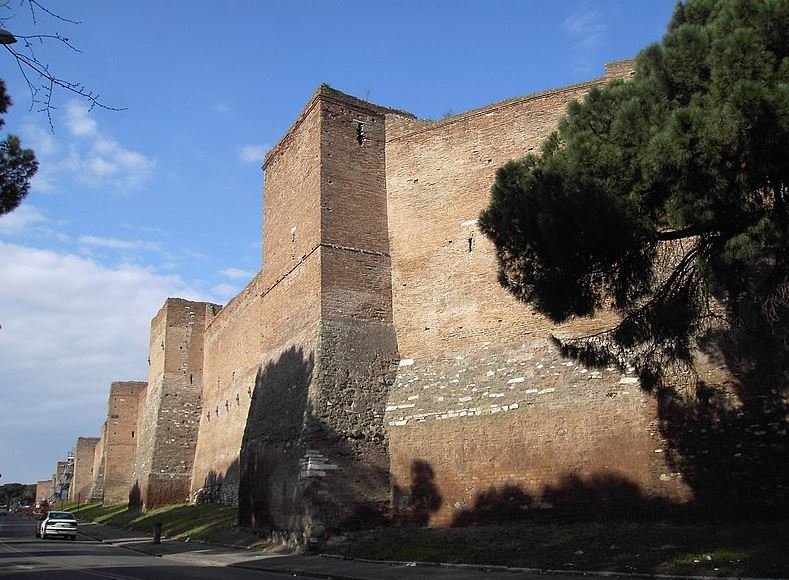
A closer view of the Aurelian Walls.
Later Use and Preservation
For centuries, the Aurelian Walls defined Rome’s boundaries, with the city’s built-up area largely confined within them. Despite their age, the walls remain remarkably well-preserved due to continuous maintenance and their long-standing use as a primary defensive structure. Today, they are an important historical and architectural landmark, with sections open to the public, including the Museo delle Mura near Porta San Sebastiano.
Architectural Features of the Aurelian Walls
The walls exhibit several noteworthy architectural elements:
The circuit included 383 towers and numerous gates, some of which served major roads leading out of the city. Examples include Porta del Popolo, Porta San Sebastiano, and Porta Maggiore. The gates often incorporated aqueducts or pre-existing structures, enhancing their utility and symbolism.
Well-preserved areas of the Aurelian Walls include sections near Porta San Sebastiano, Porta San Giovanni, and Porta San Paolo.
A cleared area behind the walls allowed for quick reinforcement during emergencies, while sentry passages facilitated troop movements.
The walls included 116 latrines and 2,066 windows, underscoring their practical design. Towers provided vantage points for surveillance and defense.
Notable Sections and Gates of the Walls
Best-Preserved Sections
- From Muro Torto (near Villa Borghese) to Corso d’Italia and Castro Pretorio.
- From Porta San Giovanni to Porta Ardeatina.
- From Porta Ostiense to the Tiber.
- Around Porta San Pancrazio.
Significant Gates
- Porta San Sebastiano: Gateway to the Appian Way.
- Porta Maggiore: Incorporates three aqueducts and serves as a monumental entrance.
- Porta del Popolo: Starting point of the Via Flaminia.
Cultural and Historical Significance
The Aurelian Walls are more than a military fortification; they symbolize Rome’s resilience and adaptability. They reflect the city’s response to external threats and internal challenges during a tumultuous period. Their construction marked a turning point in urban planning and defensive architecture, influencing later fortification designs across Europe.
Frequently Asked Questions
Why were the Aurelian Walls built, and how did they differ from earlier walls?
They were built as an emergency response to increasing invasions and Rome’s vulnerability. Unlike the earlier Servian Wall, they enclosed a much larger area, including the seven hills, Campus Martius, and Trastevere.
What materials and design features characterized the Aurelian Walls?
The walls were made of brick-faced concrete, initially 8 meters high and 3.5 meters thick, with square towers every 29.6 meters. Later, their height was doubled to 16 meters.

A section of the Aurelian walls near Pyramid of Cestius.
How extensive were the walls, and what structures were incorporated?
The walls extended 19 km, enclosing 13.7 square kilometers. Existing structures, such as the Amphitheatrum Castrense, the Pyramid of Cestius, and sections of aqueducts, were integrated to expedite construction.
What was the role of the Aurelian Walls in later periods of Rome’s history?
The walls were upgraded over centuries, helping repel invasions like the Arab raid of 846. They remained Rome’s primary defense until the late 19th century and defined the city’s boundaries.
Why were the walls not built to withstand prolonged sieges?
The walls served as a deterrent against hit-and-run raids rather than prolonged sieges, as invading forces typically lacked the resources for extensive siege warfare.
How were the walls maintained and repurposed over time?
Sections were reinforced under emperors like Maxentius and Honorius. The Leonine Walls were added later to protect Vatican Hill, and some wall parts were converted into domestic properties.
FACT CHECK: At World History Edu, we strive for utmost accuracy and objectivity. But if you come across something that doesn’t look right, don’t hesitate to leave a comment below.





