Bindusara: The Second Mauryan Emperor of Magadha
Bindusara (320 BCE – 273 BCE) was the second emperor of the Mauryan dynasty, ruling from approximately 297 BCE to 273 BCE. Known in Greco-Roman accounts as Amitrochates—a derivative of his Sanskrit title “Amitraghāta,” meaning “slayer of enemies”—Bindusara is remembered as the son of Chandragupta, the dynasty’s founder, and the father of its most famous ruler, Ashoka. Despite his pivotal role in consolidating the Mauryan Empire, details about his life are scarce, mostly derived from legends written centuries after his death.

A silver coin of 1 karshapana of the Maurya empire, period of Bindusara Maurya about 297–273 BC, workshop of Pataliputra.
Background and Historical Sources
Bindusara’s life is documented primarily through ancient and medieval texts, many of which are Jain and Buddhist accounts focusing more on Chandragupta and Ashoka. These sources include the Mahavamsa, Divyavadana, Dipavamsa, and Vamsatthappakasini among Buddhist texts, and the Parishishta-Parvan and Rajavali-Katha among Jain writings. Hindu Puranas also mention him briefly, while Greek authors such as Strabo and Athenaeus refer to him as Amitrochates. However, these records are often regarded as unreliable due to their legendary nature and the time gap between Bindusara’s reign and their composition.
Early Life
Bindusara was the son of Chandragupta, though some Buddhist texts like the Dipavamsa incorrectly name his father as Shushunaga. Jain legends state his mother was Durdhara, although no historical evidence confirms this. A popular legend claims Chanakya, Chandragupta’s advisor, saved Bindusara from poisoning during his mother’s pregnancy, leaving drops (bindu) of poison on his body, which inspired his name.
The name “Bindusara” is corroborated across multiple traditions. Buddhist and Jain texts mention him as Bindusara or Vindusara, while Greek accounts use variations like Allitrochades and Amitrochates. His title “Devanampriya” (“Beloved of the Gods”) was later adopted by Ashoka.
Family
Bindusara is said to have fathered 101 sons, according to the Mahavamsa. Among them, Sushima, Ashoka, and Tishya are the most notable. Buddhist texts name Ashoka’s mother as Subhadrangi, a Brahmin woman who rose from being an imperial barber to Bindusara’s chief empress. Jain and other texts provide varying names for Ashoka’s mother, including Dhamma and Janapadakalyani.
Bindusara’s Reign
Bindusara inherited a vast empire from Chandragupta, stretching from the Hindu Kush to Bengal and from the Himalayas to the Deccan. While some accounts credit him with further conquests, historians debate this claim. The Mauryan empire likely already spanned from the western to the eastern seas during Chandragupta’s rule, suggesting that Bindusara primarily focused on consolidating these territories rather than expanding them significantly.
During Bindusara’s reign, Takshashila, an important city, witnessed two major revolts. Ashoka was sent to suppress the first uprising and succeeded peacefully, reportedly due to the rebels’ grievances being directed at oppressive ministers rather than the emperor. However, a subsequent revolt during Bindusara’s later years saw his son Sushima fail to quell it, underscoring Ashoka’s growing prominence.
Chanakya likely continued to serve as an advisor during the early part of Bindusara’s reign, though legends describe his eventual departure under dramatic circumstances. Later advisors, including Radhagupta and Khallataka, played critical roles in ensuring Ashoka’s ascension.
Relations with Foreign Powers
Bindusara maintained diplomatic ties with the Hellenistic world, particularly the Seleucid Empire. Greek ambassador Deimachos of Plateia was stationed at his court, succeeding Megasthenes, who had served under Chandragupta. Anecdotal accounts, such as Bindusara’s request for sweet wine, dried figs, and a sophist from Seleucid King Antiochus I, reflect his interest in Greek culture and philosophy. Other sources, like Diodorus and Pliny, hint at interactions with Ptolemaic Egypt and other Hellenistic realms.
Hellenistic Kingdoms: What were they and what were some of their notable achievements?
Religion and Philosophy
Bindusara’s religious inclinations are debated. While Buddhist texts describe him as a follower of Brahmanism, Jain sources remain silent. Some accounts suggest his association with the Ajivikas, an ascetic sect, possibly evidenced by the prophecy of Ashoka’s greatness made by an Ajivika astrologer. An inscription at Sanchi hints at his possible connection to Buddhism, though its interpretation remains speculative.
Death and Succession
Bindusara likely died around 273 BCE, with sources varying on the exact date. His reign lasted approximately 25-28 years. Upon his death, a fierce succession struggle ensued. Buddhist texts describe Ashoka eliminating his brothers to secure the throne, while other accounts suggest a smoother transition. Ashoka’s eventual rise marked the beginning of one of the most remarkable chapters in Indian history.
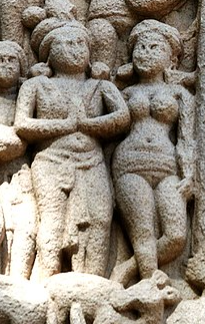
Bindusara is overshadowed by Chandragupta and Ashoka, with much of his life documented through later legends, making his historical narrative less reliable. Image: Emperor Ashoka and his Queen at the Deer Park. Sanchi relief
Legacy
Bindusara’s reign was a bridge between the foundational work of Chandragupta and the transformative rule of Ashoka. While he is overshadowed by his predecessor and successor, his role in stabilizing and governing the Mauryan Empire during its formative years remains significant. His diplomacy, administrative focus, and management of internal challenges laid the groundwork for Ashoka’s later achievements.
Frequently Asked Questions
What is the origin of Bindusara’s name?
According to legends, Bindusara’s name originated from the drops (“bindu”) of goat’s blood that spotted his body when he was delivered through an emergency procedure after his mother consumed poisoned food.
Who were Bindusara’s parents, and what speculation exists about his mother?
Bindusara was the son of Chandragupta Maurya. Some speculate that his mother may have been Greek or Macedonian due to Chandragupta’s alliance with the Seleucids, but there is no evidence for this. Jain texts name his mother as Durdhara.
What achievements are attributed to Bindusara during his reign?
Bindusara is credited with consolidating the Mauryan Empire. While some sources suggest he expanded into southern India, others argue he merely maintained the empire inherited from Chandragupta.
How did Bindusara handle revolts in Takshashila?
Bindusara sent Ashoka to quell the first revolt in Takshashila, which was resolved without conflict. A second revolt occurred near the end of his reign, but Sushima failed to suppress it.
What role did religion and advisors play in his court?
Bindusara followed Brahmanism but is also associated with Ajivika patronage. His ministers, like Radhagupta, and advisors like Chanakya and Khallataka, were instrumental in administrative and succession matters.
What foreign relations did Bindusara maintain?
Bindusara maintained diplomatic relations with Greek kings, hosting ambassadors like Deimachos and requesting items such as sweet wine, figs, and a sophist from Antiochus I.
What events led to Ashoka’s succession?
Accounts vary, but Ashoka became emperor after Bindusara’s death, reportedly through ministerial support and eliminating his rivals, including his brothers.





