British Military History: The Largest Surrenders of All Time
British military history has seen several large-scale surrenders, often occurring in the context of global conflicts where British forces were overextended or outmatched. These moments of defeat, such as the fall of Singapore, the surrender at Yorktown, and the Siege of Kut, have had significant political and military consequences, reshaping the course of wars and empires.
However, in many cases, Britain has demonstrated resilience, learning from these defeats and later achieving victories, as seen in the recapture of Tobruk and the eventual success of the British Empire in the World Wars.
Here’s an overview of British military history focusing on the largest surrenders:
Fall of Singapore (1942)

British Lieutenant-General Arthur Percival (right), escorted by Ichiji Sugita, walks under a flag of truce to negotiate Commonwealth forces’ surrender in Singapore, February 15, 1942.
Perhaps the most significant surrender in British military history occurred during World War II when Singapore, then a British stronghold in Southeast Asia, fell to the Japanese on February 15, 1942. Singapore was considered an “impregnable fortress,” but the Japanese, under General Tomoyuki Yamashita, launched a swift and brutal campaign, invading through Malaya. British forces, under Lieutenant-General Arthur Percival, were caught off guard by the speed and ferocity of the attack.
In just over a week, Yamashita’s forces overwhelmed the British, Indian, Australian, and local forces defending Singapore. Percival, facing severe water shortages, dwindling supplies, and the risk of civilian casualties, decided to surrender. Around 80,000 British and Commonwealth troops were taken prisoner in what is considered Britain’s worst military defeat. The surrender of Singapore was not only a massive blow to British morale but also reshaped the balance of power in the Asia-Pacific region during World War II.
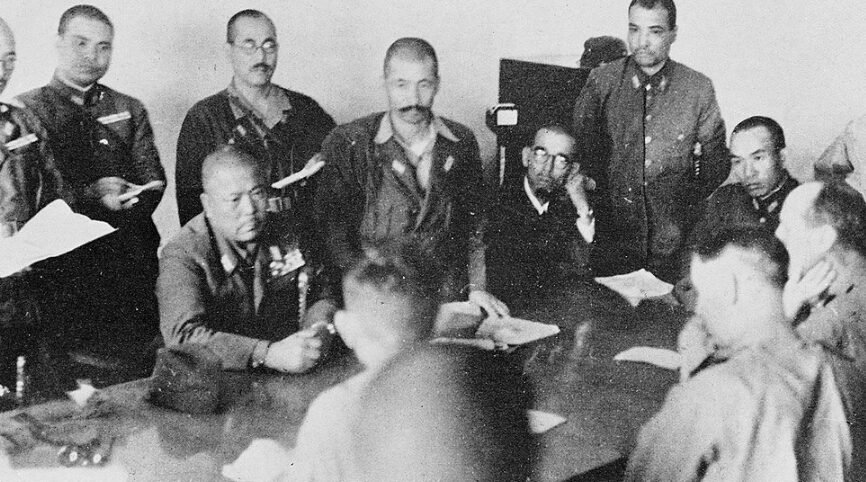
Britain surrendering Singapore to Japan
Surrender at Yorktown (1781)

Another significant surrender in British history came during the American War of Independence. The Siege of Yorktown in 1781 marked a decisive moment when British forces, under General Lord Cornwallis, were forced to surrender to the combined French and American armies.
Cornwallis had been operating in the southern colonies, attempting to suppress the growing rebellion. However, he became trapped at Yorktown, Virginia, by American and French forces led by General George Washington and the Comte de Rochambeau. The French navy, under Admiral de Grasse, blockaded the Chesapeake Bay, cutting off Cornwallis’ supply lines and preventing his escape.
After a three-week siege, with his position untenable, Cornwallis surrendered on October 19, 1781, with over 7,000 British soldiers taken prisoner. This defeat effectively ended major fighting in the American colonies and led to British negotiations for peace, culminating in the Treaty of Paris in 1783 and the recognition of American independence.

Surrender of Cornwallis. At Yorktown, VA, Oct. 1781, Nathaniel Currier. D’Amour Museum of Fine Arts
Kut al-Amara (1916)

Image: The siege by Ottoman 6th Army forces
During World War I, the Siege of Kut al-Amara in Mesopotamia (modern-day Iraq) marked another significant British surrender. British forces under Major General Charles Townshend had advanced into Mesopotamia with the objective of capturing Baghdad. However, they were stopped by Ottoman forces at Ctesiphon and forced to retreat to the town of Kut.
Townshend’s forces, numbering around 10,000, were besieged by the Ottomans under Khalil Pasha for nearly five months. British relief efforts failed, and with supplies running out and his men starving, Townshend was forced to surrender on April 29, 1916. The Ottoman victory at Kut was one of the greatest humiliations for the British during World War I, with over 13,000 troops taken prisoner, many of whom died in captivity.
Battle of Tobruk (1942)
The North African campaign of World War II saw another large-scale British surrender during the fall of Tobruk in June 1942. Tobruk, a key port city in Libya, had been held by the British and Commonwealth forces under General Neil Ritchie. The city was seen as a crucial defensive position in the fight against the German Afrika Korps, led by Field Marshal Erwin Rommel.
However, after a series of setbacks, Rommel launched a renewed offensive, quickly overrunning British positions. The garrison at Tobruk, under Major General Hendrik Klopper, was ill-prepared for the attack, and after only a day of fighting, Klopper surrendered on June 21, 1942. Over 33,000 British and Commonwealth troops were taken prisoner. The loss of Tobruk was a major blow to British prestige and morale, although it would later be recaptured in November 1942 following the Second Battle of El Alamein.
Corunna (1809)

Image: Combat of la Corogne, 16 January 1809 by French painter Hippolyte Bellangé (1843)
During the Peninsular War, the British army, under General Sir John Moore, was forced to retreat from Spain after the advance of Napoleon’s armies. Moore had been operating in northern Spain, attempting to support Spanish forces against the French. However, after Napoleon himself took to the field with a massive army, Moore found himself heavily outnumbered.
The British conducted a grueling retreat across the mountains of Galicia, pursued by the French. Finally, at the port of Corunna, Moore’s army turned to face the French in a rearguard action. While the British managed to hold off the French long enough for their forces to evacuate by sea, Moore himself was killed in the battle. Although not a formal surrender, the retreat from Corunna marked the end of British involvement in northern Spain for some time, and the loss of Moore was a significant blow to British leadership.
Fall of Hong Kong (1941)

Japanese troops during the Battle of Hong Kong in December 1941
In the early days of the Pacific War, Hong Kong, then a British colony, was attacked by Japanese forces on December 8, 1941, just hours after the attack on Pearl Harbor. British, Canadian, Indian, and local forces, under the command of Major General Christopher Maltby, attempted to defend the colony but were quickly overwhelmed by the better-equipped Japanese forces.
After 17 days of fighting, with no hope of relief and running out of supplies, Maltby surrendered the garrison on Christmas Day, 1941. Around 10,000 British and Commonwealth troops were taken prisoner, and the Japanese occupation of Hong Kong would last until the end of the war in 1945.

Image: The surrender of British forces in Hong Kong, 25 December 1941
Siege of Khartoum (1885)

Image: Portrayal of General Gordon’s death by Irish painter George W. Joy
The Siege of Khartoum, while not a British surrender in the strictest sense, involved the fall of a British-led garrison and the death of one of Britain’s most famous military figures, General Charles Gordon. In the 1880s, Sudan was in rebellion against Egyptian rule, which was backed by the British. The Mahdist forces, led by Muhammad Ahmad (the Mahdi), laid siege to Khartoum, where Gordon was attempting to organize the defense.
Despite calls for reinforcements, British relief efforts were delayed, and after a siege of nearly a year, Khartoum fell on January 26, 1885. Gordon was killed, and the garrison was massacred. The fall of Khartoum was a significant blow to British prestige in the region, though it would later be avenged by Lord Kitchener at the Battle of Omdurman in 1898.
Surrender at Kilmichael (1920)
During the Irish War of Independence, British forces faced a significant defeat at the hands of the Irish Republican Army (IRA) during the Kilmichael Ambush on November 28, 1920. The IRA, under the command of Tom Barry, ambushed a convoy of British Auxiliary forces, killing 17 out of 18 Auxiliaries. Although not a large-scale surrender, the event was a major setback for British forces in Ireland and contributed to the eventual negotiations that led to the Anglo-Irish Treaty in 1921.

Monument at the Kilmichael Ambush site