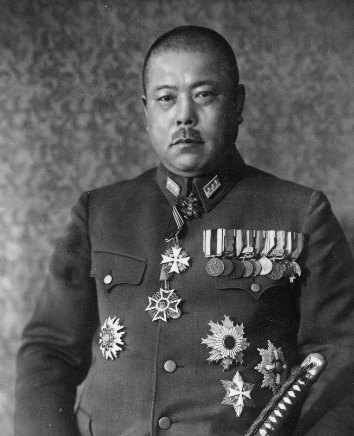
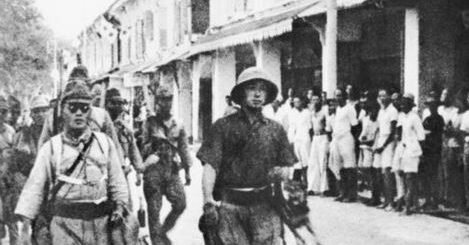
The Surrender of General Tomoyuki Yamashita

One of the most important events in Philippine history on this date occurred shortly after World War II. On September 2, 1945, General Tomoyuki Yamashita, the commander of the Japanese forces in the Philippines during the final stages of the war, formally surrendered to Allied forces. Image: General Yamashita and his staff surrender on 2 September 1945
The surrender of General Tomoyuki Yamashita on September 2, 1945, marked the official end of World War II in the Philippines. Yamashita, often referred to as the “Tiger of Malaya” for his earlier military successes in Southeast Asia, commanded the Japanese forces in the Philippines during the final, bloody stages of the war.
Yamashita’s surrender symbolized the collapse of Japanese resistance in the archipelago and was a significant moment in the broader conclusion of the Pacific theater of World War II. The event took place against the backdrop of Japan’s defeat, which followed the atomic bombings of Hiroshima and Nagasaki, and the subsequent Japanese surrender on August 15, 1945. Yamashita’s capitulation had both immediate and lasting impacts on the Philippines, the region, and the world.
Background: The Philippines in World War II
The Philippines, a U.S. Commonwealth at the time of World War II, was a major battleground between the Allied and Japanese forces. The Japanese invasion of the Philippines began in December 1941, shortly after their surprise attack on Pearl Harbor. Under General Douglas MacArthur, the U.S. and Filipino forces mounted a fierce defense but were ultimately forced to surrender in May 1942 after the fall of Corregidor.
The Japanese occupation of the Philippines was brutal, marked by widespread atrocities, including the infamous Bataan Death March. Resistance movements sprang up across the country, but the Japanese army remained entrenched in the islands for several years. By 1944, however, the tide of the war had turned in favor of the Allies. General MacArthur famously returned to the Philippines in October 1944, fulfilling his earlier promise of “I shall return,” and launched a campaign to liberate the country from Japanese control.
As the war progressed, the Japanese forces in the Philippines, under the command of General Yamashita, faced increasing pressure from the advancing U.S. military and local Filipino guerilla fighters. Yamashita, tasked with defending the Japanese occupation, ordered his troops to employ a strategy of guerrilla warfare and a protracted defense. His forces committed some of the worst atrocities of the war during this period, including the massacre of civilians in Manila in early 1945.
General Tomoyuki Yamashita: The “Tiger of Malaya”

Image: General Tomoyuki Yamashita and his troops plans an assault by Japanese troops in Malaya
General Yamashita had a distinguished military career before being assigned to the Philippines. He gained international fame during the early stages of the war for his brilliant campaign in Malaya, where his forces defeated British and Commonwealth troops with remarkable speed, leading to the fall of Singapore in February 1942. This victory earned him the nickname “Tiger of Malaya.”

Imperial Japanese forces on a street in Johor Bahru in the final stages of the Malayan campaign (8 December 1941 – 15 February 1942)
However, Yamashita’s fortunes changed when he was transferred to the Philippines in October 1944. By this time, Japan was losing the war, and Yamashita faced overwhelming odds. His forces in the Philippines were poorly supplied, scattered, and increasingly isolated as the U.S. forces advanced. Despite these challenges, Yamashita was determined to hold out as long as possible, hoping to tie down Allied forces and delay their advance on the Japanese mainland.

Image: Lt. Gen. Tomoyuki Yamashita (seated, center) demanding an unconditional surrender of Singapore as Lt. Gen. Percival, seated between his officers, demurs
The Battle for the Philippines
The campaign to liberate the Philippines was a prolonged and bloody affair, marked by intense battles across the islands. The Battle of Leyte, which began in October 1944, was one of the largest and most decisive battles of the Pacific War. The U.S. victory in Leyte allowed them to establish a foothold in the Philippines, from which they launched further operations to liberate the rest of the archipelago.
Yamashita’s forces, however, did not give up easily. They retreated to the mountainous regions of northern Luzon, where they fought a grueling guerrilla campaign against the advancing U.S. and Filipino forces. The Battle of Manila, which took place in February and March 1945, was particularly devastating. Yamashita had ordered his troops to withdraw from the city to the mountains, but a contingent of Japanese forces remained in Manila and, defying Yamashita’s orders, engaged in a brutal and indiscriminate massacre of civilians, killing tens of thousands. The destruction of Manila left the city in ruins and further stained Yamashita’s already controversial reputation.
As the Allied forces pushed northward, Yamashita’s troops were increasingly cut off from supplies and reinforcements. By the summer of 1945, the remaining Japanese forces in the Philippines were isolated in the rugged mountains of the Cordillera region, where they continued to resist despite the hopelessness of their situation.
Japan’s Surrender and Yamashita’s Dilemma
Japan’s official surrender came on August 15, 1945, following the atomic bombings of Hiroshima and Nagasaki and the Soviet Union’s declaration of war on Japan. Emperor Hirohito’s announcement of Japan’s surrender was broadcast to the Japanese people, signaling the end of the war. However, not all Japanese forces surrendered immediately. In many parts of the Pacific, isolated Japanese troops either did not receive the news or refused to lay down their arms.
In the Philippines, Yamashita faced a difficult decision. His forces were isolated and in a desperate situation, but he had always prided himself on his sense of duty and loyalty to Japan. Some Japanese commanders advocated continuing the fight, arguing that surrender was dishonorable and that they should die in battle rather than capitulate. However, Yamashita understood that further resistance was futile and would only result in more needless deaths. He was also aware that the Japanese high command had ordered all remaining forces to surrender.
By early September 1945, Yamashita’s options had run out. His troops were starving, their ammunition was running low, and they were surrounded by U.S. and Filipino forces. Recognizing the hopelessness of his situation, Yamashita made the decision to surrender.
The Surrender: September 2, 1945
On September 2, 1945, the formal Japanese surrender was signed aboard the USS Missouri in Tokyo Bay, officially bringing World War II to an end. In the Philippines, however, it took a few more days for the remaining Japanese forces to surrender. General Yamashita, along with his staff, surrendered to Allied forces on at Kiangan, a small town in the mountainous province of Ifugao in northern Luzon.
The surrender ceremony took place in a simple setting, far removed from the grandeur of the formal surrender in Tokyo. Yamashita, wearing his full military uniform, presented himself to U.S. General Jonathan M. Wainwright, the same general who had surrendered to the Japanese in 1942 during the fall of the Philippines, and British General Arthur Percival, who had surrendered Singapore to Yamashita in 1942. The symbolism of Wainwright and Percival accepting Yamashita’s surrender was not lost on the participants; it was a moment of poetic justice for both Allied commanders.
Yamashita was stoic during the surrender, showing little emotion as he handed over his sword. The scene marked the final chapter of the Japanese occupation of the Philippines and the end of organized Japanese resistance in the Pacific. After more than three years of brutal warfare, the Philippines was finally free of Japanese forces.
The Aftermath of the Surrender
Following his surrender, General Yamashita was taken into custody by the U.S. military. He was charged with war crimes for his role in the atrocities committed by Japanese forces during the occupation of the Philippines, particularly the Manila Massacre. Although Yamashita had ordered his troops to evacuate Manila, the argument was made that, as the commanding officer, he was responsible for the actions of his subordinates.
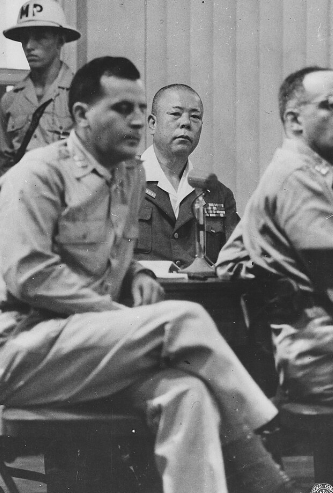
Yamashita was later tried by a U.S. military tribunal and convicted of war crimes for atrocities committed by Japanese troops during the war. Image: Yamashita (second from right) at his trial in Manila, November 1945
Yamashita’s trial was highly controversial and became a landmark case in the history of international law. His defense argued that he had no direct control over the troops responsible for the atrocities and that he could not be held accountable for their actions. However, the prosecution maintained that as the commanding officer, Yamashita had a duty to maintain control over his forces and prevent such atrocities from occurring.
The trial, held in Manila from October to December 1945, ended with Yamashita’s conviction. He was sentenced to death and hanged on February 23, 1946, at Los Baños, Laguna. The legal principle established during the trial, known as the “Yamashita Standard,” holds that military commanders can be held responsible for the actions of their troops, even if they were unaware of the specific crimes being committed. This principle has had a lasting impact on international law and has been applied in subsequent war crimes trials.
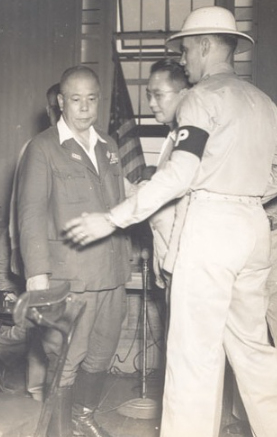
General Yamashita was executed in 1946 for the war crimes he committed during WWII. Image: General Yamashita was removed from the courtroom by military police immediately after hearing the verdict of death by hanging
The Impact of Yamashita’s Surrender on the Philippines
Yamashita’s surrender marked the end of a brutal period in Philippine history. The Japanese occupation had been characterized by widespread atrocities, including massacres, forced labor, and the destruction of cities and infrastructure. The Battle of Manila alone had left much of the capital in ruins, and the toll on the civilian population was immense.
The liberation of the Philippines and the surrender of the Japanese forces allowed the country to begin the process of rebuilding. However, the scars of the war would remain for decades. The Philippines suffered massive losses in terms of human life, infrastructure, and economic stability. The destruction of Manila, once known as the “Pearl of the Orient,” was particularly devastating, as it had been one of the most beautiful and vibrant cities in Asia before the war.
The end of the war also paved the way for Philippine independence. Although the Philippines had been promised independence by the United States before the war, the Japanese occupation delayed this process. In 1946, just months after Yamashita’s execution, the Philippines was officially granted independence, marking the beginning of a new chapter in its history.
Conclusion
The surrender of General Tomoyuki Yamashita was a pivotal moment in the history of the Philippines and the Pacific War. It marked the end of Japanese resistance in the Philippines and symbolized the collapse of Japanese military power in the region. Yamashita’s surrender, trial, and eventual execution also had significant implications for international law, particularly in the realm of command responsibility for war crimes.
For the Philippines, the surrender marked the end of a long and painful occupation and the beginning of a difficult but hopeful period of rebuilding. The liberation of the country and the subsequent attainment of independence were key milestones in the nation’s history, and the memory of the war and its aftermath continues to shape the Philippines’ identity to this day.