Cartimandua: Queen of the Brigantes
Cartimandua (reigned c. AD 43–69) was a 1st-century Brigantian queen in northern England, noted in Tacitus’s writings. She is best known for aligning her tribe with Rome, betraying Celtic leader Caratacus to the Romans for wealth.
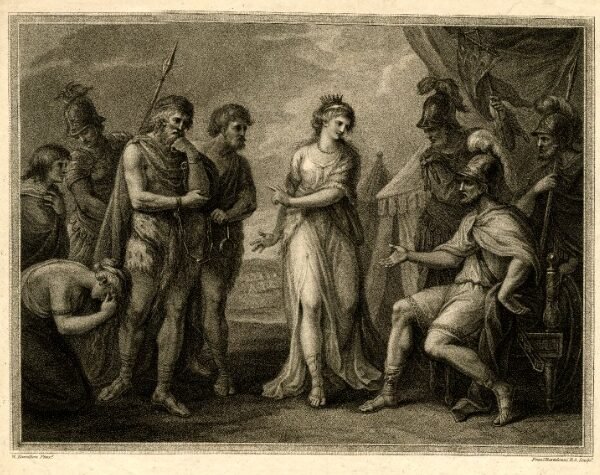
Her reign saw repeated revolts led by her ex-husband, which eventually resulted in her losing power. Cartimandua’s legacy is one of ambition, betrayal, and controversy. Image: Caractacus, Silures King, betrayed to Roman General Ostorius by Brigantes Queen Cartimandua. – British Museum
Early Rule and Relationship with Rome
Cartimandua, queen of the Brigantes during the 1st century AD, likely began her reign around AD 43, coinciding with the Roman emperor Claudius‘s conquest of Britain.
Tacitus, the primary source for her life, first mentions her in AD 51, but evidence suggests she may have been among the British leaders who surrendered peacefully to Claudius. Her rise to power may have also followed a Brigantian revolt defeated by Publius Ostorius Scapula in AD 48. Described as of “illustrious birth” by Tacitus, Cartimandua probably inherited her position as ruler, reflecting her elite status among the Celtic tribes.
From the beginning, Cartimandua aligned herself with Rome, ensuring her tribe’s survival and her own dominance. The Brigantes, a large and powerful tribe in what is now northern England, benefited from Roman military support under her leadership. This allegiance shaped her reign, as she worked to maintain Roman favor and leverage their protection to consolidate power.
READ MORE: Most Famous Celtic Gods and Goddesses
Betrayal of Caratacus
One of the most defining moments of Cartimandua’s rule occurred in AD 51, when she betrayed the British resistance leader Caratacus. Following his defeat by the Romans in Wales, Caratacus sought sanctuary with Cartimandua. However, instead of offering protection, she handed him over to the Romans. This act of treachery provided the Roman emperor Claudius with a significant propaganda victory, as Caratacus was paraded in Rome during Claudius’s triumph. In return, Cartimandua received substantial wealth and political favor, cementing her position as a key ally of Rome.
Tacitus criticized her betrayal, suggesting it stemmed from opportunism and greed. Her actions were viewed as a pragmatic, though controversial, means of maintaining her rule in a politically volatile environment.
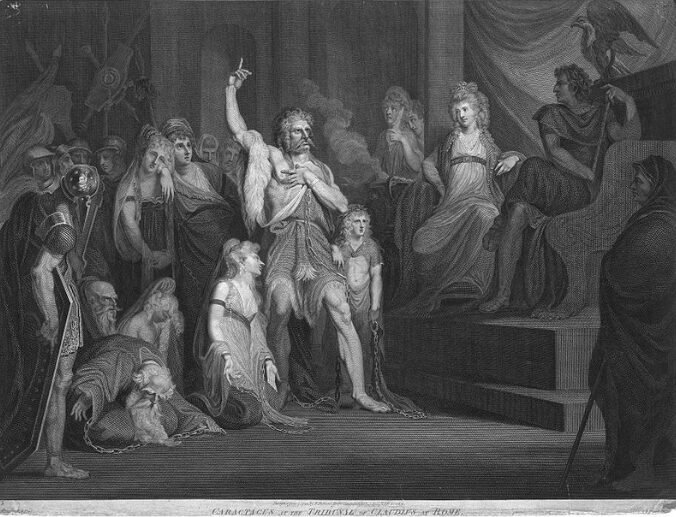
Andrew Birrell (after Henry Fuseli), Caractacus at the Tribunal of Claudius at Rome (1792)
Turmoil with Venutius
Cartimandua’s personal and political life became increasingly unstable after her betrayal of Caratacus. She was married to Venutius, who was initially a loyal ally to Rome. Together, they ruled the Brigantes, benefiting from Roman military support.
However, their partnership began to unravel in AD 57 when Cartimandua divorced Venutius and replaced him with his armor-bearer, Vellocatus. This decision, seen as scandalous by her contemporaries, alienated her husband and many within the Brigantes.
Known for political cunning, she divorced her husband and took a common soldier as her consort, sparking prolonged conflict.
Venutius responded by rallying opposition to Cartimandua. He built alliances with factions discontented with her leadership and staged a rebellion against her.
Although Cartimandua managed to capture some of his relatives as hostages, Venutius’s forces gained significant support. Roman troops, including the IX Hispana Legion under Caesius Nasica, were dispatched to assist her, enabling her to retain her throne temporarily. The intervention highlights the precariousness of her reign and her reliance on Roman support.
Year of the Four Emperors and Fall from Power
The most challenging period of Cartimandua’s reign came in AD 69, during the Roman Empire’s Year of the Four Emperors. This year of political chaos weakened Rome’s ability to support its allies.
Venutius capitalized on the instability, launching another revolt against Cartimandua. Lacking sufficient Roman reinforcements, she was forced to flee. The Romans managed to evacuate her safely, but Venutius seized control of the Brigantes, leaving the tribe in open conflict with Rome.
Cartimandua’s subsequent fate remains unknown, as she disappears from historical records after her evacuation. Her fall marked the end of a complex and turbulent reign, characterized by her attempts to navigate the shifting power dynamics between Rome and the local British tribes.
READ MORE: Roman Emperors who changed the course of history
Legacy and Controversy
Cartimandua’s legacy is a subject of significant debate among historians. On one hand, she is seen as a shrewd political leader who successfully aligned with the dominant Roman power to secure her position. Her betrayal of Caratacus and reliance on Roman support reflect her pragmatic approach to leadership in a time of great uncertainty. On the other hand, her personal decisions, such as divorcing Venutius and taking Vellocatus as her consort, alienated key supporters and contributed to her eventual downfall.
Tacitus portrays her in a negative light, emphasizing her perceived greed, betrayal, and personal scandals. However, his accounts are shaped by Roman biases, potentially exaggerating her flaws to serve a broader narrative about loyalty and morality under Roman rule.

Tacitus’s accounts depict Queen Cartimandua as a pragmatic but divisive figure, whose alliances with Rome ensured temporary stability but ultimately led to her downfall amidst internal and external conflict. Image: Statue of Roman historian Tacitus outside the Austrian Parliament Building, Vienna
The Role of Women in Celtic Leadership
Cartimandua’s reign also sheds light on the role of women in Celtic societies. Unlike in Rome, where political power for women was limited, Celtic tribes often recognized women as leaders. Cartimandua’s ability to rule independently and negotiate with Rome underscores the relatively high status of women in Brigantian culture. Her story highlights both the opportunities and challenges faced by female leaders in patriarchal and militarized societies.
READ MORE: When and why did the Romans leave Britain?
Conclusion
Cartimandua’s reign was marked by significant achievements and profound challenges. As a queen who navigated the complexities of Roman imperialism and local tribal dynamics, she left an indelible mark on British history. Her alignment with Rome ensured temporary stability, but her controversial decisions ultimately led to her loss of power.
Frequently Asked Questions about Queen Cartimandua
Who was Cartimandua, and which tribe did she rule?
Cartimandua was a 1st-century queen of the Brigantes, a Celtic tribe in northern Britain.
What suggests Cartimandua may have been ruling during Claudius’s conquest of Britain?
Claudius’s triumphal arch mentions British leaders who surrendered without a fight, potentially including Cartimandua, indicating she may have ruled as early as AD 43.
How did Cartimandua rise to power, according to Tacitus?
Tacitus describes her as of “illustrious birth,” implying she inherited her position rather than gaining it through marriage.
What does Cartimandua’s name mean, and what are its linguistic roots?
Her name derives from the Common Celtic roots carti- (“chase, expel”) and mandu- (“pony”).
What significant betrayal did Cartimandua commit in AD 51?
She handed over the British resistance leader Caratacus to the Romans after he sought her protection, securing wealth and favor from Rome.
Why was Cartimandua’s divorce from Venutius significant?
In AD 57, she divorced Venutius and took his armor-bearer, Vellocatus, as her consort. This scandalous act destabilized her rule and led to a series of conflicts.
How did Roman support influence Cartimandua’s ability to maintain power?
Roman military intervention, including troops led by Caesius Nasica and the IX Hispana Legion, helped her defeat Venutius’s rebellion and retain power temporarily.
What marked the end of Cartimandua’s reign?
During the Year of the Four Emperors (AD 69), Venutius capitalized on Roman instability to revolt again. With insufficient Roman reinforcements, Cartimandua was evacuated, and Venutius assumed control of the Brigantes. She disappears from historical records after this.





