Chief Justice Roger B. Taney
by World History Edu · November 27, 2024
Roger Brooke Taney (March 17, 1777 – October 12, 1864) was a significant figure in American legal and political history. His life and career were marked by accomplishments, controversy, and significant decisions that shaped the course of the United States, most notably his role as Chief Justice of our nation’s Supreme Court from 1836 until his death in 1864.
His legacy is deeply tied to his majority opinion in Dred Scott v. Sandford (1857), a ruling that has been widely condemned for its impact on slavery and its contribution to the Civil War.
Below, American historians at World History Edu provide an extensive overview of Taney’s life and career, highlighting his background, political ascent, judicial tenure, and lasting impact on American history.
Early Life and Education
Roger B. Taney was born into a prominent slaveholding family in Calvert County, Maryland. His father, Michael Taney, was a tobacco planter and a staunch Federalist.
The Taney family’s wealth and status afforded Roger access to an excellent education. He attended Dickinson College in Pennsylvania, graduating in 1795 as the class valedictorian. Taney then pursued a legal career, studying law under Judge Jeremiah Townley Chase in Annapolis, Maryland. He was admitted to the Maryland bar in 1799, marking the beginning of a distinguished legal career.
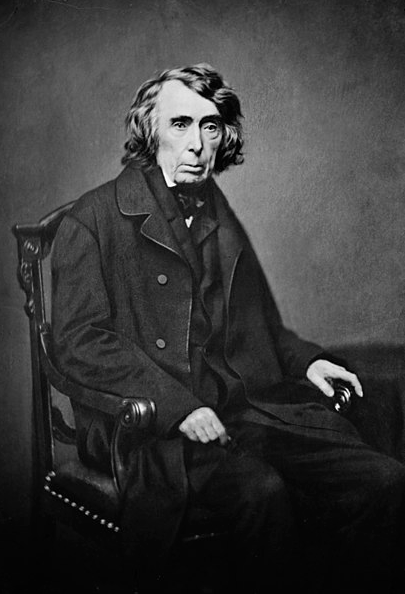
Image: A photo of Taney by American photographer Mathew Brady.
Early Political Career
Taney initially aligned himself with the Federalist Party, reflecting his family’s political leanings. In 1799, he was elected to the Maryland House of Delegates, beginning his political journey.
However, his Federalist affiliations waned after the War of 1812, which divided the party. The Federalists’ opposition to the war alienated Taney, who believed in the necessity of defending American sovereignty. This political disillusionment led him to switch allegiance to the Democratic-Republican Party, which was gaining dominance under figures like Thomas Jefferson and James Madison.
In 1816, Taney was elected to the Maryland Senate, where he built a reputation as an able politician and attorney. By the 1820s, Taney was recognized as one of Maryland’s most prominent lawyers, handling high-profile cases and earning respect for his legal acumen. His career took a significant step forward in 1827 when he was appointed Attorney General of Maryland.
Rise to National Prominence
Taney’s support for Andrew Jackson’s presidential campaigns in 1824 and 1828 brought him closer to the national stage. Jackson’s populist ideals resonated with Taney, who became a staunch ally of the future president.
When Jackson assumed office in 1829, Taney’s loyalty was rewarded with an appointment as U.S. Attorney General in 1831. In this role, Taney became a key member of Jackson’s administration, known for his vigorous support of Jackson’s policies.
One of the defining moments of Taney’s early national career was his involvement in the “Bank War,” a political struggle between President Jackson and proponents of the Second Bank of the United States. Jackson, distrustful of centralized financial institutions, sought to dismantle the Bank, and Taney played a pivotal role in this effort.
In 1833, Jackson appointed Taney as Secretary of the Treasury under a recess appointment, bypassing Senate confirmation. As Secretary, Taney facilitated the removal of federal funds from the Bank, a controversial move that solidified Jackson’s opposition to the institution but earned Taney considerable political enmity. When Jackson submitted Taney’s nomination to the Senate for confirmation, it was rejected, marking a rare setback in Taney’s career.
Appointment as Chief Justice
Despite this defeat, Taney’s fortunes changed when John Marshall, the long-serving Chief Justice of the Supreme Court, passed away in 1835. President Jackson nominated Taney to succeed Marshall. This nomination faced significant opposition due to Taney’s role in the Bank War and his perceived partisanship. However, with the Democrats controlling the Senate, Taney was confirmed in 1836, becoming the first Catholic to serve on the Supreme Court.
Taney’s ascension marked a shift in the Court’s ideological trajectory. Whereas John Marshall had championed strong federal authority, Taney’s tenure leaned more toward states’ rights. His jurisprudence reflected a delicate balance, seeking to preserve federal authority in some cases while emphasizing the autonomy of state governments in others.
Tenure as Chief Justice
Taney’s time on the Supreme Court saw several notable decisions that shaped American constitutional law. Early in his tenure, he delivered opinions that upheld the power of the federal government while respecting state sovereignty.
For instance, in Charles River Bridge v. Warren Bridge (1837), Taney ruled in favor of economic competition and against monopolistic privileges, emphasizing the need to adapt legal interpretations to public welfare and technological progress.
Despite these contributions, Taney’s legacy is overwhelmingly defined by the Dred Scott v. Sandford decision of 1857. This case arose from a lawsuit by Dred Scott, an enslaved man who sought his freedom based on his residence in free territories. Taney’s majority opinion not only denied Scott his freedom but also declared that African Americans, whether free or enslaved, could not be U.S. citizens.
Furthermore, the Dred Scott ruling invalidated the Missouri Compromise, stating that Congress lacked the authority to regulate slavery in federal territories. Taney believed this decision would settle the slavery debate once and for all. Instead, it had the opposite effect, deepening sectional divisions and energizing the anti-slavery movement in the North.
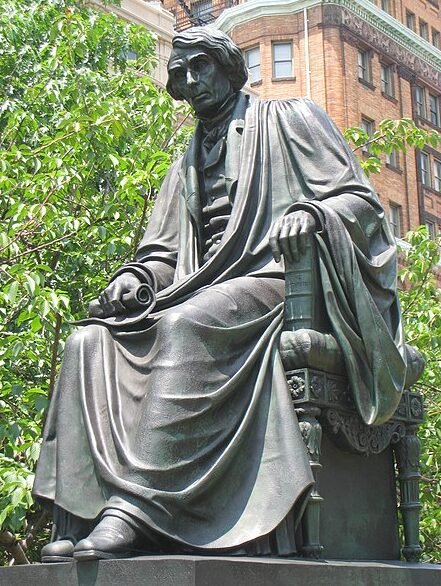
Image: Statue of Taney.
Personal Stance on Slavery
Taney’s personal views on slavery were complex. Although he was born into a slaveholding family, he emancipated his own slaves and provided pensions to elderly former slaves.
However, his actions as Chief Justice, particularly in the Dred Scott case, revealed a deep sympathy for Southern interests and a strong opposition to Northern attacks on slavery. Taney viewed slavery as a constitutionally protected institution and sought to shield it from federal interference.
Conflict with Abraham Lincoln
The outbreak of the Civil War in 1861 further complicated Taney’s legacy. As a Marylander with Southern sympathies, Taney opposed the secession of Southern states but remained critical of President Abraham Lincoln’s wartime policies. In Ex parte Merryman (1861), Taney ruled that Lincoln had exceeded his constitutional authority by suspending the writ of habeas corpus. This decision asserted the judiciary’s role as a check on executive power, but Lincoln ignored the ruling, reflecting the diminished influence of the Court during the national crisis.
Taney’s relationship with Lincoln remained strained throughout the war. The issuance of the Emancipation Proclamation in 1863 symbolized a direct repudiation of Taney’s legal positions on slavery. Isolated and increasingly powerless, Taney acknowledged his inability to counter the administration’s actions effectively.
Death and Legacy
Roger B. Taney died on October 12, 1864, as the Civil War was nearing its end. His passing went largely unremarked upon by President Lincoln, who appointed Salmon P. Chase as Taney’s successor. At the time of his death, Taney was widely reviled in the North for his role in the Dred Scott decision, while Southerners saw him as a defender of their constitutional rights.
Taney’s legacy remains one of the most controversial in American judicial history. While his tenure as Chief Justice included significant legal developments, such as his emphasis on balancing federal and state powers, these contributions are overshadowed by the Dred Scott ruling. Historians and legal scholars often cite the decision as the worst in the Supreme Court’s history, criticizing its flawed reasoning and its devastating impact on the nation.
Conclusion
Roger B. Taney’s life and career encapsulate the complexities of 19th-century America. From his privileged upbringing in Maryland to his rise as a prominent legal and political figure, Taney’s story reflects the nation’s struggles over slavery, federalism, and constitutional interpretation. His tenure as Chief Justice left an indelible mark on the Supreme Court and American history, but his legacy is marred by the Dred Scott decision, which contributed to the Civil War and tarnished his reputation.
Frequently Asked Questions
What was the significance of the Dred Scott v. Sandford decision?
The decision ruled that African Americans could not be U.S. citizens and declared Congress lacked the authority to prohibit slavery in U.S. territories, intensifying sectional tensions and contributing to the onset of the Civil War.
What was Taney’s early political affiliation?
Taney was initially a member of the Federalist Party but later broke with the party due to its opposition to the War of 1812. He subsequently joined the Democratic-Republican Party.
What positions did Taney hold before becoming Chief Justice?
Taney served as a member of the Maryland House of Delegates, Maryland Senate, Attorney General of Maryland, U.S. Attorney General, and Secretary of the Treasury under President Andrew Jackson.
How did Taney become Chief Justice of the Supreme Court?
President Andrew Jackson nominated Taney to replace John Marshall as Chief Justice in 1835. His nomination was approved after Democrats gained control of the Senate.
What was Taney’s role in the “Bank War”?
As Secretary of the Treasury, Taney supported Andrew Jackson in dismantling the Second Bank of the United States, a contentious issue during Jackson’s presidency.

Image: Engraving of Taney.
How did Taney’s jurisprudence differ from that of his predecessor, John Marshall?
Taney’s decisions marked a shift toward emphasizing states’ rights while still recognizing federal authority, though not as strongly as Marshall’s federalist principles.
What was Taney’s personal stance on slavery?
While Taney emancipated his own slaves and provided pensions to elderly former slaves, he was sympathetic to Southern interests and opposed Northern criticism of slavery.
How did the Dred Scott decision impact Taney’s legacy?
The Dred Scott ruling is widely regarded as one of the worst Supreme Court decisions, tarnishing Taney’s legacy due to its flawed legal reasoning and its role in deepening the sectional divide.
What was Taney’s stance during the Civil War?
Taney sympathized with the Southern states but remained on the Supreme Court. He frequently clashed with President Lincoln over constitutional authority, particularly in cases like Ex parte Merryman.
What was Taney’s ruling in Ex parte Merryman?
In Ex parte Merryman, Taney ruled that President Lincoln exceeded his constitutional powers by suspending the writ of habeas corpus during the Civil War, a decision Lincoln ignored.
How did Taney’s influence diminish during the Civil War?
Lincoln’s administration repeatedly ignored Taney’s rulings, including his stance on habeas corpus and his opposition to the Emancipation Proclamation, reflecting the diminished power of the judiciary during wartime.
What happened after Taney’s death?
Taney died in 1864, and President Lincoln appointed Salmon P. Chase as his successor. His death was largely unremarked upon by Lincoln, and Taney’s legacy remains controversial due to his role in the Dred Scott decision.





