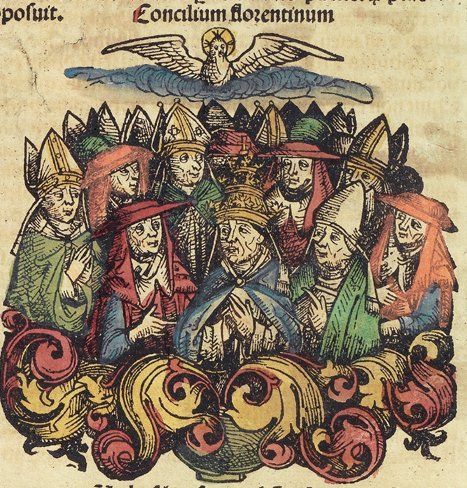
The Council of Florence as depicted in the “Nuremberg Chronicle” (1493).
The Council of Florence, the seventeenth ecumenical council recognized by the Catholic Church, took place between 1431 and 1449. Initially convened as the Council of Basel, it was convoked by Pope Martin V shortly before his death in February 1431.
The council occurred within the broader contexts of the Hussite Wars in Bohemia and the rising Ottoman threat. The primary issue at stake was the conflict between the conciliar movement, which emphasized the supremacy of church councils, and the principle of papal supremacy.
The Council of Florence evolved through multiple phases, changing locations and objectives, eventually striving for an ephemeral union between the Eastern Orthodox and Roman Catholic Churches.
Background and Convocation
The decision to hold the council in Basel, part of the Holy Roman Empire, reflected a desire to avoid undue influence from the Pope, the Emperor, or the kings of France and Aragon.
Pope Martin V, under pressure to implement church reforms, sanctioned the council following the precedent set by the Council of Constance (1414–1418). However, Martin died before the council commenced, and his successor, Pope Eugene IV, inherited the responsibility.
The council opened on December 14, 1431, presided over by Cardinal Julian Cesarini. At its inception, only a few bishops and abbots attended. However, as the council gained momentum, its composition expanded, allowing members of the lower clergy to have significant influence. This growing democratic nature of the council set it on a collision course with the papacy.
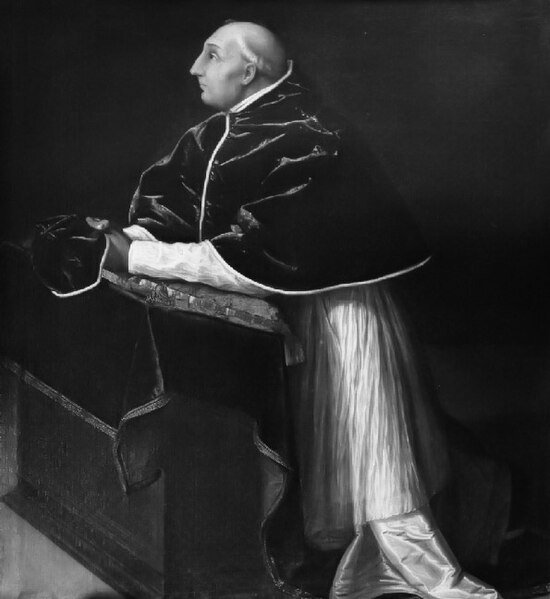
Pope Martin V
Council of Basel and Early Conflicts
From the outset, the Council of Basel adopted a position of superiority over the Pope. In December 1431, Pope Eugene IV attempted to dissolve it, seeking instead to transfer the council to Bologna, an Italian territory more favorable to papal authority.
However, the council defied the Pope and continued its proceedings. The assembly declared itself the highest authority in the Church, a stance rooted in the conciliarist ideology emerging from the Council of Constance.
The council also sought to address the Hussite heresy in Bohemia. King Sigismund of Hungary, recently crowned Holy Roman Emperor, had suffered a major defeat at the hands of the Hussites in 1431. Under his auspices, the council negotiated a temporary agreement with moderate Hussites, known as the Calixtines, in 1433. This settlement, however, failed to establish long-term stability.
Transition to Ferrara and Florence
By 1437, after the death of Emperor Sigismund, Pope Eugene IV took decisive action to undermine the Council of Basel. He transferred the council to Ferrara on January 8, 1438, effectively creating a competing assembly. The primary reason for this move was to facilitate negotiations with the Eastern Orthodox Church regarding a potential union. Some members of the council refused to accept the transfer and remained in Basel, forming a “rump council” that later declared Eugene IV a heretic and elected an antipope, Felix V, in 1439.
Due to an outbreak of plague in Ferrara, the council relocated once more, this time to Florence in 1439. The move proved advantageous, as Florence provided financial support in return for ecclesiastical prominence. This phase of the council became particularly significant in the history of East-West relations within Christianity.
Union with the Eastern Orthodox Church
The most notable achievement of the Council of Florence was its temporary reconciliation between the Roman Catholic and Eastern Orthodox Churches.
Delegates from Constantinople, including Byzantine Emperor John VIII Palaiologos and Patriarch Joseph II of Constantinople, engaged in theological discussions with Latin representatives. Key doctrinal disputes, including the Filioque clause in the Nicene Creed, papal primacy, and the nature of Purgatory, were central points of contention.
On July 6, 1439, the decree Laetentur Caeli (“Let the Heavens Rejoice”) was signed, officially proclaiming the union of the two churches. While many Eastern bishops signed the agreement, opposition remained strong, particularly from Mark of Ephesus, who became the leading voice against the union upon returning to Byzantium. In Russia, the Orthodox Church outright rejected the agreement, declaring itself independent of Constantinople.
Ultimately, despite the diplomatic victory for the papacy, the union was never fully realized. When Constantinople fell to the Ottoman Empire in 1453, any remaining hope for unity dissipated.
The Rump Council of Basel and Its Demise
While the Council of Florence pursued reconciliation with the Eastern Church, the rump Council of Basel continued to challenge papal authority. In 1439, it elected Amadeus VIII, Duke of Savoy, as Pope Felix V.
However, Felix V’s influence remained minimal, and by 1447, Frederick III, the Holy Roman Emperor, ordered Basel to expel the council. The remaining members regrouped in Lausanne before officially dissolving in 1449.
The council’s defeat of conciliarism cemented the primacy of the Pope, shaping the governance of the Catholic Church for centuries.
Felix V abdicated the papal claim in 1449, marking the end of the conciliar challenge to papal supremacy. The subsequent Pope, Nicholas V, ensured that the authority of the papacy remained intact.
Reforms and Doctrinal Decisions
Beyond the East-West union, the Council of Florence addressed several theological and disciplinary issues:
- Papal Primacy – The council affirmed the Pope’s universal and supreme jurisdiction over the entire Church, reinforcing the doctrine of papal primacy.
- Sacraments – It established that there were seven sacraments, a significant clarification amid earlier debates on the matter.
- Filioque Clause – The council declared that the Holy Spirit proceeds from both the Father and the Son, a stance opposed by the Eastern Church.
- Purgatory – The Latin Church’s understanding of Purgatory was formalized as a doctrine.
- Dietary Laws – The council determined that the apostolic decree restricting the consumption of blood and strangled animals, issued in the Book of Acts, was no longer binding on Christian converts.
Long-Term Impact
While the Council of Florence failed to achieve lasting East-West unity, its legacy influenced both ecclesiastical and geopolitical developments:
The defeat of the conciliar movement ensured that future ecumenical councils would function under papal authority rather than as independent governing bodies.
The council facilitated cultural and intellectual exchanges, particularly as Greek scholars introduced classical learning to Italy, influencing the Renaissance.
The failure of the East-West union solidified the independence of the Russian Orthodox Church and reaffirmed the Eastern Orthodox resistance to papal claims.
Frequently Asked Questions
What was the main purpose of the Council of Florence?
The Council aimed to resolve the conflict between conciliarism and papal supremacy while negotiating a reunion between the Catholic and Eastern Orthodox Churches.
Why did the Council move from Basel to Florence?
Pope Eugene IV transferred it to Ferrara in 1438 to facilitate talks with the Eastern Orthodox Church, and later to Florence due to a plague outbreak in Ferrara and financial support from Florence.
What was the outcome of the Council’s negotiations with the Eastern Orthodox Church?
The council achieved a temporary union, formalized in Laetentur Caeli in 1439, but the agreement was widely rejected in the East, particularly by the Russian Orthodox Church and Mark of Ephesus.
How did the Council of Florence impact the conciliar movement?
It marked the decline of conciliarism by reaffirming papal supremacy and ultimately led to the dissolution of the rival Council of Basel.
What were some key theological decisions made at the Council?
It affirmed papal primacy, the Filioque clause, the doctrine of Purgatory, and the number of sacraments as seven.
What happened to the Council of Basel after the move to Florence?
A faction remained in Basel, declared Pope Eugene IV a heretic, and elected an antipope, Felix V. This schism lasted until 1449 when Felix V abdicated.
What was the political significance of the Council?
It strengthened papal authority and facilitated cultural exchanges that contributed to the Renaissance, particularly through the influence of Greek scholars.
Did the Council of Florence achieve lasting unity between the Catholic and Orthodox Churches?
No, despite initial agreements, the union was rejected in the East, and the fall of Constantinople in 1453 cemented the division.





