David Lloyd George: Life and Major Accomplishments as Prime Minister of the United Kingdom
David Lloyd George, 1st Earl Lloyd-George of Dwyfor, was one of the most significant British political figures of the early 20th century. His life and career were marked by a rise from humble beginnings to the highest office in the land, navigating a time of tremendous change for the United Kingdom, Europe, and the world.
Lloyd George’s leadership during World War I, his social reforms, and his efforts to reshape the post-war global order through his participation in the Paris Peace Conference of 1919 are among his most notable contributions. He was also instrumental in negotiating the establishment of the Irish Free State, and he played a central role in transforming the United Kingdom’s political and social landscape.
READ MORE: Greatest British Prime Ministers of All Time
Early Life and Background
David Lloyd George was born on January 17, 1863, in Manchester, England, to Welsh parents. His father, William George, was a schoolteacher, but he died when David was very young. The family returned to their native Wales, where Lloyd George was raised by his mother and her brother, Richard Lloyd, a shoemaker and Baptist minister. It was in this modest, Nonconformist environment in rural Wales that Lloyd George developed many of the values that would shape his political career—religious nonconformity, Welsh nationalism, and a deep sympathy for the working classes.
Lloyd George’s early education took place in Llanystumdwy, a village in North Wales, and despite the family’s financial struggles, his uncle Richard encouraged him to pursue a legal career. Lloyd George was articled to a firm of solicitors in 1879 and was admitted to the bar in 1884. This career path allowed him to develop the skills of argument, oration, and advocacy that would serve him well in his future political career.
Early Political Career
Lloyd George’s political career began in earnest in 1890 when he was elected as the Member of Parliament (MP) for Caernarvon Boroughs, a Welsh constituency, following a by-election. He would hold this seat for the next 55 years, demonstrating both his deep connection to his Welsh roots and his enduring political resilience. As an MP, he quickly made a name for himself as an advocate for Welsh nationalism, land reform, and the disestablishment of the Church of England in Wales, which he viewed as an unjust imposition on the largely Nonconformist Welsh population.
Lloyd George was also a firm believer in social justice and was aligned with the Radical wing of the Liberal Party. He supported reforms aimed at improving the lives of working-class people, including land reforms to benefit tenant farmers and laborers. His passionate speeches and ability to articulate the grievances of the marginalized earned him a reputation as a skilled orator and political agitator.
In 1905, Lloyd George was appointed President of the Board of Trade in Sir Henry Campbell-Bannerman’s government. This marked the beginning of his ascent to higher office within the British government.
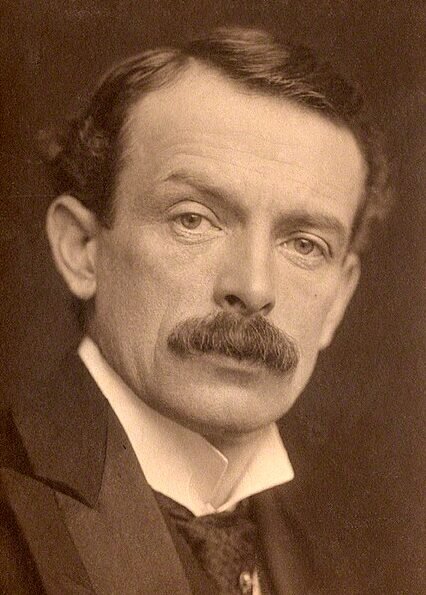
Image: David George in 1902.
Chancellor of the Exchequer and Domestic Reforms
In 1908, after H. H. Asquith succeeded Campbell-Bannerman as Prime Minister, Lloyd George was appointed Chancellor of the Exchequer. As Chancellor, Lloyd George oversaw some of the most significant social and economic reforms in early 20th-century Britain. His most famous initiative was the “People’s Budget” of 1909, which aimed to fund extensive social welfare programs, including pensions and unemployment benefits, through increased taxes on landowners and the wealthy.
The budget was highly controversial and was initially rejected by the Conservative-dominated House of Lords, leading to a constitutional crisis. The resulting political battle between the House of Commons and the Lords culminated in the passing of the Parliament Act of 1911, which significantly curtailed the powers of the House of Lords, preventing them from blocking money bills and other legislation approved by the Commons.
Lloyd George’s reforms laid the foundation for the modern welfare state. His National Insurance Act of 1911 introduced unemployment and health insurance for workers, a landmark development in British social policy. Although these measures were criticized by the upper classes and conservative factions, they were immensely popular among the working-class population.
World War I and the Ministry of Munitions
When World War I broke out in 1914, Lloyd George initially continued to serve as Chancellor of the Exchequer. However, as the war progressed and Britain faced increasing challenges in mobilizing its resources, he was appointed Minister of Munitions in 1915 in the coalition government led by Asquith. In this role, Lloyd George displayed his organizational prowess and ability to navigate complex political and economic challenges. He dramatically increased the production of artillery shells, ensuring that British troops were better equipped in the trenches.
By the middle of the war, it became increasingly clear that Asquith’s leadership was faltering, with military setbacks and growing public dissatisfaction over the government’s handling of the war effort. Lloyd George, who had been growing more critical of Asquith’s leadership, positioned himself as a more dynamic and proactive leader.
Prime Minister During World War I
In December 1916, Asquith was forced to resign as Prime Minister, and Lloyd George took over as the head of a wartime coalition government. As Prime Minister, Lloyd George centralized authority and created a smaller, more efficient war cabinet, which helped streamline decision-making during the critical final years of the war. He also played a key role in organizing the convoy system, which helped protect British merchant ships from German U-boat attacks, a major threat to Britain’s food and supply lines.
One of the most controversial decisions of Lloyd George’s wartime leadership was his support for the Nivelle Offensive in 1917, a disastrous French military operation that resulted in heavy casualties. However, Lloyd George’s ability to work across party lines and unite Britain’s military and political leadership helped him maintain public confidence. He also successfully pushed for the appointment of Ferdinand Foch as the Supreme Allied Commander, which helped unify the Allied military command and contributed to the eventual victory over Germany in November 1918.
Post-War Leadership and the Paris Peace Conference
After the war, Lloyd George’s leadership was rewarded in the “Coupon Election” of December 1918, in which he led a coalition government supported by both Liberals and Conservatives. The election gave Lloyd George a mandate to oversee the peace negotiations at the Paris Peace Conference of 1919. He played a major role in shaping the Treaty of Versailles, which formally ended the war with Germany.
At the conference, Lloyd George faced a difficult balancing act. He sought to impose significant penalties on Germany, which had been the primary aggressor in the war, but he also recognized the importance of rebuilding Europe and preventing future conflicts. His approach contrasted with the more punitive stance of French Prime Minister Georges Clemenceau, who wanted to cripple Germany permanently, and U.S. President Woodrow Wilson’s idealistic vision of a world order based on self-determination and the League of Nations. Lloyd George’s pragmatism ultimately helped shape a peace settlement that, while flawed, reflected a compromise between these competing visions.
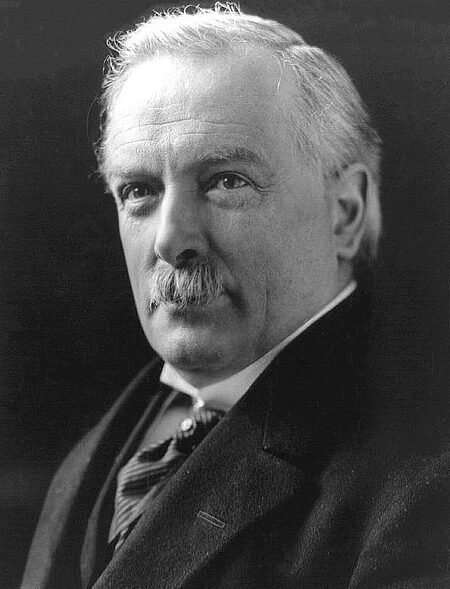
During his final years, Lloyd George withdrew from active politics, only briefly returning to the public eye during World War II. Image: George in 1919.
Domestic Challenges and the Irish Question
Lloyd George’s post-war government faced numerous domestic challenges. The British economy, like those of many European nations, was in poor shape after the war. Inflation, rising unemployment, and industrial unrest created a tense political climate. Lloyd George’s administration implemented reforms in housing and education, but these measures were often overshadowed by the economic difficulties of the post-war period.
One of the most pressing issues facing Lloyd George’s government was the situation in Ireland. The Irish War of Independence broke out in 1919, pitting Irish republicans, led by Sinn Féin and the Irish Republican Army (IRA), against British forces. Lloyd George initially attempted to suppress the rebellion through military force, but the violence escalated, and the conflict became increasingly brutal.
In 1921, after years of bloodshed, Lloyd George negotiated the Anglo-Irish Treaty, which established the Irish Free State as a self-governing dominion within the British Empire. While the treaty marked a significant step toward resolving the Irish question, it also caused deep divisions within Ireland and the British political establishment. Irish nationalists were split between those who accepted the treaty and those who wanted full independence from Britain, leading to the Irish Civil War in 1922.
Fall from Power and Later Career
Lloyd George’s tenure as Prime Minister came to an end in 1922. A series of scandals, including accusations of selling honors, damaged his reputation. Additionally, his handling of the Chanak Crisis, a diplomatic conflict with Turkey that almost led to war, further eroded his support among the Conservative members of his coalition government. At a meeting at the Carlton Club, Conservative MPs voted to withdraw from the coalition, forcing Lloyd George to resign.
Despite his resignation, Lloyd George remained active in politics. He continued to lead a faction of the Liberal Party and advocated for public works programs to address unemployment during the economic depression of the 1920s. However, the Liberal Party was in decline, and Lloyd George’s influence waned. He led the Liberals from 1926 to 1931 but made only modest gains in the 1929 election.
By 1931, Lloyd George was heading a small group of Liberals opposed to the National Government, a coalition of Conservative, Labour, and Liberal politicians. He continued to push for social and economic reforms but remained on the political fringes during this period.
Final Years and Legacy
Lloyd George’s final years were marked by a retreat from active politics, though he briefly reemerged during World War II. When Winston Churchill formed a coalition government in 1940, Lloyd George was offered a position in the War Cabinet, but he declined, feeling that his role would be largely symbolic.
In 1945, shortly before his death, Lloyd George was elevated to the peerage as the 1st Earl Lloyd-George of Dwyfor. He passed away on March 26, 1945, at the age of 82.
David Lloyd George’s legacy is complex and multifaceted. He was a brilliant and pragmatic leader whose vision for social reform helped shape the modern welfare state. His role in navigating Britain through the final years of World War I and in shaping the post-war peace settlement was critical to the country’s future. However, his career was also marked by controversy, particularly over his handling of the Irish question, his involvement in political scandals, and his role in the troubled peace settlement at Versailles, which many historians argue sowed the seeds for World War II.
Nonetheless, Lloyd George remains one of Britain’s most important and influential Prime Ministers, remembered for his dynamism, his ability to navigate the complexities of wartime leadership, and his enduring impact on British politics and society. As the last Liberal Prime Minister, his career also marks the end of an era in British politics, as the Liberal Party, which had dominated much of the 19th century, gradually fell into decline, overtaken by the Labour and Conservative parties
Questions and Answers
What was Lloyd George’s role during World War I?
Lloyd George became Prime Minister in 1916 during World War I. He streamlined decision-making by creating a smaller war cabinet, implemented the convoy system to combat food shortages, introduced rationing, and played a key role in unifying Allied command, contributing to the eventual Allied victory in 1918.
What significant policies did Lloyd George advocate for as a Liberal politician?
Lloyd George was known for his radical Liberal policies, advocating for Welsh devolution, the disestablishment of the Church of England in Wales, land ownership reform, and equality for laborers and tenant farmers.
What was the “People’s Budget” and why was it significant?
The “People’s Budget,” introduced by Lloyd George in 1909 as Chancellor of the Exchequer, aimed to fund welfare reforms through taxes on land ownership and high incomes. The budget was rejected by the House of Lords, leading to a constitutional crisis and the eventual passage of the Parliament Act in 1911, which reduced the power of the Lords.
What role did Lloyd George play at the Paris Peace Conference?
After World War I, Lloyd George was a leading figure at the Paris Peace Conference in 1919, where he helped shape the post-war settlement, including the Treaty of Versailles, which dealt with the aftermath of the war and future international relations.
How did Lloyd George handle the situation in Ireland?
During Lloyd George’s tenure, the Irish War of Independence broke out, leading to violent conflict between British forces and Irish nationalists. In 1921, Lloyd George negotiated the establishment of the Irish Free State, granting independence to Ireland while maintaining a constitutional link to the British crown.
What caused Lloyd George’s fall from power in 1922?
Lloyd George’s political downfall in 1922 was triggered by a scandal over the sale of honors and the Chanak Crisis, a diplomatic conflict with Turkey. These issues weakened his position, and the Conservative Party decided to end their coalition with the Liberals, leading to his resignation.
What were some of Lloyd George’s accomplishments in domestic policy?
Domestically, Lloyd George introduced significant reforms in education and housing. He also implemented welfare reforms through the National Insurance Act of 1911, which helped establish the modern welfare state.
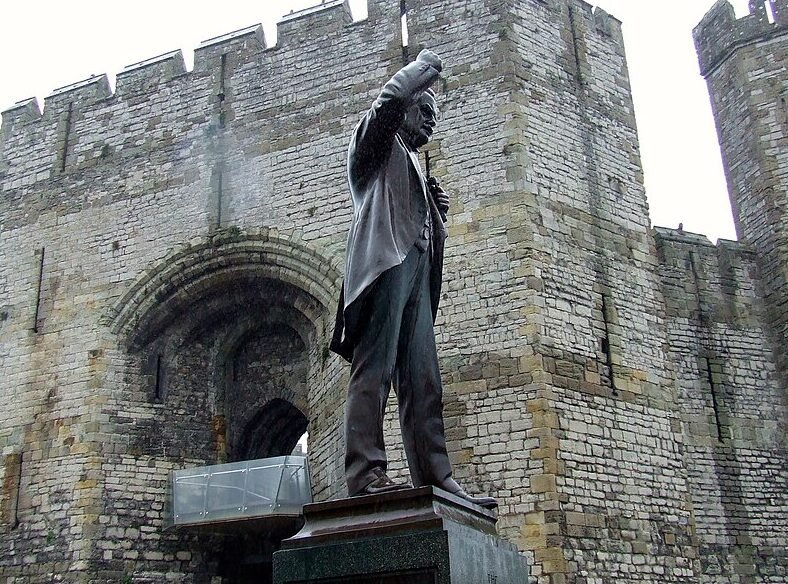
Image: Statue of George at Caernarfon Castle
What happened to Lloyd George’s political career after his resignation in 1922?
After resigning as Prime Minister, Lloyd George remained the leader of a faction of the Liberal Party. He attempted a reunion with Asquith’s faction in 1923 and led the weakened Liberal Party from 1926 to 1931. However, his influence waned, and by 1931, he led a small group of breakaway Liberals opposed to the National Government.
How did Lloyd George’s career end, and what was his legacy?
Lloyd George declined to join Winston Churchill’s War Cabinet in 1940 and was elevated to the peerage as the 1st Earl Lloyd-George of Dwyfor shortly before his death in 1945. His legacy includes his role as a dynamic reformer, a wartime leader, and the last significant figure of the Liberal Party in British politics.





