Diana of Versailles: History and Mjaor Facts
The Diana of Versailles, a slightly larger-than-life marble statue of Diana (Artemis in Greek mythology), was created as a Roman copy of a lost Greek bronze original by Leochares, dating to around 325 BCE. The Roman replica, made in the 1st or 2nd century CE, reflects the enduring influence of Greek artistic traditions on Roman culture.
READ MORE: 10 Most Famous Ancient Greek Sculptors and their Accomplishments
The statue was gifted to Henry II of France in 1556 by Pope Paul IV. Its symbolism carried personal significance, as Diana, the goddess of the hunt, evoked subtle associations with the king’s mistress, Diane de Poitiers. Likely discovered in Italy, some speculate it was found at the Temple of Diana at Nemi, while others suggest Hadrian’s Villa in Tibur (modern Tivoli).
In the late 16th century, the statue became a centerpiece of the Jardin de la Reine at the Château de Fontainebleau, among the first Roman sculptures displayed in France. By 1602, Henri IV moved it to the Louvre‘s Salle des Antiques, where it was restored by Barthélemy Prieur.
In 1696, Louis XIV relocated it to the Grande Galerie of Versailles, cementing its status as a symbol of royal opulence. During the French Revolution, the statue returned to the Louvre in 1798, where it remains today. A later restoration was completed by Bernard Lange in 1802.
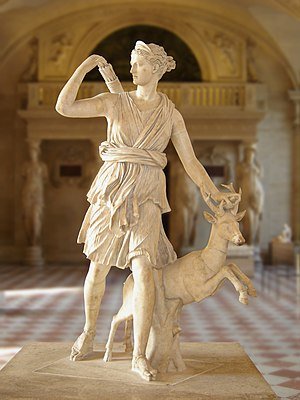
The Diana of Versailles is a slightly larger-than-life marble statue of Diana (Artemis in Greek mythology), the Roman goddess of the hunt, currently housed in the Musée du Louvre, Paris.
READ MORE: Most Powerful Ancient Greek Gods and Goddesses
Description of the Statue
The Diana of Versailles portrays the goddess in a dynamic, forward-moving pose, as though hunting. Her right arm, raised to retrieve an arrow from her quiver, conveys energy and readiness, while her restored left arm appears to hold part of what may have been a bow. At her feet stands a deer, although some scholars suggest a dog, as a traditional hunting companion, might have been more appropriate.
Diana is dressed in a short Dorian chiton, tied at the waist with a himation, a style that emphasizes her active role as a huntress. She also wears sandals, completing her athletic and purposeful appearance. A unique feature of the statue is her Morton’s toe, where the second toe is longer than the big toe—a small but intriguing detail that adds realism to the sculpture.
The statue, slightly over life-sized, demonstrates a harmonious balance between movement and grace, typical of Greek classical art. Its restoration efforts over the centuries, including adjustments to the arms and deer, reflect its long and varied history of appreciation and reinterpretation.
Significance in French Royal Collections
The Diana of Versailles holds a central place in French art history as one of the first Roman sculptures introduced to France, marking the Renaissance fascination with classical antiquities. Its installation at Fontainebleau’s Jardin de la Reine symbolized the growing prestige of French royal collections. Its later move to the Louvre’s Salle des Antiques further elevated its importance, positioning it as a centerpiece of French artistic and cultural heritage.
Under Louis XIV, the statue became an emblem of royal grandeur, displayed prominently in the Grande Galerie at Versailles. By the time of the French Revolution, its return to the Louvre underscored its role as a national treasure, representing France’s dedication to preserving classical art.
Fountain of Diana at Fontainebleau
When the statue was moved from Fontainebleau in 1605, a bronze replica by Barthélemy Prieur replaced it as part of an elaborate fountain. The fountain, designed by Tommaso Francini, included hunting-themed elements such as bronze dogs and stag heads sculpted by Pierre Biard, reflecting Diana’s association with the hunt.
A 1684 bronze copy of the Diana of Versailles was installed on the garden fountain at the Château de Fontainebleau in 1813.
During the French Revolution, Prieur’s bronze replica was transferred to the Louvre but later gifted by Napoleon to Empress Joséphine for her Château de Malmaison. Another bronze cast by the Keller brothers in 1684 was installed at Fontainebleau in 1813. These replicas ensured Diana’s continued presence at the historic site, highlighting her enduring legacy in French art and landscape design.
Replicas and Artistic Legacy
The Diana of Versailles inspired numerous replicas throughout Europe, cementing its status as a classical icon. Roman replicas have been found in Leptis Magna (Libya), Antalya (Turkey), and Annaba (Algeria), demonstrating the widespread influence of the original Greek model.
In the 17th century, a bronze replica was crafted by Hubert Le Sueur for Charles I of England, while a marble copy by Guillaume Coustou was made for Marly in 1710. By the 18th century, smaller replicas in bronze, plaster, and lead became popular, showcasing the statue’s appeal across artistic mediums.
In a surprising modern connection, a miniature replica of the Diana of Versailles adorned the Titanic’s first-class lounge. This replica, photographed on the seafloor in 1986, adds a unique layer to the statue’s cultural significance and its journey through history.
Cultural and Artistic Significance
The Diana of Versailles exemplifies the fusion of Greek artistic ideals with Roman reinterpretation. Its dynamic pose, detailed attire, and lifelike proportions reflect the classical Greek focus on harmony, movement, and balance, while its Roman origins highlight the adaptation of Greek themes to suit a new cultural context.
In France, the statue symbolized the monarch’s authority and sophistication, while its placement in royal gardens and palaces reflected the Renaissance revival of classical antiquity. Over centuries, it became an icon of French artistic achievement, bridging ancient heritage with modern appreciation.
Today, the Diana of Versailles remains a masterpiece, celebrated not only for its aesthetic qualities but also for its historical journey—from ancient sanctuaries and Italian villas to royal collections and public museums. It continues to inspire admiration, study, and artistic replication, securing its place as one of the world’s most enduring symbols of mythological and artistic excellence.
Questions and Answers about the Diana of Versailles
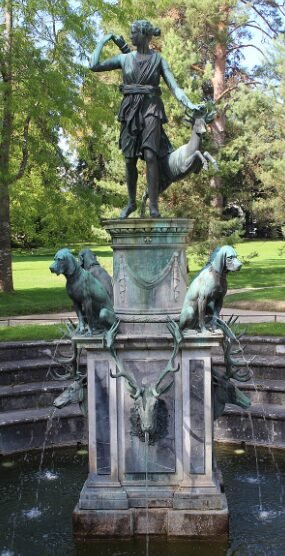
The 1684 bronze copy of the Diana of Versailles at the Château de Fontainebleau
What is the statue’s origin?
The statue is a 1st or 2nd century CE Roman copy of a lost Greek bronze original attributed to ancient Greek sculptor Leochares, dating to around 325 BCE.
How is Diana depicted in the statue?
Diana is shown in motion, reaching for an arrow from her quiver with her raised right arm, possibly holding a bow in her restored left hand, with a deer at her feet. She wears a short Dorian chiton, a himation, and sandals.
What unique detail is seen in the statue?
Diana’s second toes are longer than her big toes, a condition known as Morton’s toe.
What is the historical significance of the statue in France?
Gifted by Pope Paul IV to Henry II of France in 1556, it became one of the first Roman sculptures displayed in France and was central to the Jardin de la Reine at Château de Fontainebleau.
Where has the statue been displayed?
Initially at Fontainebleau, it was moved to the Louvre in 1602, later to Versailles in 1696, and returned to the Louvre in 1798.
What is the connection to the Fountain of Diana at Fontainebleau?
A bronze replica of the statue was created in 1605 by Barthélemy Prieur to replace the original at Fontainebleau, forming part of a fountain with hunting-themed sculptures.
Are there other notable replicas?
Roman replicas exist at Leptis Magna, Antalya, and Annaba. Modern replicas include a 1634 bronze for Charles I of England and an 18th-century marble copy by Guillaume Coustou.
What is the Titanic connection?
A miniature replica of the statue was displayed in the Titanic’s first-class lounge. It was photographed on the seafloor in 1986, with plans for recovery following its rediscovery in 2024.





