Ancient Greek Sculptor Leochares
Leochares was a prominent sculptor from Athens, active during the 4th century BC. Renowned for his contributions to monumental and portrait sculpture, he played a significant role in defining the classical Greek artistic tradition. His works demonstrate a blend of technical mastery, realism, and idealized beauty, which influenced both his contemporaries and subsequent Roman artists.
Early Life and Career
Little is known about Leochares’ early life, but he emerged as one of the leading sculptors of the late Classical period in Greece. His career coincided with a flourishing era in Greek art when sculptors were pushing the boundaries of realism and anatomical precision. He worked on both large-scale public projects and smaller, more intimate pieces, earning a reputation for his craftsmanship and versatility.
The Mausoleum of Mausolos

Seven Wonders of the ancient world – Mausoleum at Halicarnassus
One of Leochares’ most notable contributions was to the Mausoleum of Mausolos at Halicarnassus, one of the Seven Wonders of the Ancient World. This grand structure, built as a tomb for the Persian satrap Mausolos, showcased the collaborative efforts of several Greek sculptors. Leochares’ work on the Mausoleum solidified his status as a master of monumental art. His contributions likely included intricate reliefs or freestanding statues that adorned the mausoleum’s exterior, reflecting the grandeur and artistic innovation of the project.
Diana of Versailles
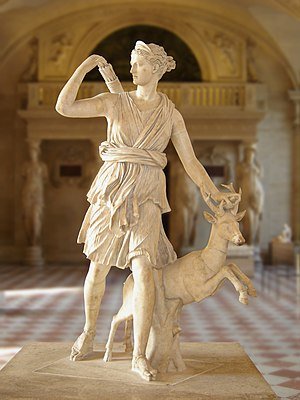
The Diana of Versailles, a marble statue of Diana with a deer, is a Roman copy of a lost Greek bronze by Leochares, housed in the Louvre. Image: Diana of Versailles
The Diana of Versailles is a Roman copy of an original sculpture attributed to Leochares around 325 BC. This statue depicts Artemis, the Greek goddess of the hunt, in a poised and dynamic stance, capturing a sense of movement and grace. The original, now lost, exemplified Leochares’ skill in portraying divine figures with a balance of power and elegance. The Roman reproduction, housed in the Louvre Museum, continues to be admired for its lifelike qualities and fluid design.
Apollo Belvedere
Leochares is often credited as the creator of the iconic Apollo Belvedere. While the original Greek bronze is lost, the surviving Roman marble copy resides in the Vatican Museums. This sculpture, depicting the Greek god Apollo as an archer, showcases Leochares’ ability to combine idealized beauty with dynamic motion. Apollo is depicted in a contrapposto stance, emphasizing the grace and poise characteristic of classical Greek sculpture. The Apollo Belvedere became a symbol of neoclassical ideals during the Renaissance and Enlightenment, celebrated for its “noble simplicity and quiet grandeur.”
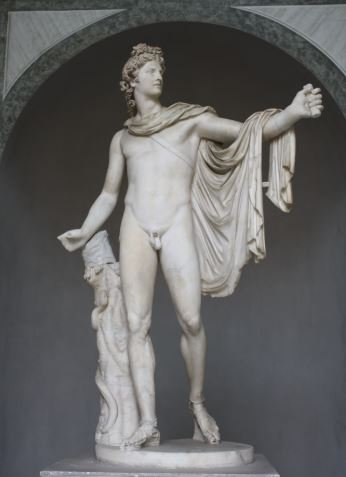
The Apollo Belvedere, a Roman copy of a Greek bronze by Leochares, rediscovered in Italy, symbolizes classical beauty and neoclassical aesthetic ideals. Image: Apollo del Belvedere
READ MORE: Most Powerful Ancient Greek Gods and Goddesses
Portrait Sculptures of Macedonian Royalty
Leochares also excelled in portraiture, creating ivory and gold statues of the Macedonian royal family. His most famous works in this genre included portraits of Philip II of Macedon, Alexander the Great, Amyntas III, Olympias, and Eurydice I. These statues were displayed in the Philippeion, a circular memorial at Olympia, built by Philip II to commemorate his victory at the Battle of Chaeronea in 338 BC. These portraits not only highlighted Leochares’ technical skill but also captured the grandeur and authority of his subjects, emphasizing their divine and heroic status.
Artistic Style and Techniques
Leochares’ style combined realism with idealism, focusing on anatomical accuracy and harmonious proportions. His sculptures often depicted gods and mortals in fluid, dynamic poses, showcasing movement and balance. His attention to detail, particularly in rendering clothing, musculature, and expressions, added a lifelike quality to his works. He also demonstrated an ability to convey narrative through his statues, making them deeply expressive and engaging.
Influence on Roman and Renaissance Art
The works of Leochares profoundly influenced Roman art, as evidenced by the numerous copies of his sculptures made during the Roman Empire. These reproductions preserved his artistic vision and ensured his legacy endured. During the Renaissance, Leochares’ sculptures, particularly the Apollo Belvedere, inspired artists like Michelangelo and Albrecht Dürer. The neoclassical movement of the 18th century also celebrated his works as embodiments of Greek aesthetic ideals.
Top 10 Renaissance Artists and their Most Famous Masterpieces
Legacy
Leochares’ contributions to sculpture cemented his place among the greatest artists of antiquity. His ability to depict both divine figures and historical individuals with grace, power, and realism remains unparalleled. Although many of his original works are lost, the Roman copies continue to symbolize the artistic excellence of classical Greece. Through his sculptures, Leochares shaped the course of Western art, leaving an enduring legacy that continues to inspire and captivate.
10 Most Famous Ancient Greek Sculptors and their Accomplishments
Frequently asked questions about Leochares
What notable project was Leochares involved in?
He contributed to the construction of the Mausoleum of Mausolos at Halicarnassus, one of the “Seven Wonders of the Ancient World.”
What is the Diana of Versailles, and what does it signify?
The Diana of Versailles is a Roman copy of a sculpture attributed to Leochares, depicting the goddess Artemis. It showcases his skill in capturing movement and grace in marble.
Did Leochares create the Apollo Belvedere?
Leochares is thought to be the creator of the Apollo Belvedere, one of the most iconic sculptures of classical antiquity, represented today by a Roman copy housed in the Vatican.
What type of portraits did Leochares create?
He crafted ivory and gold statues of Macedonian royalty, including Philip II of Macedon, Alexander the Great, Amyntas III, Olympias, and Eurydice I.
Where were Leochares’ portrait statues displayed?
These statues were displayed in the Philippeion, a circular memorial at Olympia, built to commemorate Philip II’s victory at the Battle of Chaeronea in 338 BC.
What is Leochares’ legacy?
Leochares left a lasting impact on classical art through his mastery of both monumental and portrait sculpture. His works, preserved in Roman copies, continue to symbolize the ideals of classical Greek art.





