Dummy Heads Used in World War I
World War I marked the first large-scale deployment of snipers in modern warfare, with rifles fitted with telescopic sights playing a crucial role. As trench combat became the norm, sharpshooters discovered that magnified optics allowed for highly accurate shots over significant distances. This introduced a new level of lethality, as snipers could pick off targets that appeared only briefly above the parapets.
The psychological impact was immense; soldiers in the trenches soon came to fear the sudden and deadly threat posed by hidden marksmen. To counter this peril, inventive methods of deception emerged, including the dummy heads that drew enemy fire and gave defending forces a valuable edge.
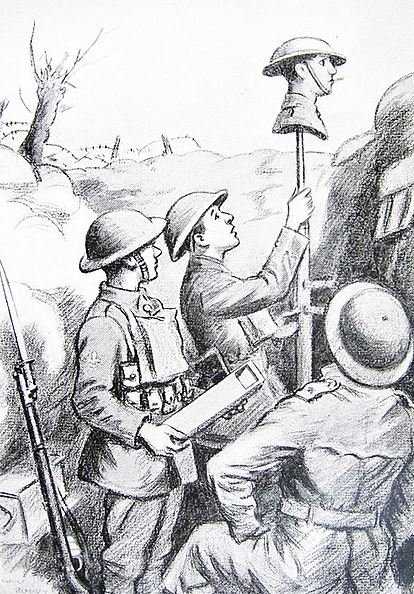
Soldiers used a dummy head to expose and identify the position of an enemy sniper.
The Rise of Sniper Warfare
Before the Great War, specialized marksmen had existed in various armies, but they were not yet a dominant factor in combat. The conditions of trench warfare changed that swiftly. Stationary lines of troops dug into long trenches meant that any soldier who exposed his head or body even momentarily could become a target. Under these circumstances, the ability to strike at long distances with precision became indispensable. Snipers capitalized on careful observation, steady aim, and a short window of opportunity to strike, making them among the most feared assets on both sides.
German Innovations
At the outset, the German Imperial Army was the first to wholeheartedly adopt scoped rifles on a large scale. Their early success revealed that, with a reliable telescopic sight, a skilled shooter could deliver devastatingly precise shots. This breakthrough coincided with the evolving art of camouflage, in which German snipers excelled. They learned to conceal themselves behind parapets, debris, or foliage, waiting patiently for the smallest sign of movement. This mastery of hidden warfare forced enemy forces to adopt extreme caution, slowing their movements within the trenches and heightening the daily tension of front-line life.
Allied Adaptations
As soon as German snipers demonstrated how effective scoped rifles could be, the British and French quickly followed suit. They equipped their best marksmen with similar weaponry and enlisted specialized training to counter the German threat.
New tactics emerged, including the use of trench periscopes and designated counter-snipers tasked with hunting down enemy sharpshooters. Over time, the skill gap narrowed, with both sides engaging in elaborate cat-and-mouse games. Each army worked to perfect concealment techniques, scout likely firing positions, and innovate new ways of deceiving the other.
The Fear Factor
Snipers were not just lethal; they had a profound psychological impact. Living under constant threat drained soldiers’ morale in the trenches. Even a fleeting glimpse over the sandbags could invite instant death from an unseen adversary.
This ever-present danger contributed to trench fatigue, heightening the sense of vulnerability and eroding confidence. As accuracy improved and camouflage techniques advanced, the fear only grew. Soldiers often recounted how the mere knowledge of a skilled enemy sniper on the other side made daily routines unbearably tense, contributing to the mental toll of trench warfare.
Camouflage and Deception
The relentless quest to outsmart enemy snipers fostered innovations in camouflage. Uniforms, helmets, and equipment were adapted to blend more seamlessly with the environment. But subterfuge went beyond personal concealment.
To force snipers into quick, inaccurate shots, armies set up decoys. These lures appeared at a moment’s notice above the trenches, tempting an enemy sharpshooter to give away his position. By triggering a hasty response, the decoys exposed the shooter’s likely firing spot, opening opportunities for counter-snipers or artillery. It was a practical solution to a deadly problem.

A snipper wearing a camouflage clothing.
Paper-Mache Heads
One of the most famous types of decoys employed in World War I was the paper-mache dummy head. Paper mache had been a cheap and popular material for dolls, carnival props, and exhibition items before hostilities began. Its versatility and affordability made it ideal for creating realistic human heads.
Small camouflage workshops stationed near the frontlines took on the task of producing these lifelike props. Thin layers of paper, reinforced with glue or starch, formed the basic structure. This process allowed for detailed shaping, so each dummy head closely resembled an actual soldier’s face.

Crafting Realism
Camouflage units went to great lengths to ensure these heads looked convincingly human under magnification. Sculptors and artists painstakingly added fine details: eyes, ears, nose, and mouth were contoured to appear natural. The faces were painted in flesh tones, often incorporating shadows, highlights, and subtle variations in coloration.
Some heads featured synthetic or carefully affixed hair, heightening the illusion. In especially elaborate versions, a rubber tube ran from the mouth to a soldier hiding below, enabling the dummy to appear as if it were smoking a cigarette—an action sure to draw a sniper’s eager aim.
Operational Use
Deployed in carefully timed intervals, the dummy heads were typically mounted on long sticks that extended them safely above the parapet. Soldiers hoped that an enemy sniper, operating under intense time pressure, would see the silhouette and fire. If the head was struck, the resulting bullet hole offered a critical clue to the shooter’s location.
Sometimes, spotters replaced the dummy with a periscope inserted into the top of the decoy, using the bullet’s angle to gauge where the shot originated. By encouraging the sniper to reveal himself, these ruses opened the door to effective countermeasures.
Triangulation and Counter-Sniping
Once a dummy head drew fire, allied teams used several methods to pinpoint the sniper’s position. Triangulation was a frequent approach: spotters in multiple locations tracked the bullet’s trajectory and calculated intersection points. This calculation provided approximate coordinates of the concealed marksman. Afterward, artillery could be directed to shell the targeted area, or dedicated counter-snipers focused their scopes on the likely hiding spot. Though snipers were already challenging to detect, these decoys evened the odds by forcing them to make mistakes under time pressure, granting defenders a vital advantage.
British Invention and Wider Adoption
The British are credited with pioneering the concept of these paper-mache dummy heads. At the beginning of the war, they faced formidable German snipers and desperately needed a way to fight back. This innovation arose from practical necessity, and before long, other armies recognized the tactic’s effectiveness.
French and Commonwealth forces, as well as eventually the Germans themselves, adopted similar decoys. While each army’s approach varied, the core principle remained constant: if the enemy could be baited to shoot at a lifelike replica, his muzzle flash or bullet trajectory could be used against him.
Questions and Answers

What was the main purpose of dummy heads in WWI?
They were designed to lure enemy snipers into firing, so their position could be detected and neutralized.
Why did snipers become so feared during trench warfare?
They used rifles with telescopic sights that allowed them to accurately shoot targets from well-concealed positions over long distances.
Why was paper-mâché commonly used for the decoy heads?
It was cheap, easy to mold into realistic facial features, and widely available before and during the war.
Who crafted these dummy heads?
Camouflage units with sculptors and artists worked in small frontline workshops to create lifelike heads, paying special attention to details and coloration.
How did soldiers use the decoys to locate enemy snipers?
When a sniper fired at the dummy, the bullet hole allowed for triangulation of the sniper’s position or spotting through a periscope hidden inside the head.
What happened once the sniper’s position was found?
Artillery bombardment or counter-sniper fire targeted the sniper’s location, often driving him from his concealed position or neutralizing him.





