Franco-Dutch War: History, Causes, & Outcome
The Franco-Dutch War (1672–1678) was a significant European conflict that showcased the expansionist ambitions of Louis XIV of France and the resilience of the Dutch Republic under the leadership of William of Orange. This war not only altered the balance of power in Europe but also led to shifting alliances and territorial changes that shaped the continent’s political landscape for decades.
Background to the War
In the late 17th century, France was a rising power under Louis XIV, who sought to establish French dominance in Europe and expand its territorial boundaries. The Dutch Republic, by contrast, was a small but prosperous nation that had emerged as a leading commercial and naval power. The Dutch were a thorn in the side of France’s ambitions due to their control of vital trade routes and their strong alliance with Spain and other European powers.
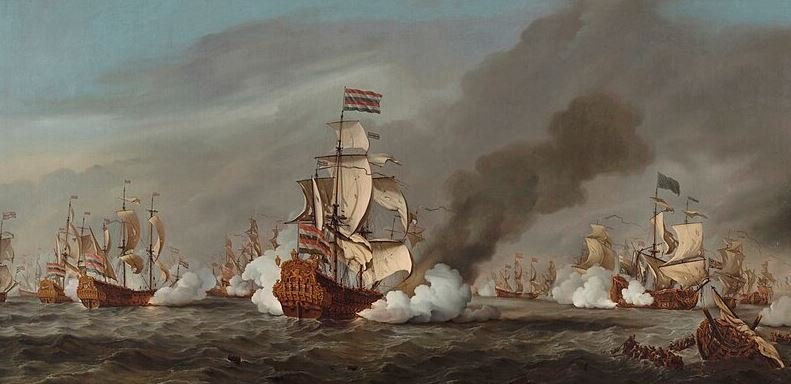
The Franco-Dutch War was primarily caused by Louis XIV’s ambition to expand French territory and weaken the Dutch Republic, a major economic and naval power. Image: A depiction of the Battle of Texel, where the Dutch took on the Anglo-French troops.
Causes of the Franco-Dutch War
Several factors contributed to the outbreak of the Franco-Dutch War:
- French Ambitions for Expansion: Louis XIV sought to expand France’s borders and influence, particularly in the Spanish Netherlands (modern Belgium) and the Rhineland. These regions were strategically important and rich in resources. The Dutch Republic stood in the way of these ambitions, both geographically and economically.
- Economic Rivalry: The Dutch Republic had established itself as a major economic power, dominating trade routes and global commerce. France wanted to challenge Dutch economic dominance and seize control of lucrative trade routes, particularly those involving colonies in the Americas and Asia.
- Diplomatic Tensions: The Dutch Republic was part of a larger European alliance system that opposed French expansion. This included Spain, the Holy Roman Empire, and several German states. The French sought to isolate the Dutch diplomatically and weaken their alliances.
- Personal Rivalry Between Louis XIV and William of Orange: William of Orange, who later became King William III of England, was a staunch opponent of French expansion and a key leader of the Dutch resistance. His personal rivalry with Louis XIV added a layer of complexity to the conflict.
The Outbreak of the War: 1672, the “Rampjaar” (Disaster Year)
The war began in May 1672 when France, supported by its allies Münster, Cologne, and England (in what became known as the Third Anglo-Dutch War), launched a sudden and overwhelming attack on the Dutch Republic. This year is known in Dutch history as the “Rampjaar” or “Disaster Year” because the Republic faced near-collapse.
Early French Successes
- France’s powerful military, led by the skilled Marshal Turenne, swept through Dutch defenses with remarkable speed. By June, they had captured several key cities, including Utrecht, and the Dutch position seemed desperate.
- The French military’s rapid advance was aided by the fact that the Dutch land defenses, based on a system of waterlines, were not fully prepared. The French exploited weaknesses in the Dutch defenses, nearly bringing the Republic to its knees.
Dutch Resistance and the Turn of the War
- Despite the initial French success, the Dutch managed to rally under the leadership of William of Orange, who was appointed Stadtholder (military and political leader) in July 1672.
- William implemented a scorched-earth policy, opening the dikes and flooding large parts of the country to halt the French advance. This drastic measure bought the Dutch time to regroup and strengthen their defenses.
- The unexpected resilience of the Dutch, coupled with their diplomatic efforts to form alliances with other European powers, began to turn the tide of the war.

Louis XIV initially aimed for a swift victory over the Dutch Republic. However, when that goal proved elusive, he shifted his focus to securing France’s borders by capturing key territories like Franche-Comté and parts of the Spanish Netherlands. Image: Louis XIV.
The Third Anglo-Dutch War (1672–1674)
The Franco-Dutch War overlapped with the Third Anglo-Dutch War, which was a related conflict between England and the Dutch Republic. England had allied with France under King Charles II, who sought to weaken the Dutch and assert English naval dominance.
Key Points of the Third Anglo-Dutch War
- The English and French fleets launched several naval attacks on the Dutch, but the Dutch fleet, under Admiral Michiel de Ruyter, proved highly effective in defending their coastlines and key trade routes.
- The Dutch inflicted several defeats on the combined Franco-English fleets, including notable victories at the Battle of Solebay (1672) and the Battle of Texel (1673).
- By 1674, domestic opposition in England to the war and its alliance with Catholic France grew significantly. England’s Parliament forced Charles II to abandon the war, and England made peace with the Dutch, withdrawing from the conflict.
The War on Multiple Fronts: 1674–1677
After England’s withdrawal, France continued the war against the Dutch Republic and its new allies, including the Holy Roman Empire, Spain, Brandenburg-Prussia, and Denmark-Norway. This transformed the war into a broader European conflict.
Key Developments:
- Louis XIV’s Strategy Shift: Louis XIV, who had initially aimed for a swift and overwhelming victory over the Dutch, now found himself facing a coalition of powerful enemies on multiple fronts. He shifted his strategy, focusing on consolidating French gains in the Spanish Netherlands and Rhineland rather than attempting to conquer the Dutch outright.
- The Capture of Franche-Comté: One of France’s major achievements during this phase of the war was the occupation of Franche-Comté, a strategically important region between France and the Holy Roman Empire. The capture of this territory significantly strengthened France’s position in the long term.
- Stalemate in the Spanish Netherlands: Despite several French victories, including the capture of key towns in the Spanish Netherlands and Alsace, the Allies, led by William of Orange, managed to prevent a decisive French victory. The conflict became a stalemate, with both sides making gains but neither able to deliver a knockout blow.
The Scanian War (1675–1679)
The Scanian War, fought between Sweden (an ally of France) and Denmark-Norway (an ally of the Dutch and the Holy Roman Empire), was a related conflict that added to the complexity of the Franco-Dutch War. The war in Scandinavia was closely tied to the broader struggle between France and the anti-French coalition in Europe.
Key Points:
- Sweden, under King Charles XI, was drawn into the conflict as part of its alliance with France. However, Sweden’s involvement in the war proved costly, as Danish and Dutch forces inflicted several defeats on the Swedish military.
- The Scanian War ended in 1679 with the Treaty of Lund, which restored the pre-war status quo in Scandinavia. While the war did not directly affect the outcome of the Franco-Dutch War, it drained resources and attention from both Sweden and Denmark-Norway.
The Peace of Nijmegen: 1678
By 1677, both sides were exhausted, and the prospect of a decisive military victory seemed increasingly remote. France and its opponents began negotiations to bring the conflict to an end.
Key Terms of the Peace of Nijmegen (1678):
- France’s Territorial Gains: France emerged from the war with significant territorial gains, most notably the acquisition of Franche-Comté and parts of the Spanish Netherlands, including parts of Artois and Hainaut. These gains were seen as a major victory for Louis XIV and solidified French dominance in Western Europe.
- Spain’s Losses: Spain, which had been a major participant in the war on the side of the Dutch Republic, was forced to cede significant territory to France. Spain’s declining power and influence were further eroded by the terms of the peace settlement.
- Dutch Victory in Defense: Although the Dutch Republic did not make any territorial gains, they succeeded in defending their independence and recovering all the land that had been occupied by France during the early stages of the war. Under the leadership of William of Orange, the Dutch solidified their position as a major European power.
- Impact on the Holy Roman Empire and Brandenburg-Prussia: The Holy Roman Empire and Brandenburg-Prussia were part of the anti-French coalition, and while they managed to limit French expansion, they did not make significant territorial gains themselves.
Aftermath and Long-Term Consequences
French Power and Ambition
The Franco-Dutch War is often seen as the peak of French power under Louis XIV. While France did not achieve all of its objectives, the territorial gains from the Peace of Nijmegen significantly strengthened its position in Europe. Franche-Comté, in particular, was a valuable acquisition that enhanced France’s strategic depth and resources.
Dutch Republic’s Survival and the Rise of William of Orange
The Dutch Republic’s ability to survive the war was a major achievement, particularly given the precarious situation it faced in 1672. William of Orange’s leadership during the war solidified his political influence, both within the Dutch Republic and across Europe. His role in forming the Grand Alliance—a coalition of European powers opposed to French expansion—would be crucial in future conflicts, including the Nine Years’ War (1688–1697) and the War of the Spanish Succession (1701–1714).
Shifting Alliances in Europe
The Franco-Dutch War reshaped the alliance structures in Europe. The Dutch Republic, once diplomatically isolated, emerged from the war as part of a powerful coalition of states that opposed French expansion. The conflict also highlighted the growing decline of Spain as a European power, as it continued to lose territory and influence to France.
Economic Impact
The war had a significant economic impact on the Dutch Republic, particularly during the early years when much of its territory was occupied by France. However, the Dutch economy proved resilient, and the Republic quickly recovered after the war, maintaining its position as one of the leading commercial and naval powers in Europe.
Prelude to Future Wars
The Franco-Dutch War set the stage for future conflicts between France and its European rivals. The peace settlement did not fully resolve the underlying tensions between France and the rest of Europe, and within a decade, Louis XIV would find himself embroiled in another major conflict, the Nine Years’ War, which saw many of the same powers once again opposing French expansion.
Questions and Answers
The Franco-Dutch War was a pivotal moment in European history, shaping the political, territorial, and military landscape of the continent. For France, it marked a high point in Louis XIV’s reign, as he consolidated his power and expanded French territory. For the Dutch Republic, it was a test of resilience, but under the leadership of William of Orange, the Republic not only survived but emerged as a key player in European politics.
Below are some frequently asked questions about the war:
When was the Franco-Dutch War fought, and who were the main belligerents?
The Franco-Dutch War was fought from 1672 to 1678. The main belligerents were France, supported by Münster, Cologne, England, and the Swedish Empire, against the Dutch Republic, allied with the Holy Roman Empire, Spain, Brandenburg-Prussia, and Denmark-Norway.
What two related conflicts occurred during the Franco-Dutch War?
The two related conflicts were the Third Anglo-Dutch War (1672-1674) and the Scanian War (1675-1679).
What event in Dutch history is referred to as the “Rampjaar” or “Disaster Year”?
The “Rampjaar” refers to the year 1672, when France launched a swift invasion of the Dutch Republic and nearly overran the country.
How did the Dutch manage to stabilize their position after the initial French success in 1672?
By late July 1672, the Dutch had managed to stabilize their position despite the initial French success. In 1673, they gained support from Emperor Leopold I, Spain, and Brandenburg-Prussia, which helped bolster their defenses.
Why did England leave the war in 1674?
England left the war in February 1674, signing a peace treaty with the Dutch, likely due to growing concerns over France’s territorial gains and shifting alliances.
What was Louis XIV’s original strategy, and how did it change over the course of the war?
Louis XIV of France initially aimed for a quick and decisive victory. However, as the war dragged on, he shifted his focus to fortifying France’s borders with the Spanish Netherlands and Rhineland, while the Allies, led by William of Orange, worked to minimize losses.
What strategic gains did France make by 1677, and were they decisive?
By 1677, France had occupied Franche-Comté and made strategic advances in the Spanish Netherlands and Alsace. However, these gains were not decisive, and the war continued without a clear victory for either side.
How did the Franco-Dutch War conclude, and what were the terms of the Peace of Nijmegen in 1678?
The war concluded in September 1678 with the Peace of Nijmegen. Under the treaty, Spain regained Charleroi but ceded Franche-Comté and parts of Artois and Hainaut to France. The Dutch, under William of Orange, recovered all their lost territory.

Image: French and Dutch diplomats formalizing the peace treaty with their signatures.
What impact did the Peace of Nijmegen have on William of Orange and the Dutch Republic?
The Peace of Nijmegen allowed the Dutch to recover all lost territories and solidified William of Orange’s dominance in Dutch domestic politics. This strengthened his position, enabling him to form the anti-French Grand Alliance, which played a key role in the Nine Years’ War (1688-1697) and the War of the Spanish Succession (1701-1714).
Why is the Peace of Nijmegen often viewed as a high point of French power during this period?
The Peace of Nijmegen is considered a high point for French power because France, despite not conquering the Dutch Republic, made significant territorial gains, including the acquisition of Franche-Comté and parts of Artois and Hainaut, which expanded its influence in Europe.





