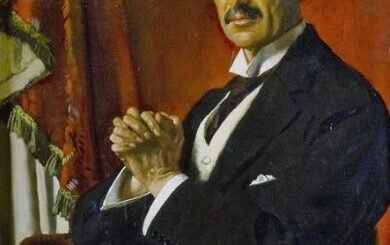
English Egyptologist E. A. Wallis Budge
E. A. Wallis Budge (1857–1934) was a prominent English Egyptologist, philologist, and author who made significant contributions to the study and popularization of ancient Egyptian and Near Eastern culture.
Known for his extensive work at the British Museum and his prolific writing, Budge played a major role in expanding the public’s understanding of ancient Egypt and its religious beliefs, despite the controversies surrounding some of his methods and theories.

Early Life and Education
Ernest Alfred Thompson Wallis Budge was born in Bodmin, Cornwall, in 1857. Raised in a modest household, he faced early challenges that limited his access to formal education.
Budge’s interest in languages developed at an early age, and by his teenage years, he was self-studying Biblical Hebrew and Syriac with the help of volunteer tutors. At the age of 12, Budge left school to work as a clerk at WHSmith, a job that he held for several years. During this period, he frequented the British Museum, studying ancient texts and artifacts and nurturing his passion for ancient cultures, particularly the languages of the Near East.
His dedication and talent soon drew the attention of Samuel Birch, the head of Oriental Antiquities at the British Museum, and George Smith, a pioneering Assyriologist.
Recognizing Budge’s potential, Birch and other supporters, including former Prime Minister William Gladstone, arranged for him to attend Cambridge University. At Cambridge, Budge studied Semitic languages, including Hebrew, Arabic, Geʽez, and Assyrian, establishing a strong academic foundation for his future career in Egyptology and Assyriology.
Career at the British Museum
In 1883, Budge joined the British Museum’s Department of Egyptian and Assyrian Antiquities, initially working with Assyrian artifacts before transitioning to Egyptian antiquities. Under the mentorship of Birch and later Peter le Page Renouf, Budge honed his expertise in Egyptian language and culture.
His work in the museum involved cataloging, translating, and acquiring artifacts, and he quickly rose through the ranks. In 1894, Budge was appointed Keeper of the Egyptian and Assyrian Antiquities Department, a position he held until his retirement in 1924.
Budge traveled extensively to Egypt and Sudan to acquire antiquities and authored numerous popular books on Egyptology, making ancient studies accessible to a wider audience.
During his tenure, Budge traveled extensively in Egypt and Iraq, acquiring a vast collection of antiquities for the museum. These expeditions allowed the British Museum to amass one of the most impressive collections of Egyptian artifacts, including some of the most notable ancient manuscripts and tablets.
Budge’s acquisitions were driven by a fierce competition with other European museums, and he often employed unorthodox methods, such as bypassing local customs and using diplomatic channels to secure artifacts. Some of his most famous acquisitions include the Papyrus of Ani, one of the most detailed copies of the Egyptian Book of the Dead, and the Amarna Letters, a set of diplomatic correspondence from ancient Egypt.
Major Works and Contributions
Budge’s contributions to Egyptology and the study of ancient cultures are extensive, with more than 50 books published during his lifetime. His writing covered a range of topics, from translations of ancient texts to comprehensive studies of Egyptian religion, language, and mythology. Some of his most significant works include:
- The Egyptian Book of the Dead (1895) – Budge’s translation of this funerary text, also known as the “Papyrus of Ani,” introduced a Western audience to ancient Egyptian beliefs about the afterlife. This work became one of his most famous publications and remains widely read today.
- The Gods of the Egyptians (1904) – This two-volume work is a detailed exploration of the Egyptian pantheon, examining gods such as Osiris, Isis, and Horus. Budge’s interpretations, though sometimes speculative, brought Egyptian mythology into the popular imagination.
- An Egyptian Hieroglyphic Dictionary (1920) – This reference book provided an extensive list of Egyptian hieroglyphs with translations, making it an invaluable resource for students and enthusiasts of the Egyptian language.
- By Nile and Tigris (1920) – Budge’s autobiography recounts his travels in Egypt and Iraq, as well as his experiences working in the field. It offers insights into his methods, challenges, and perspectives on the world of archaeology.
- The Rosetta Stone (1929) – In this book, Budge discussed the significance of the Rosetta Stone and its role in the decipherment of Egyptian hieroglyphs, bringing an important archaeological breakthrough to the public’s attention.
- Osiris and the Egyptian Resurrection (1911) – Budge examined ancient Egyptian beliefs about death and rebirth, focusing on the Osiris myth and its significance in Egyptian religion. His work contributed to the comparative study of resurrection myths across different cultures.
Controversies and Criticisms
Budge’s career was not without controversy. In 1893, he faced a lawsuit from Hormuzd Rassam, a fellow archaeologist, whom Budge had accused of smuggling artifacts out of Nineveh.
The dispute highlighted tensions within the field of archaeology and raised questions about Budge’s ethics. Additionally, some of his peers criticized his aggressive acquisition methods and his tendency to blend speculation with scholarship in his writings.
Budge’s theories on the African origins of Egyptian religion and his assertion that Osiris and other Egyptian deities may have evolved from indigenous African beliefs also met with resistance.
His ideas ran counter to the prevailing view that Egyptian civilization was a product of foreign influences, a theory endorsed by leading Egyptologists like Flinders Petrie. Although Budge’s ideas were dismissed at the time, they have gained renewed interest in recent studies emphasizing the African roots of Egyptian culture.
Influence and Legacy
Budge’s contributions to Egyptology extended beyond academic circles. His books were accessible to the general public, inspiring widespread interest in ancient Egypt and influencing a generation of writers, artists, and spiritualists. Figures such as William Butler Yeats and James Joyce drew from Budge’s interpretations of Egyptian mythology, while his translations of the Egyptian Book of the Dead found a following among those interested in the occult.
Though modern scholars critique Budge’s work for its outdated methods and occasional inaccuracies, his publications continue to be reprinted and remain popular among general readers. His accessible style and passion for ancient cultures helped demystify Egyptology, bringing the wonders of the ancient world to a broad audience.
Later Years and Recognition
In 1920, Budge was knighted for his contributions to Egyptology and his service to the British Museum. That same year, he published his autobiography, By Nile and Tigris, which provided readers with a glimpse into his adventurous life and the challenges of his profession. Budge continued to write until his death in 1934, with his last book, From Fetish to God in Ancient Egypt, exploring the evolution of Egyptian religious beliefs.
Knighted in 1920, Wallis Budge is celebrated for his contributions to Egyptology and his dedication to preserving ancient Near Eastern history.
Despite the criticisms of his methods, Budge’s impact on the field of Egyptology and on popular culture is undeniable. His work laid a foundation for future scholars and helped shape Western perceptions of ancient Egypt. Today, Budge’s life and career are seen as emblematic of the Victorian-era fascination with ancient civilizations and the drive to uncover and preserve the past.
Frequently Asked Questions
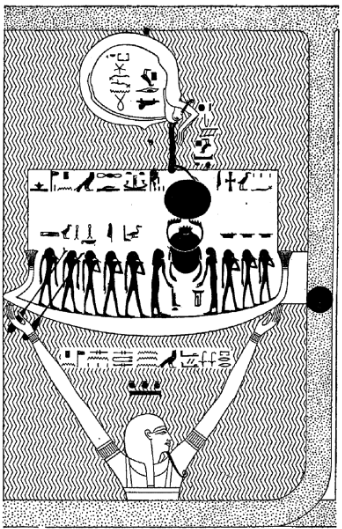
Illustration by E. A. Wallis Budge from Egyptian Ideas of the Future Life (published 1908).
Where was E. A. Wallis Budge born, and what were his early life circumstances?
He was born in Bodmin, Cornwall, in 1857. Raised by his mother, Mary Ann Budge, he later lived with his aunt and grandmother in London. His father is unknown, and he came from a modest background with limited access to formal education.
How did Budge first develop an interest in ancient languages and cultures?
He showed an interest in languages at a young age, teaching himself Biblical Hebrew and Syriac with the help of a volunteer tutor, Charles Seeger. His passion grew when he began visiting the British Museum to study ancient cuneiform tablets, where his enthusiasm for Assyrian culture developed.
Samuel Birch, head of Oriental Antiquities at the British Museum, and Assyriologist George Smith noticed Budge’s dedication. Birch introduced Budge to prominent figures like former Prime Minister William Gladstone, who helped fund his studies at Cambridge University.
What did Budge study at Cambridge, and who influenced him there?
From 1878 to 1883, he studied Semitic languages, including Hebrew, Arabic, and Geʽez, at Cambridge. He worked closely with William Wright, a renowned scholar in Semitic languages, which helped establish a solid foundation for his career in Egyptology.
When did he start working at the British Museum, and what was his role?
Budge began working at the British Museum in 1883 in the Department of Egyptian and Assyrian Antiquities. Initially in the Assyrian section, he soon moved to the Egyptian section and became instrumental in expanding the museum’s collection.
What was Budge’s mission in Iraq between 1886 and 1891?
He was assigned to investigate why British Museum cuneiform tablets were appearing on the London antiquities market. He sought permits from the Ottoman Empire for further excavations and established connections with local dealers to acquire artifacts at local rates.
Which significant artifacts did Budge help acquire for the British Museum?
He acquired many notable artifacts, including the Papyrus of Ani (Book of the Dead), Aristotle’s Constitution of Athens, and the Amarna letters. His acquisitions helped build one of the world’s leading collections of ancient Near Eastern antiquities.
By 1894, Budge became keeper of his department, a role he held until 1924. His tenure was marked by intense competition with other European museums for artifacts, with Budge and his colleagues sometimes using unconventional methods to secure antiquities.
What was the nature of the 1893 lawsuit involving Budge and Hormuzd Rassam?
Budge was sued by Rassam, whom he had accused of smuggling artifacts. Though Rassam lost the case, the dispute highlighted tensions in archaeology over credit for discoveries. Some scholars, like Austen Henry Layard, defended Rassam’s contributions.
What were some criticisms of his academic work?
While his books were popular, scholars have criticized his translations for mixing opinion with fact. Egyptologist James Peter Allen noted that Budge’s works were unreliable when published and are now outdated due to advances in translation accuracy and archaeological methods.
What impact did Budge have on the public’s understanding of ancient Egypt?
His books introduced ancient Egyptian religion and language to a broad audience. His theories, including the idea of African origins for the Osiris religion, were controversial but influenced scholars and writers like James Frazer, who integrated Budge’s ideas into The Golden Bough.
How did his work resonate with the spiritualist and occult communities?
Budge’s translation of the Egyptian Book of the Dead captivated occult enthusiasts, influencing figures like William Butler Yeats and James Joyce. His interest in the paranormal and membership in the Ghost Club extended his reach beyond academia to those interested in spirituality.
What was his social life like in London, and who introduced him to high society?
Budge was well-connected in London society, often invited to social events. He was a member of the Savile Club, introduced by novelist H. Rider Haggard. Budge’s humor and stories about his travels made him a popular figure among the British elite.
What autobiographical work did Budge publish, and what was his final book?
In 1920, he published his autobiography, By Nile and Tigris, recounting his experiences in Egyptology. His last book, From Fetish to God in Ancient Egypt, was published shortly before his death in 1934.
What honors did Budge receive for his work, and how is his legacy viewed today?
Budge was knighted in 1920 for his contributions to Egyptology and the British Museum. His legacy is complex; while his acquisition methods and translations faced criticism, his work helped make ancient Egyptian culture accessible to the public and inspired generations of scholars and enthusiasts.