English Painter Edward Burne-Jones
Sir Edward Coley Burne-Jones, 1st Baronet, ARA, stands as a luminary in the annals of English art, celebrated for his profound contributions to both painting and decorative design.
Born on August 28, 1833, in Birmingham, England, Burne-Jones’s life and work encapsulate the essence of the Victorian aesthetic, blending romanticism, medievalism, and meticulous craftsmanship.
His journey through art, his personal life, particularly his marriage, and his extensive body of paintings reveal a man deeply committed to beauty, imagination, and artistic integrity.
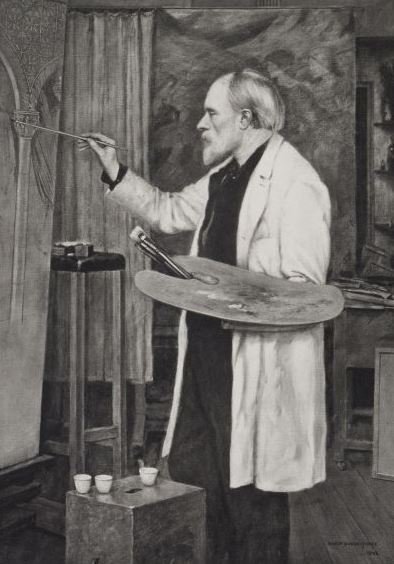
Burne-Jones significantly influenced the aesthetic landscape of the late 19th century through his paintings and designs in various decorative arts, including stained glass, ceramics, and textiles. Image: Burne-Jones in his studio. Artwork by his son Philip Burne-Jones.
Early Life and Education
Edward Burne-Jones was born into a family of modest means; his father, Edward Burne-Jones, was a teacher, and his mother, Sarah Coley, hailed from a Quaker background.
This upbringing instilled in him a strong sense of discipline and an appreciation for education. From an early age, Burne-Jones exhibited a proclivity for drawing, encouraged by his father. His initial artistic training took place at the Birmingham School of Design, where he honed his skills in drawing and design, laying the foundation for his future endeavors in the arts.
In 1851, at the age of eighteen, Burne-Jones relocated to London to further his education at the Royal Academy Schools. His time at the Royal Academy was formative, exposing him to classical art and the prevailing academic standards of the time.
However, Burne-Jones found the Academy’s emphasis on historical and mythological subjects somewhat restrictive. This discontent led him to seek alternative avenues for artistic expression, ultimately aligning himself with the burgeoning Pre-Raphaelite movement.
Association with the Pre-Raphaelite Brotherhood
The Pre-Raphaelite Brotherhood, founded in 1848 by Dante Gabriel Rossetti, William Holman Hunt, and John Everett Millais, sought to revive the rich detail, vivid colors, and complex compositions of early Renaissance art, particularly that of the Quattrocento period in Italy. Burne-Jones, drawn to their ideals of truth to nature and symbolic content, became closely associated with the movement.
Initially, Burne-Jones’s work was significantly influenced by Dante Gabriel Rossetti, whose lyrical quality and romantic themes resonated with him. This influence is evident in Burne-Jones’s early paintings, which feature rich colors, intricate details, and subjects drawn from literature and mythology. His ability to capture ethereal beauty and emotional depth quickly established him as a key contributor to the Pre-Raphaelite Brotherhood, even though he was not one of its founding members.
Collaboration with William Morris and the Arts and Crafts Movement
A pivotal chapter in Burne-Jones’s career was his collaboration with William Morris, a central figure in the Arts and Crafts Movement. In 1861, Burne-Jones joined Morris, Marshall, Faulkner & Co., a firm dedicated to the design and production of decorative arts. This partnership marked a significant expansion of Burne-Jones’s creative repertoire beyond painting, allowing him to engage in the design of textiles, wallpapers, stained glass, ceramics, and metalwork.
Edward Burne-Jones and William Morris founded Morris, Marshall, Faulkner & Co., producing decorative arts such as textiles, wallpapers, stained glass, ceramics, and metalwork.
The Arts and Crafts Movement, emerging in response to the industrial revolution’s mass production, emphasized craftsmanship, quality materials, and the integration of art into everyday life. Burne-Jones’s meticulous attention to detail and his commitment to beauty and functionality aligned perfectly with these principles. His work with Morris and Co. not only broadened his artistic horizons but also solidified his reputation as a versatile designer capable of translating his artistic vision across various mediums.
Personal Life and Marriage
Edward Burne-Jones’s personal life was marked by deep emotional connections and enduring partnerships. In 1859, he met Maria Zambaco, a Greek Cypriot immigrant, who became his muse and long-term companion. Maria, a dancer and a figure of remarkable beauty and intellect, played a significant role in Burne-Jones’s life, inspiring many of his works. Their relationship was unconventional for the time, as Maria was not formally married to Burne-Jones. Despite societal norms, their bond remained strong, and she was a constant presence in his life until her untimely death in 1887.
In 1894, Burne-Jones married Georgiana MacDonald, the daughter of William Holman Hunt, one of the founding members of the Pre-Raphaelite Brotherhood. Georgiana was herself an artist, and their marriage represented a union of artistic spirits. This partnership provided Burne-Jones with companionship and mutual artistic support during the final years of his life. Georgiana continued Burne-Jones’s legacy after his death, ensuring that his works and contributions to art were duly recognized and preserved.
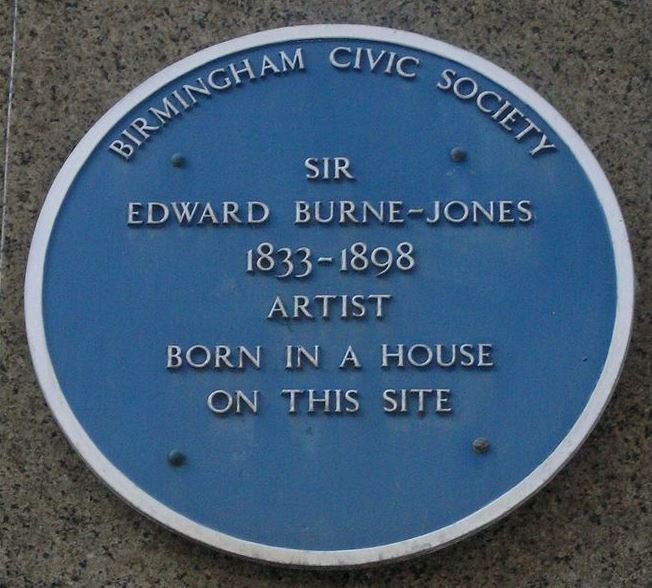
Image: Blue plaque in honor of Burne-Jones.
Artistic Style and Major Works
Burne-Jones’s artistic style evolved significantly over his career, reflecting his personal growth and the changing artistic landscape of the time. While his early works were heavily influenced by the Pre-Raphaelite Brotherhood, by the 1870s, he had developed a distinctive style characterized by elongated figures, ethereal beauty, and a dreamlike atmosphere. This unique approach combined elements of symbolism and medievalism, often delving into themes of love, myth, and legend.
Key Themes and Subjects
Burne-Jones’s paintings frequently explore themes of medieval romance, classical mythology, and biblical narratives. His works are imbued with a sense of otherworldly grace and idealized beauty, often portraying figures in serene, contemplative poses set against lush, detailed backgrounds. This blend of romanticism and symbolism creates a visually stunning and intellectually engaging body of work that invites viewers to explore deeper emotional and narrative layers.
Notable Paintings
The Beguiling of Merlin (1877)
One of Burne-Jones’s most celebrated works, “The Beguiling of Merlin,” exemplifies his mature style. Exhibited at the Grosvenor Gallery in 1877, this painting features intricate detail, vibrant colors, and a mythological subject matter. The artwork portrays the legendary wizard Merlin being seduced by a beautiful enchantress, capturing the essence of medieval romance and mysticism that characterizes much of Burne-Jones’s work.
The Golden Stairs (1879-1880)
Commissioned for the Red House, William Morris’s residence, “The Golden Stairs” is a triptych that combines elements of symbolism and allegory. The painting depicts a staircase ascending into a celestial realm, with figures embodying virtues and artistic ideals. This work reflects Burne-Jones’s belief in the transformative power of art and its ability to elevate the human spirit.
The Last Sleep of Arthur in Avalon (1880-1890)
This painting is part of a larger cycle of Arthurian-themed works by Burne-Jones. It portrays the legendary King Arthur in his final repose, surrounded by symbols of his reign and the mystical landscape of Avalon. The artwork is noted for its serene composition, rich color palette, and the emotional depth conveyed through Arthur’s contemplative expression.
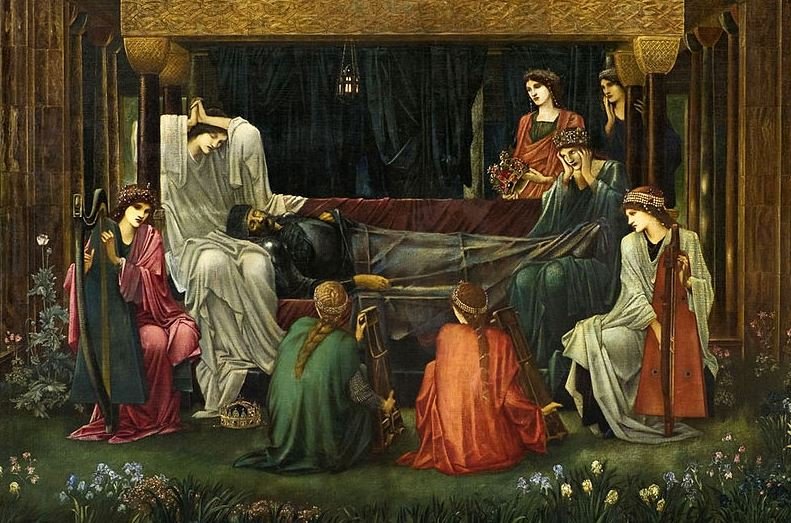
Image: “The Last Sleep of Arthur in Avalon”
Love Among the Ruins (1861-1865)
One of his earlier works, “Love Among the Ruins,” reflects the Pre-Raphaelite emphasis on literary and mythological subjects. The painting depicts two figures embracing amidst ancient, crumbling structures, symbolizing the endurance of love amidst decay and change. This piece showcases Burne-Jones’s ability to blend romantic themes with detailed, evocative settings.
Stained Glass and Decorative Arts
Beyond painting, Burne-Jones made significant contributions to the world of stained glass and decorative arts. His designs for stained glass windows are particularly notable for their intricate patterns, rich colors, and ability to manipulate light to enhance the spiritual and aesthetic experience of the viewer. These windows can still be admired in numerous churches across the United Kingdom, as well as in institutions in the United States and Australia.
One of his most famous stained glass works is the series for the chapel of Queen’s College, Oxford. These windows depict scenes from Arthurian legend and biblical narratives, rendered with the same poetic sensitivity and attention to detail found in his paintings. Burne-Jones’s stained glass designs exemplify the principles of the Arts and Crafts Movement, emphasizing handcrafted quality and the integration of art into architectural spaces.
Exhibitions and Recognition
Burne-Jones’s artistic achievements were widely recognized during his lifetime. A significant milestone was his 1877 exhibition at the Grosvenor Gallery, a new institution established as a rival to the Royal Academy. This exhibition featured eight oil paintings, including “The Beguiling of Merlin,” and coincided with the burgeoning Aesthetic Movement, which emphasized beauty and sensory experience over narrative content or moral messages. Burne-Jones’s work was embraced by this movement, positioning him as a leading figure and a “herald and star” of the aesthetic shift in art.
Throughout his career, Burne-Jones received numerous accolades for his contributions to art. In 1894, he was created a baronet, a hereditary title, in recognition of his achievements. This honor underscored his status as a leading artist of his time and cemented his legacy within the British art establishment.
Legacy and Influence
Sir Edward Burne-Jones’s legacy extends far beyond his lifetime, influencing generations of artists and designers. His seamless fusion of fine art with decorative design set a precedent for the integration of artistic disciplines, advocating for the presence of beauty in everyday objects and spaces. This holistic approach resonated with later movements, including Art Nouveau and modernist design, which similarly sought to break down barriers between fine and applied arts.
Burne-Jones’s holistic approach to creativity influenced subsequent generations of artists and designers, solidifying his legacy as a pivotal figure in English art and design.
Burne-Jones’s emphasis on craftsmanship and attention to detail inspired future artists to prioritize quality and artistic integrity over mass production and commercialism. His stained glass designs, in particular, continue to be celebrated for their enduring beauty and technical excellence, remaining integral elements of many ecclesiastical and public buildings.
Moreover, Burne-Jones’s exploration of mythological and literary themes paved the way for Symbolism and other narrative-driven art forms, encouraging artists to delve into the psychological and emotional depths of their subjects. His ability to convey complex emotions and narratives through serene and idealized imagery remains a hallmark of his work, admired for its poetic and contemplative qualities.
Conclusion
Sir Edward Coley Burne-Jones’s life was a testament to the pursuit of beauty, imagination, and artistic excellence. From his early days in Birmingham to his influential collaborations with William Morris and his esteemed position within the Pre-Raphaelite Brotherhood and the Arts and Crafts Movement, Burne-Jones continually sought to elevate art and design to new heights. His marriage to Georgiana MacDonald and his deep emotional connections enriched his personal life, providing inspiration and support for his creative endeavors.
Burne-Jones’s paintings, characterized by their ethereal beauty, intricate detail, and rich thematic content, remain masterpieces of Victorian art. His contributions to stained glass and decorative arts have left an indelible mark on architectural and ecclesiastical spaces, ensuring that his legacy endures in both fine art and everyday design.
Frequently Asked Questions
When and where was Edward Burne-Jones born?
Edward Burne-Jones was born on August 28, 1833, in England.
With which artistic movement was Burne-Jones initially associated, and what are its main characteristics?
Burne-Jones was initially associated with the Pre-Raphaelite Brotherhood. This movement is characterized by vivid colors, intricate detail, complex compositions, and themes drawn from literature, mythology, and medievalism. The Pre-Raphaelites sought to return to the abundant detail and craftsmanship of Quattrocento Italian art, emphasizing symbolic content and rejecting the conventions of academic art of their time.
Who were the founders of the Pre-Raphaelite Brotherhood, and how did Burne-Jones relate to them?
The Pre-Raphaelite Brotherhood was founded by Dante Gabriel Rossetti, William Holman Hunt, and John Everett Millais in the mid-19th century. Burne-Jones was initially influenced by Dante Gabriel Rossetti and quickly became a key contributor to the movement, producing works that echoed its principles while also developing his unique artistic voice.
How did Burne-Jones’s artistic style evolve around 1870?
Around 1870, Burne-Jones began to develop a distinctive style characterized by elongated figures, ethereal beauty, and a dreamlike atmosphere. This evolution marked his departure from the direct influence of the Pre-Raphaelite Brotherhood, allowing him to explore more personal and imaginative subjects. His unique approach incorporated elements of symbolism and medievalism, often delving into themes of love, myth, and legend.
What was the significance of Burne-Jones’s 1877 exhibition at the Grosvenor Gallery?
In 1877, Burne-Jones exhibited eight oil paintings at the Grosvenor Gallery, a new institution established as a rival to the Royal Academy. This exhibition included “The Beguiling of Merlin” and coincided with the burgeoning Aesthetic Movement, which emphasized beauty and sensory experience over narrative content or moral messages. The successful exhibition positioned Burne-Jones as a leading figure and a “herald and star” of the aesthetic shift in art, gaining him greater recognition and aligning him with contemporary artistic trends.
What types of decorative arts did Burne-Jones design while working with Morris, Marshall, Faulkner & Co.?
While working with Morris, Marshall, Faulkner & Co., Burne-Jones designed a wide range of decorative arts, including ceramic tiles, jewelry, tapestries, mosaics, textiles, wallpapers, stained glass windows, and metalwork. His versatility allowed him to translate his artistic vision across different mediums effectively.
Why are Burne-Jones’s stained glass window designs particularly significant?
Burne-Jones’s stained glass window designs are significant because they represent a revival of the craft during the 19th century, influenced by the Gothic Revival and the Arts and Crafts Movement. His designs are celebrated for their intricate patterns, rich colors, and ability to capture light, enhancing the spiritual and aesthetic experience of viewers. These stained glass windows remain in numerous churches across the United Kingdom, the United States, and Australia, showcasing his lasting impact on ecclesiastical art.
How did Burne-Jones’s work contribute to both fine arts and decorative design?
Burne-Jones contributed to fine arts through his paintings, which depicted scenes of medieval romance, classical mythology, and biblical narratives with poetic sensitivity and detailed execution. In decorative design, his work with Morris, Marshall, Faulkner & Co. involved creating designs for various crafts, including stained glass, ceramics, and textiles. This seamless fusion of fine art with decorative design not only broadened the scope of his own work but also influenced generations of artists and designers, elevating the decorative arts to the level of fine art.
What honors did Burne-Jones receive for his contributions to art?
Burne-Jones was knighted for his contributions to art, becoming the 1st Baronet in recognition of his achievements.
When did Sir Edward Burne-Jones pass away, and what is his legacy?
Sir Edward Burne-Jones passed away on June 17, 1898. His legacy includes a rich body of work that continues to inspire and captivate audiences. He is remembered for the enduring power of his beauty and imagination, as well as his ability to integrate fine art with decorative design. His contributions remain significant in the history of English art and design.
In what ways did Burne-Jones align himself with the Aesthetic Movement?
Burne-Jones aligned himself with the Aesthetic Movement by emphasizing beauty and sensory experience in his work over narrative content or moral messages. His exhibition at the Grosvenor Gallery in 1877, which showcased paintings like “The Beguiling of Merlin,” coincided with the movement’s rise. His intricate detail, vibrant colors, and mythological themes were embraced by the Aesthetic Movement, positioning him as a leading figure and embodying the movement’s principles.
What themes are commonly found in Burne-Jones’s paintings?
Common themes in Burne-Jones’s paintings include medieval romance, classical mythology, biblical narratives, love, myth, and legend. His works often portray these themes with idealized beauty and an otherworldly grace, blending romanticism and symbolism to create visually stunning and intellectually engaging compositions.
How did Burne-Jones’s commitment to craftsmanship influence his work and legacy?
Burne-Jones’s commitment to craftsmanship was evident in both his fine art and decorative designs. By prioritizing detailed execution and high-quality materials, he ensured that his works were not only aesthetically pleasing but also enduring. This dedication to craftsmanship aligned with the principles of the Arts and Crafts Movement and the Pre-Raphaelite Brotherhood, emphasizing the integration of art into daily life.





