Eratosthenes: Life and Major Accomplishments of the Ancient Greek Polymath
Eratosthenes of Cyrene stands as one of the most illustrious figures of ancient Greece, renowned for his diverse contributions to mathematics, geography, astronomy, philosophy, and literature.
Born in 276 BC in Cyrene, a significant city in what is now modern-day Libya, Eratosthenes emerged from a culturally rich environment that fostered his intellectual growth and scholarly pursuits.
His life and achievements not only reflect his personal genius but also highlight the vibrant scholarly activities of the Hellenistic period.

Eratosthenes of Cyrene (c. 276–c. 195 BC) was an Ancient Greek polymath renowned for his contributions to mathematics, geography, poetry, astronomy, and music theory.
Early Life and Education
Eratosthenes was the son of Aglaos, residing in Cyrene, which was established centuries earlier by Greek settlers. Cyrene was the capital of Pentapolis, a federation of five cities: Cyrene, Arsinoe, Berenice, Ptolemais, and Apollonia. This region thrived under Greek influence, especially after Alexander the Great‘s conquest of Cyrene in 332 BC.
Following Alexander’s death in 323 BC, Cyrene came under the control of Ptolemy I Soter, one of his trusted generals, who founded the Ptolemaic Kingdom. Under Ptolemaic rule, Cyrene prospered economically, primarily through the export of horses and silphium—a highly prized plant used for seasoning and medicine. This economic prosperity created an environment conducive to the flourishing of knowledge and culture, laying the foundation for Eratosthenes’s extensive education.
READ MORE: Most Famous Rulers of the Ptolemaic Kingdom
As a young Greek in Cyrene, Eratosthenes received a comprehensive education at the local gymnasium. The gymnasium was not merely a place for physical training but also a center for intellectual development, where students engaged in social discourse and studied various academic disciplines such as reading, writing, arithmetic, poetry, and music.
This well-rounded education equipped Eratosthenes with the skills and knowledge that would later enable him to excel in multiple fields.
Driven by a thirst for knowledge, Eratosthenes journeyed to Athens, the intellectual heart of the Greek world, to further his studies. In Athens, he immersed himself in philosophy, particularly Stoicism, under the tutelage of Zeno of Citium, the founder of the Stoic school. Stoicism, with its emphasis on virtue, rationality, and self-control, profoundly influenced Eratosthenes’s philosophical outlook.
Philosophical and Literary Pursuits
Eratosthenes’s philosophical education did not stop with Zeno. He continued his studies under Aristo of Chios, who led a more skeptical and cynical branch of Stoicism, and Arcesilaus of Pitane, the head of the Platonic Academy. These diverse philosophical influences shaped Eratosthenes’s multifaceted approach to knowledge, blending rigorous scientific inquiry with deep philosophical contemplation.
His admiration for Plato inspired him to author “Platonikos,” a scholarly work that explored the mathematical foundations of Plato’s philosophies. This early endeavor showcased Eratosthenes’s ability to intertwine abstract philosophical concepts with concrete mathematical principles, demonstrating his unique capacity to bridge different realms of thought.
Beyond philosophy, Eratosthenes was also a talented poet. He composed works in various poetic forms, including “Hermes,” written in hexameters, which narrates the life of the messenger god Hermes, and “Erigone,” an elegiac poem that tells the tragic story of the Athenian maiden Erigone. These poetic endeavors not only highlighted his literary talent but also his ability to convey complex narratives through verse, blending artistic expression with intellectual depth.
READ MORE: Most Revered Ancient Greek Gods and Goddesses
Contributions to Chronology and History
In addition to his literary and philosophical pursuits, Eratosthenes made significant contributions to the field of chronology. His work “Chronographies” meticulously documented important dates, including the infamous Trojan War, which he dated to 1183 BC. This work was highly regarded for its precision and reliability, demonstrating his dedication to accurate historical recording.
Eratosthenes founded scientific chronology by dating events like the Trojan War to 1183 BC using historical records.
Another notable contribution was “Olympic Victors,” a comprehensive chronology of the winners of the ancient Olympic Games. These efforts in chronography underscored his commitment to recording and understanding historical timelines with scientific rigor, laying the groundwork for future historical methodologies.
READ MORE: Greek gods during the Trojan War
The Library of Alexandria and Role as Chief Librarian
Eratosthenes’s diverse accomplishments caught the attention of Ptolemy III Euergetes, the third Pharaoh of the Ptolemaic Kingdom. In 245 BC, recognizing his scholarly prowess and poetic abilities, Ptolemy invited Eratosthenes to become the librarian of the famed Library of Alexandria. At the age of thirty, Eratosthenes accepted the offer and relocated to Alexandria, where he would spend the remainder of his life. Within approximately fifty years, he ascended to the position of Chief Librarian, succeeding the poet Apollonius Rhodius.
As Chief Librarian, Eratosthenes played a pivotal role in expanding the library’s vast collection. He instituted policies requiring all books in Alexandria to be surrendered for duplication, ensuring that the library amassed a comprehensive repository of knowledge. This policy led to the creation of numerous copies of important works, contributing to the Library of Alexandria’s reputation as the intellectual heart of the ancient world. The accuracy of these copies was legendary, with reports claiming that the duplicates were indistinguishable from the originals, thereby preserving essential literary and scholarly works for future generations.
Frequently Asked Questions about the Library of Ashurbanipal
Eratosthenes was also instrumental in maintaining the Library of Alexandria’s supremacy over rival institutions like the Library of Pergamum. He established specialized sections within the library, such as one dedicated to the works of Homer, and acquired original manuscripts of significant tragic dramas by playwrights like Aeschylus, Sophocles, and Euripides. These efforts not only preserved essential literary works but also enhanced the library’s reputation as a center of scholarly excellence, attracting scholars from all over the ancient world.
Beyond administrative duties, Eratosthenes was a prolific mathematician and scientist. Around 255 BC, he invented the armillary sphere, an intricate model of celestial objects used to demonstrate the movement of stars and planets. This device was not only a tool for astronomical observations but also a representation of the heavens, reflecting the Hellenistic fascination with celestial mechanics and the cosmos.
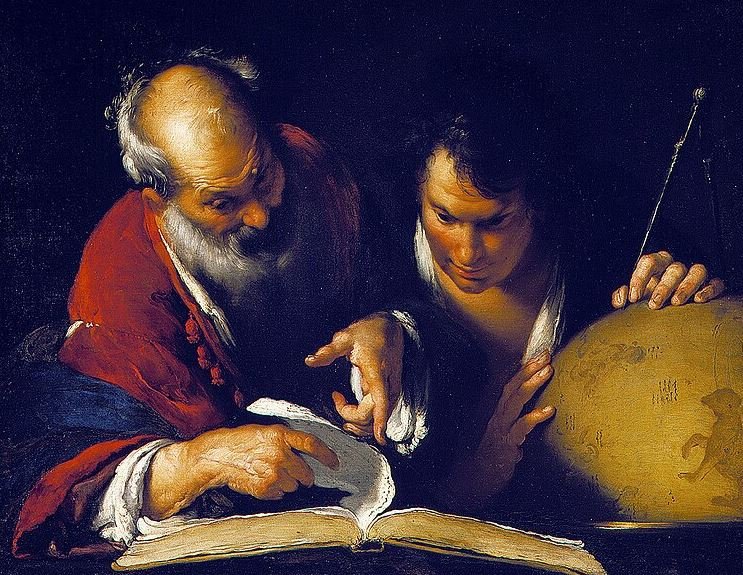
As the chief librarian at Alexandria’s Library, Eratosthenes advanced geographical studies by introducing enduring terminology and creating the first global map with parallels and meridians. Image: Eratosthenes instructing a scholar in Alexandria.
Mathematical and Scientific Achievements
One of Eratosthenes’s most renowned achievements was his calculation of the Earth’s circumference. Around 240 BC, he employed a method that involved measuring the distance between Alexandria and Syene (modern-day Aswan) along the same meridian and observing the angle of the Sun’s rays at noon on the summer solstice in both cities.
By using the difference in shadow angles cast by a vertical rod (gnomon) in each location, he was able to estimate the Earth’s circumference with remarkable accuracy, achieving an error margin of less than 1%. This groundbreaking calculation demonstrated his profound understanding of geometry and his ability to apply mathematical principles to real-world observations.
Eratosthenes is famous for calculating the Earth’s circumference with remarkable accuracy.
Eratosthenes’s approach involved a clever application of geometry and observational data. He recognized that the Sun’s rays are nearly parallel when they reach Earth, allowing him to use the difference in shadow angles between two locations on the same meridian to calculate the Earth’s curvature.
By measuring the distance between Alexandria and Syene and the corresponding angle difference, he applied the principles of similar triangles to derive the Earth’s circumference. This method not only showcased his exceptional analytical skills but also laid the groundwork for future advancements in geodesy and cartography.
In addition to his work in geography and astronomy, Eratosthenes made significant strides in number theory. He developed the sieve of Eratosthenes, an efficient algorithm for identifying prime numbers. This simple yet effective method involves iteratively marking the multiples of each prime number, starting with 2, to isolate prime numbers within a given range.
The sieve remains a fundamental tool in modern mathematics for its elegance and efficiency in prime number generation, illustrating Eratosthenes’s lasting impact on mathematical methodologies.

Geographic Innovations and “Geographika”
Eratosthenes’s contributions to geography were equally groundbreaking. Leveraging the extensive resources of the Library of Alexandria, he compiled and synthesized information from various travel accounts and geographic data.
In his lost work “Geographika,” he created the first global projection of the known world, incorporating the concepts of parallels and meridians. This innovative approach allowed for more accurate mapping and the ability to estimate distances between remote locations using a grid system. His division of the Earth into five climate zones—two freezing, two temperate, and one tropical—provided a foundational framework for the study of geography and demonstrated his ability to categorize and systematize complex information.
“Geographika” was a monumental work that mapped the known world with unprecedented precision. By establishing a grid system of parallels (lines of latitude) and meridians (lines of longitude), Eratosthenes provided a structured method for locating and referencing places across the globe. This grid system not only enhanced the accuracy of maps but also facilitated navigation and exploration, as travelers could now estimate their positions and distances from various landmarks with greater confidence.
Although “Geographika” itself has been lost to history, its influence is evident in the works of later geographers such as Strabo and Pliny. These historians preserved fragments of Eratosthenes’s ideas, ensuring that his contributions continued to inform and shape the study of geography for centuries to come. His integration of mathematical principles with geographic knowledge marked the beginning of a more scientific approach to understanding the Earth, distinguishing him as the “Father of Modern Geography.”
Mechanical Innovations and Collaborations
Eratosthenes’s ingenuity extended beyond theoretical studies into practical applications and mechanical innovations. He designed the mesolabio, a mechanical line-drawing device intended to aid in mathematical calculations, such as doubling the cube—a classical problem in geometry. This invention highlighted his innovative approach to solving mathematical challenges and his ability to bridge theoretical concepts with practical tools.
His collaboration with Archimedes, one of the greatest mathematicians of the ancient world, further fueled his scientific endeavors. Together, they explored various mathematical and mechanical innovations, including the development of war instruments like catapults. This partnership underscored Eratosthenes’s ability to apply theoretical knowledge to practical engineering problems, enhancing the technological capabilities of his time.
Did you know…?
Eratosthenes’s work in geography, particularly his “Geographika,” was groundbreaking. By creating a global map with a grid system of parallels and meridians, he provided a tool that could be used to accurately plot the locations of over 400 cities known at the time. This systematic approach to mapping enabled more precise navigation and the ability to estimate distances between distant places, thereby enhancing the understanding of the world’s geography.
Eratosthenes’s rejection of binary classification of humans
Eratosthenes’s philosophical views also left a lasting impact. He challenged Aristotle’s binary classification of humans into Greeks and barbarians, advocating instead for a more nuanced understanding of different cultures and peoples. This progressive stance underscored his belief in the value of diverse civilizations and his opposition to racial purity, reflecting his broader intellectual commitment to knowledge and inclusivity.
Contributions to Astronomy and Calendar Systems
Eratosthenes made significant contributions to astronomy, most notably his accurate calculation of the Earth’s circumference and axial tilt. His estimation of the Earth’s circumference demonstrated his ability to apply geometric principles to astronomical observations, providing a foundation for future geodetic studies. Additionally, his work in devising a calendar system that accounted for the solar year showed his deep understanding of celestial mechanics and their practical applications in daily life.
His calendar system, which recognized 365 days in a year with a leap year every four years, exemplified his commitment to precision and his ability to synthesize astronomical knowledge with practical needs. This system not only improved the accuracy of timekeeping but also facilitated better agricultural planning and societal organization.
Personal Challenges and Legacy
Despite his numerous accomplishments, Eratosthenes faced significant personal challenges later in life. He suffered from ophthalmia, a condition that caused blindness around 195 BC. The loss of his sight was a devastating blow, as it impaired his ability to read and observe the natural world—two of his greatest sources of inspiration and intellectual engagement.
Overwhelmed by his inability to continue his scholarly pursuits, Eratosthenes chose to end his life through voluntary starvation, passing away in 194 BC at the age of eighty-two in Alexandria.
Eratosthenes’s legacy is most prominently embodied in his accurate measurement of the Earth’s circumference. Using his innovative method of shadow measurement and distance calculation between Alexandria and Syene, he estimated the meridian to be approximately 252,000 stadia, translating to around 39,060 to 40,320 kilometers (24,270 to 25,050 miles), depending on the exact length of the stadion used. This estimation was impressively close to the actual circumference of the Earth, showcasing his exceptional analytical skills and his ability to apply theoretical knowledge to practical problems.
Greatest Scientists of the Hellenistic Period and their Accomplishments
Frequently Asked Questions
Where and when was Eratosthenes born?
Eratosthenes was born in 276 BC in Cyrene, a prominent city in what is now modern-day Libya.
What was Cyrene’s role in the region during Eratosthenes’s early life?
/Cyrene served as the capital of Pentapolis, a federation comprising five cities: Cyrene, Arsinoe, Berenice, Ptolemais, and Apollonia.
Who took control of Cyrene after Alexander the Great’s death, and what was the impact on the city?
After Alexander the Great’s death in 323 BC, control of Cyrene passed to Ptolemy I Soter, one of Alexander’s trusted generals. Under Ptolemaic rule, Cyrene flourished economically, largely due to the export of horses and silphium, a valuable plant used as seasoning and medicine.

Image: Mosaic of Alexander the Great.
What educational background did Eratosthenes receive in Cyrene?
In Cyrene, Eratosthenes received a comprehensive education at the local gymnasium, where he learned physical training, social interaction, and academic disciplines such as reading, writing, arithmetic, poetry, and music.
Which philosophers influenced Eratosthenes during his studies in Athens?
In Athens, Eratosthenes studied Stoicism under Zeno of Citium, followed by Aristo of Chios, who led a more skeptical branch of Stoicism, and Arcesilaus of Pitane, the head of the Platonic Academy.
What was Eratosthenes’s first scholarly work, and what did it explore?
Eratosthenes’s first scholarly work was “Platonikos,” which delved into the mathematical underpinnings of Plato’s philosophies, demonstrating his ability to intertwine abstract philosophical concepts with concrete mathematical principles.
What contributions did Eratosthenes make to the field of chronology?
Eratosthenes authored “Chronographies,” which meticulously documented important dates, including the Trojan War dated to 1183 BC, and “Olympic Victors,” a comprehensive chronology of the winners of the ancient Olympic Games, showcasing his dedication to accurate historical timelines.
How did Eratosthenes become the librarian of the Library of Alexandria?
Recognizing his scholarly prowess and poetic abilities, Ptolemy III Euergetes invited Eratosthenes to become the librarian of the Library of Alexandria in 245 BC. At thirty years old, Eratosthenes accepted the offer and relocated to Alexandria, where he eventually became Chief Librarian.
What policies did Eratosthenes implement as Chief Librarian to expand the Library of Alexandria’s collection?
Eratosthenes instituted policies requiring all books in Alexandria to be surrendered for duplication, ensuring the library amassed a comprehensive repository of knowledge. He also established specialized sections, such as one dedicated to Homer, and acquired original manuscripts of significant tragic dramas by playwrights like Aeschylus, Sophocles, and Euripides.
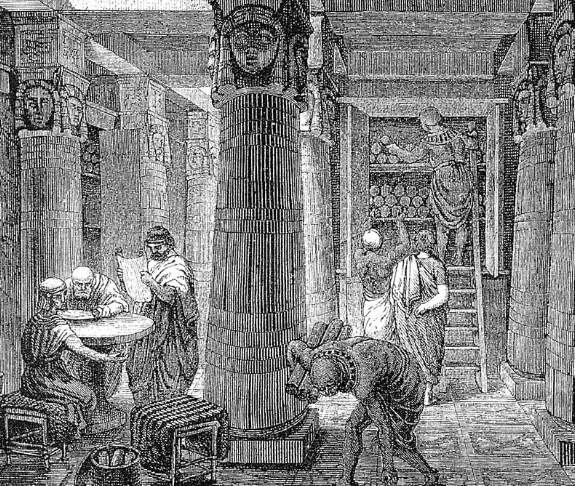
An illustration depicting the Library of Alexandria
How did Eratosthenes calculate the Earth’s circumference, and how accurate was his estimation?
Eratosthenes calculated the Earth’s circumference around 240 BC by measuring the distance between Alexandria and Syene (modern-day Aswan) along the same meridian and observing the angle of the Sun’s rays at noon on the summer solstice in both cities. Using the difference in shadow angles cast by a vertical rod (gnomon) in each location, he estimated the Earth’s circumference with an error margin of less than 1%, achieving remarkable accuracy.
What led to Eratosthenes’s death?
Eratosthenes suffered from ophthalmia, which caused blindness around 195 BC, impairing his ability to read and observe nature. Overwhelmed by his inability to continue his scholarly pursuits, he chose to end his life through voluntary starvation, passing away in 194 BC at the age of eighty-two in Alexandria.





