Eye of Horus
The Eye of Horus, also known as the left wedjat eye or udjat eye, is a profound symbol in ancient Egyptian religion, embodying well-being, healing, and protection. It is closely related to the Eye of Ra (the right wedjat eye), with both serving as significant emblems in Egyptian mythology.
READ MORE: Major Events in Ancient Egyptian Mythology
Origins of the Eye of Horus
The origins of the Eye of Horus trace back to the mythological battle between Horus and his adversary, Set (Seth). In this myth, Set damages or destroys one or both of Horus’s eyes, but the eye is restored or healed with the help of another deity, often Thoth.
The Eye of Horus represents well-being, healing, protection, and restoration. It is often associated with the moon.
This restoration gave the symbol its association with healing and rejuvenation. Horus then offers the restored eye to his deceased father, Osiris, whose continued existence in the afterlife is sustained by its power. Due to this connection, the Eye of Horus became closely tied to funerary rituals and temple offerings. It also symbolized the moon, reflecting its waxing and waning as a metaphor for injury and recovery.
Symbolism and Usage in Ancient Egypt
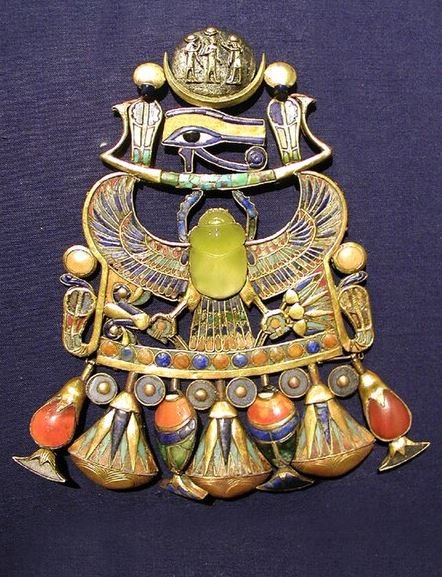
A 14th-century BC amulet from Tutankhamun’s tomb, featuring the Eye of Horus.
The Eye of Horus is depicted as a stylized human eye with distinctive markings that resemble those found on a falcon, an animal sacred to Horus. This symbol was believed to hold protective magical properties and frequently appeared in Egyptian art, including amulets, tombs, and temples.
Its usage spanned from the Old Kingdom (c. 2686–2181 BCE) to the Roman period (30 BCE–641 CE), demonstrating its enduring significance. During the First Intermediate Period (c. 2181–2055 BCE) and Middle Kingdom (c. 2055–1650 BCE), pairs of Horus eyes were often painted on coffins to protect the deceased.
The symbol was also carved onto stone stelae, inscribed onto temple walls, and even painted on the bows of boats, reinforcing its function as a talisman against harm.
Beyond Egypt, the Eye of Horus was adopted by neighboring cultures, including those of Nubia, Canaan, and Syria, attesting to its widespread influence.
Additionally, the hieroglyphic representation of the Eye of Horus (𓂀) held mathematical significance, with different parts of the eye believed to represent fractions in ancient Egyptian mathematics. Although this theory has been debated, it highlights the Eye’s integration into multiple facets of Egyptian life.

READ MORE: Who were the Two Ladies in Ancient Egyptian Religion?
Origins and Mythological Background
Horus, a major deity in Egyptian mythology, was primarily a sky god. Many texts describe his right eye as representing the sun and his left eye as representing the moon. Some scholars suggest that these two eyes were later distinguished as the solar Eye of Ra and the lunar Eye of Horus.
However, there is debate regarding when this distinction became explicit in Egyptian texts. Some argue that early references to the Eye of Horus were instead linked to the planet Venus before becoming associated with the moon in later periods.
A central theme in Egyptian mythology is the notion of an object that is lost or separated from its owner before being returned or restored.
In the myth of Horus and Set, Set steals or destroys Horus’s eye in their struggle for the throne of Egypt after the death of Osiris. Various myths describe different restorations of the eye, with Thoth, Hathor, or Isis playing crucial roles in healing it. In some versions, the eye is broken into pieces and reassembled by Thoth, paralleling the lunar cycle’s phases.
Mythological Significance
The Pyramid Texts, dating to the Old Kingdom, contain some of the earliest references to the conflict between Horus and Set. These texts describe Set stealing and consuming the Eye of Horus, which is then reclaimed by Horus through divine intervention.
Some texts also link the theft of Horus’s eye with Set’s own mutilation, as he is often depicted losing his testicles in their battles. In later texts, the Book of the Dead describes Set transforming into a black boar to wound Horus’s eye. Other versions from the Greco-Roman era detail how the eye was restored using specific plants and minerals, linking the restoration process to the healing cycle of the moon.
The Eye of Horus is one of the most enduring symbols of ancient Egyptian religion, representing healing, protection, and divine power.
One unusual variation of the myth connects the Eye of Horus to a separate episode in which Set attempts to sexually assault Horus. According to some interpretations, Horus retaliates by impregnating Set, and the resulting entity appears on Set’s forehead as a golden disk, which Thoth then places on his own head. Some scholars propose that this golden disk is actually the Eye of Horus, suggesting an alternative origin for its restoration.
The Eye of Horus in Funerary Practices and Rituals
The myth of Horus offering his eye to Osiris provided the foundation for ancient Egyptian funerary customs. Just as Horus revitalized his father with the power of the eye, offerings made to the dead were believed to sustain their spirits in the afterlife. This principle extended to temple rituals, where the Eye of Horus symbolized all offerings made to deities.
In addition to its role in funerary rites, the Eye of Horus was linked to the concept of maat (cosmic order). Because offerings ensured the gods’ well-being, and divine favor sustained the universe, the Eye of Horus became synonymous with the ritual acts that maintained balance and harmony.

A depiction of the Eye of Horus.
READ MORE: Egyptian Mythology: How the universe was created
Healing and Protective Qualities
Medical texts from ancient Egypt often incorporate references to the Eye of Horus. Egyptian medicine blended practical treatments with religious rituals, and many healing spells invoked the power of the Eye of Horus to restore health.
For instance, some spells likened physicians to Thoth, the healer of Horus’s eye, and equated medical instruments with the tools used to mend the divine eye.
The Eye of Horus was particularly associated with the treatment of eye diseases, and certain spells designated the left eye of a patient as a representation of the Eye of Horus to ensure divine protection.
Symbolism in Art and Amulets
Horus was commonly depicted as a falcon-headed god, and the Eye of Horus took on characteristics of both human and falcon eyes. The symbol includes distinctive features such as an eyebrow, a spiral extending from the outer corner, and a cheek marking reminiscent of falcon plumage. Some scholars believe that the curling line beneath the eye represents the facial markings of cheetahs, which the Egyptians associated with celestial forces.
Amulets bearing the Eye of Horus were among the most popular protective charms in ancient Egypt. They were worn by the living and placed on the deceased during burial. These amulets varied in design, incorporating elements such as cobra figures, feline features, and even miniature depictions of gods. The Eye of Horus also influenced later traditions, with some scholars suggesting that modern protective eye motifs, such as the Mediterranean “evil eye,” originated from the wedjat amulet.
Other Uses and Legacy
The Eye of Horus appeared in various artistic and architectural contexts beyond amulets. In the Middle Kingdom, pairs of painted eyes were placed on the sides of coffins, allowing the deceased to see into the afterlife while providing protective power.
Eyes were also painted on the bows of ships to offer divine vision and safeguard voyages. The motif frequently appeared on temple walls, and in some periods, only deities and kings were permitted to stand beneath winged sun disks, while common people were depicted under the protective gaze of wedjat eyes.
The Eye of Horus remained influential beyond Egypt, especially in Nubia, where it appeared in artistic motifs for centuries. The modern practice of painting eyes on boats in the Mediterranean may stem from its ancient Egyptian usage.
Frequently Asked Questions
How did the Eye of Horus originate in mythology?
It comes from the conflict between Horus and Set, in which Set damaged or stole Horus’s eye, and it was later restored by Thoth or another deity.

A sculpture work depicting Thoth, in the form of a baboon, holding the Eye of Horus.
Why was the Eye of Horus linked to funerary practices?
Horus offered the restored eye to his father Osiris, symbolizing sustenance and revival in the afterlife, leading to its use in funerary offerings.
What was the relationship between the Eye of Horus and the Eye of Ra?
They were complementary opposites: the Eye of Horus was the left (lunar) eye, while the Eye of Ra was the right (solar) eye, associated with the sun god Ra.
How was the Eye of Horus used in Egyptian magic and protection?
It was a common amulet believed to ward off evil, protect the wearer, and aid in healing rituals, particularly for eye diseases.
What role did the Eye of Horus play in Egyptian mathematics?
Egyptologists once believed its parts symbolized fractions of a hekat (a unit of volume), but this theory has been challenged.
Where did the Eye of Horus appear in Egyptian art?
It was used on coffins, boats, stelae, and jewelry, often painted on objects to provide protection and guidance.
Did other cultures adopt the Eye of Horus?
Yes, it influenced symbols in Nubia, Canaan, and Syria, and its use on ships may have inspired the Mediterranean practice of painting eyes on boats.
FACT CHECK: At World History Edu, we strive for utmost accuracy and objectivity. But if you come across something that doesn’t look right, don’t hesitate to leave a comment below.





