Ancient Egyptian Pharaoh Menkare
Menkare was a king of the Eighth Dynasty, ruling briefly around 2200 BC during the transition between the Old Kingdom and the First Intermediate Period.
Summary
Menkare was a little-known pharaoh of ancient Egypt who ruled during the early 22nd century BC, at a time of significant political and environmental instability. He is believed to have been the first or second ruler of the Eighth Dynasty, a period that marked the decline of the Old Kingdom and the beginning of the First Intermediate Period. His reign was likely short-lived, as suggested by the rapid succession of rulers during this tumultuous time. Like other pharaohs of the Eighth Dynasty, Menkare’s power was probably centered in Memphis. However, very little concrete evidence of his reign has survived, and much of what is known about him comes from later historical records and fragmentary artifacts.
Attestations
Due to the chaotic nature of the First Intermediate Period, very few records from Menkare’s time have been preserved. However, his existence is confirmed through various sources, including ancient king lists, potential contemporaneous inscriptions, and later artifacts that may reference him.
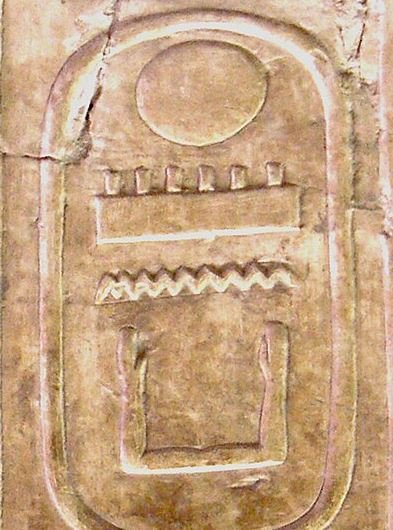
The Abydos King List featuring the cartouche of Menkare.
Historical Source: The Abydos King List
The primary historical record that confirms Menkare’s existence is the Abydos king list. This list was compiled during the reign of Seti I (c. 1290–1279 BC) and serves as one of the most important sources for early Egyptian rulers.
Menkare’s name is preserved in the Abydos king list, and he may have been referenced in an inscription from Queen Neit’s tomb.
Menkare appears in the 41st entry of this list, identifying him as one of the pharaohs of the obscure Eighth Dynasty. The purpose of the Abydos king list was religious rather than historical, meaning that it selectively included kings who were considered legitimate by later rulers. As a result, it is not a complete chronological record of all Egyptian monarchs.
The Turin Canon: A Possible but Lost Entry
Another important king list, the Turin Canon, was compiled during the early Ramesside period (13th century BC) and is written on a papyrus document. This text is considered one of the most comprehensive records of Egyptian rulers. However, the portion of the papyrus where Menkare’s name would have appeared has been lost due to damage, creating a frustrating gap in historical knowledge. If Menkare was indeed listed in the Turin Canon, it would have provided additional confirmation of his reign, but as it stands, this evidence is inconclusive.
Contemporaneous Evidence: The Tomb of Queen Neit
A possible reference to Menkare from his own time appears in a relief found in the tomb of Queen Neit, located in South Saqqara. The relief depicts the queen standing in front of a royal cartouche, which is unfortunately damaged.
The Egyptologist Percy Newberry proposed that the partially preserved name in the cartouche reads “Menkare,” suggesting that this may be the only contemporary attestation of his reign. This interpretation was later supported by Gae Callender, who reexamined the published images of the inscription made by Swiss Egyptologist Jean-Philippe Lauer and Jacques de Morgan. If correct, this would provide crucial evidence that Menkare was an active ruler rather than merely a name recorded in later king lists.
Later Artifact: The Cylinder Seal
Another potential, though much later, reference to Menkare is a cylinder seal made of glazed steatite, now housed in the British Museum under catalog number 30557. This artifact is inscribed with the phrase “The Good God, Lord of the Two Lands, Menkare.” However, the seal dates to the 26th Dynasty (c. 664–525 BC), nearly 1,700 years after Menkare’s supposed reign.
Given the obscure status of Menkare in history, many scholars believe that the inscription is actually a mistake and that the seal was intended to refer to the more famous pharaoh Menkaure (c. 2530–2510 BC), the builder of the third pyramid at Giza. This theory highlights the confusion surrounding Menkare’s identity, as later periods of Egyptian history may have conflated him with better-known rulers.
Theories and Misidentifications
Due to the scarcity of evidence regarding Menkare, there has been significant speculation and debate regarding his identity and historical role. One particularly intriguing but ultimately incorrect theory attempted to link him to the legendary Queen Nitocris.
The Discredited Identification with Nitocris
One of the most famous hypotheses about Menkare was proposed by the Egyptologist Flinders Petrie. He suggested that Menkare and Queen Nitocris, a semi-legendary ruler mentioned by Herodotus and Manetho, were actually the same person.
According to Herodotus, Nitocris avenged her brother’s murder and later drowned herself, while Manetho credited her with constructing the third pyramid at Giza. Since the third pyramid was, in fact, built by the Fourth Dynasty pharaoh Menkaure, Petrie theorized that later historical traditions had confused Menkare with Menkaure and that Nitocris was a misinterpretation of Menkare’s name.
However, this theory has been definitively disproven by modern scholars. Analysis of the Turin Canon has confirmed that Nitocris was not a male ruler but instead a corruption of the name Netjerkare Siptah, another obscure king from the late Old Kingdom. This revelation invalidated Petrie’s hypothesis, showing that Menkare and Nitocris were two entirely separate figures. The cylinder seal with Menkare’s name may also be a result of this longstanding confusion, further complicating the historical record.

Herodotus (c. 484 BC – c. 425 BC)
The Historical Context of Menkare’s Reign
Menkare’s reign occurred at a time of profound crisis in Egypt. The collapse of the Old Kingdom was marked by political fragmentation, economic decline, and environmental changes. The 4.2-kiloyear event, a significant period of aridification, led to widespread droughts that weakened the centralized power of the pharaohs. Famine and internal conflict became rampant, contributing to the rapid turnover of rulers and the eventual rise of regional warlords who challenged Memphis’s authority.
As a pharaoh of the Eighth Dynasty, Menkare likely ruled over a weakened state with little control beyond the immediate area of Memphis. The rapid succession of kings during this period suggests that his reign was brief and that he struggled to maintain order amid growing instability. Unlike the great pharaohs of the Fourth and Fifth Dynasties, who built massive pyramids and commanded vast territories, Menkare’s resources and influence were likely limited.
The Legacy of Menkare
Despite his obscurity, Menkare represents an important chapter in Egyptian history. His reign is a testament to the challenges faced by the pharaohs during the transition from the Old Kingdom to the First Intermediate Period. While he left behind no grand monuments or detailed records, his name survives in king lists and a handful of artifacts, ensuring that he is remembered as part of Egypt’s long and complex dynastic history.
The uncertainty surrounding Menkare’s identity, the possible misattribution of his name to later artifacts, and his brief rule reflect the broader difficulties of reconstructing history from fragmentary evidence. Scholars continue to piece together information about rulers like Menkare, whose lives and legacies have been obscured by time.





