False Beard in Ancient Egypt: Origin Story and Meaning
In ancient Egypt, the false beard, known as “postiche,” was a significant symbol of power and divinity. This unique ornament was not merely a fashion statement but a potent emblem of authority and connection to the gods.
In the article below, World History Edu delves into the origins, cultural significance, and evolution of the false beard in ancient Egypt, highlighting its role in the socio-political and religious fabric of the Egyptian civilization.
The Origins of the False Beard
The tradition of wearing false beards in ancient Egypt dates back to the early dynastic period, around 3000 BC. Initially, it was primarily associated with male pharaohs, who wore it as a symbol of their divine status. The false beard was usually made of metal, gold being the most prestigious material, although some were crafted from bronze or even precious stones. It was attached to the face using a strap that looped around the ears and tied at the back of the head.

False beards were often braided, represented by inward-slanting lines in the same gold and green colors as the wigs. Image: Mask of Tutankhamun, depicting the Egyptian pharaoh wearing a false beard.
Symbolism and Cultural Significance
The false beard was imbued with deep symbolic meaning. It was considered an attribute of the gods, particularly Osiris, the god of the afterlife, and Ra, the sun god. By wearing the false beard, pharaohs not only asserted their kingship but also their divine right to rule. This symbolic gesture underscored the belief that the pharaoh was a living deity on earth, an intermediary between the gods and the people.
Divinity and Kingship
In ancient Egyptian cosmology, the pharaoh was seen as the earthly embodiment of Horus during their lifetime and Osiris in death. The false beard, therefore, was more than an ornament; it was a declaration of the pharaoh’s divine nature. The beard’s shape, often curved at the end, mirrored the traditional depictions of gods, reinforcing the ruler’s god-like status.

Through the false beard, the pharaohs of ancient Egypt projected their power, connected with the divine, and left an indelible mark on history. Image: Statue of Egyptian pharaoh Amenhotep III, who reigned from 1388 BC to 1351 BC.
Gender and Authority
While the false beard was predominantly a male accessory, its use was not strictly limited by gender. Female pharaohs, such as Hatshepsut, also donned the false beard to assert their legitimacy and authority. Hatshepsut, who ruled during the 18th Dynasty, famously adopted the full regalia of a male king, including the false beard, to solidify her position as pharaoh. This practice highlights the beard’s role as a symbol of power rather than a marker of gender.
Evolution of the False Beard
Over the millennia, the style and significance of the false beard evolved. Different periods in Egyptian history saw variations in the length, curvature, and materials used for the beard, reflecting changes in artistic styles and religious beliefs.
Old Kingdom
During the Old Kingdom (c. 2686–2181 BC), the false beard was relatively short and square-ended. It was during this period that the convention of depicting pharaohs with false beards became standardized in royal iconography. Statues and reliefs from this era show pharaohs with neatly trimmed false beards, signifying their orderly and divine rule.
Middle Kingdom
In the Middle Kingdom (c. 2055–1650 BC), the false beard began to take on a more elongated and slightly curved form. This change may have been influenced by the increasing association of the pharaoh with Osiris, who was often depicted with a long, curved beard. The emphasis on Osirian imagery reflected the period’s heightened focus on the afterlife and the pharaoh’s role in ensuring the continuity of ma’at, or cosmic order.
New Kingdom
The New Kingdom (c. 1550–1070 BC) saw the false beard reach its most elaborate form. Pharaohs were depicted with long, intricately braided false beards that curved upward at the tip. This style was not only a mark of divine kingship but also a statement of the pharaoh’s prowess and capability as a ruler. The opulence of the false beard during this period mirrored the wealth and power of the New Kingdom pharaohs, who expanded Egypt’s influence through military conquests and extensive building projects.
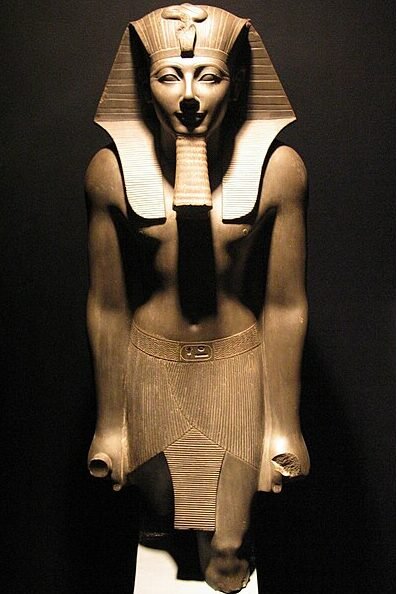
In ancient Egypt, the beard was seen as an attribute of several gods, especially Osiris, the god of the underworld and vegetation. Although real facial hair was not often admired, pharaohs (divine rulers) would wear false beards to signify their status as living gods. Image: A statue depicting Egyptian pharaoh, Tuthmosis III (reign: 1479 BC – 1425 BC) wearing a false beard.
Religious Context and Rituals
The false beard’s significance extended into religious rituals and ceremonies. During important religious festivals, pharaohs wore the false beard as part of their ceremonial attire. It was believed that wearing the beard helped the pharaoh channel divine energy and communicate with the gods more effectively.
Funerary Practices
The false beard also played a crucial role in funerary practices. Pharaohs were often buried with their false beards, either attached to their mummies or included in their tombs as part of their burial regalia. This practice was intended to ensure that the deceased ruler could assume their divine role in the afterlife, continuing to serve as a god-king in the realm of Osiris.
Artistic Representations
Artistic representations of the false beard are abundant in ancient Egyptian art. From statues and reliefs to painted tomb walls, the false beard is a consistent feature of royal iconography. These depictions not only highlight the beard’s symbolic importance but also provide insights into the artistic conventions and technological advancements of different periods.
Did you know…?
Typically, the Pharaoh’s face was shown hairless and clean-shaven, with only a rare white stone ostracon depicting a king with unshaven stubble.
Famed Greek historian Herodotus noted that close relatives of the deceased in Egypt grew beards and let their hair grow, indicating mourning for the predecessor.
Statues and Reliefs
Statues of pharaohs, both large and small, almost invariably include the false beard. These statues served as eternal representations of the ruler’s divine status, meant to inspire reverence and awe in both contemporaries and future generations. The detail and craftsmanship of these statues varied, with some false beards featuring intricate patterns and designs that underscored the ruler’s wealth and artistic patronage.

Not limited to pharaohs, influential members of society sometimes depicted their mummy cases with false beards to associate themselves with Osiris, the god of the afterlife, who also wore a false beard. Image: Osiris.
Tomb Paintings and Texts
Tomb paintings and hieroglyphic texts also frequently depict the false beard. These artworks often show the pharaoh performing religious rituals, interacting with gods, or presiding over important state functions, always adorned with the false beard. The consistency of these depictions reinforces the beard’s role as an indispensable element of royal identity and divine symbolism.
Decline and Legacy
The practice of wearing false beards declined during the later periods of Egyptian history, particularly after the conquest of Egypt by Alexander the Great in 332 BC. However, the symbolism of the false beard continued to influence the art and culture of subsequent civilizations. Greek and Roman rulers who adopted Egyptian iconography sometimes incorporated elements of the false beard into their representations to assert their authority over Egypt.
Frequently Asked Questions
What cultural, religious, and political significance did the false beard hold in ancient Egypt?
The false beard was a powerful symbol of divine kingship and authority, projecting the pharaoh’s power, connecting with the divine, and distinguishing the pharaoh from ordinary mortals.
From which period does the tradition of wearing false beards in ancient Egypt originate?
The tradition of wearing false beards in ancient Egypt dates back to the early dynastic period.
How did pharaohs use the false beard to assert their divine status?
Pharaohs wore false beards to signify their status as living gods, projecting their divine right to rule and serving as a tool for religious expression.
Why did influential members of society sometimes depict their mummy cases with false beards?
Influential members of society depicted their mummy cases with false beards to associate themselves with Osiris, the god of the afterlife, who also wore a false beard.
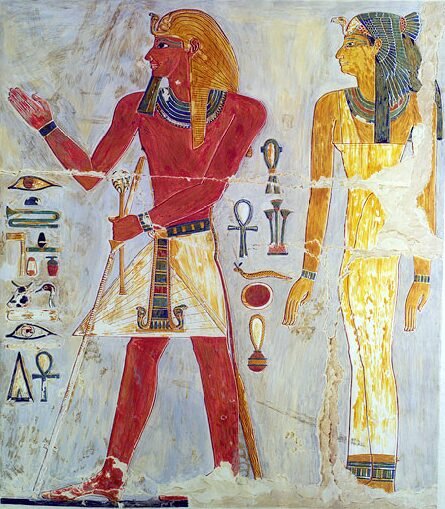
False beards were often braided and represented by inward-slanting lines in gold and green colors. They symbolized royal rank and divine status and were worn on the chin, attached to the ears by a long golden thread. Image: An artwork of Thutmosis I with his wife.
Which pharaoh, despite being female, wore the false beard to assert her supreme power?
Pharaoh Hatshepsut, of the 18th Dynasty, wore the false beard to assert her supreme power.
What other items, besides the false beard, were used to symbolize power and protection in ancient Egypt?
Other items used to symbolize power and protection included crowns, scepters, canes, scarves, sandals, and loincloths.
How did the ceremonial beard help distinguish pharaohs from ordinary mortals?
The ceremonial beard, a royal insignia since the Predynastic period, was shared with male deities and worn as a long, braided artificial goatee, distinguishing pharaohs from ordinary mortals.
What role did false beards play in the depictions of sphinxes in ancient Egypt?
In depictions of sphinxes, false beards indicated royal rank and divine status, often shown with a human face and a lion’s body.





