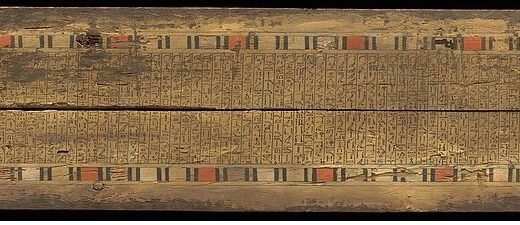
Pharaoh Mentuhotep II
Pharaoh Mentuhotep II, often regarded as the unifier of Egypt and the founder of the Middle Kingdom, played a pivotal role in shaping the course of ancient Egyptian history.
His reign marked the end of the First Intermediate Period, a time of fragmentation and disorder, and ushered in a new era of stability and centralized rule. Mentuhotep II’s accomplishments in uniting Egypt, reforming the government, and commissioning monumental architecture earned him a revered place in Egyptian history.
Below, World History Edu explores the key aspects of his life and reign, examining his family background, rise to power, military campaigns, government reforms, and cultural contributions.
READ MORE: Most Famous Middle Kingdom Pharaohs
Early Life and Family Background
Mentuhotep II was born into the royal family of the Eleventh Dynasty, a lineage that ruled from the city of Thebes in Upper Egypt. He was the son of Intef III, the fifth pharaoh of the Eleventh Dynasty, and Iah, a woman who was likely his father’s sister. Iah held the title “King’s Mother,” underscoring her important role within the royal family. Mentuhotep’s parentage is confirmed through various sources, including the stele of Henenu, an official who served under several Theban rulers, including Mentuhotep II.
Some scholars have speculated that Mentuhotep II may have had Nubian ancestry, due to certain facial features depicted in his iconography. This theory is further supported by the strong connections between the Theban rulers of Upper Egypt and Nubia, a region located to the south of Egypt. The potential Nubian influence, however, remains a matter of debate among scholars and is not universally accepted.
Mentuhotep II grew up in Thebes, a city that, during his youth, was a significant political and religious center in Upper Egypt. His father, Intef III, expanded Theban influence northward, bringing territories from the First Cataract of the Nile to Abydos under his control. When Intef III passed away, Mentuhotep II inherited a divided kingdom. Lower Egypt, centered around the city of Herakleopolis, was ruled by a rival faction, the Tenth Dynasty, which claimed control over the northern regions. Mentuhotep II’s challenge upon ascending to the throne was to reunite these two regions under a single, centralized government.

Mentuhotep II succeeded his father, Intef III, and was later succeeded by his son, Mentuhotep III. Image: Statue of Mentuhotep II.
Ascension to the Throne
Mentuhotep II likely ascended the throne as a young man around 2061 BCE, although the exact date is uncertain. His early years as pharaoh were marked by relative peace, particularly in the Theban region, where he inherited control over a significant portion of Upper Egypt. The fact that little is known about the first 14 years of his reign suggests that he focused on consolidating his power in the south rather than engaging in immediate conflict with the rulers of Lower Egypt.
At this time, Egypt was still in the midst of the First Intermediate Period, a time of political instability and weakened central authority that followed the collapse of the Old Kingdom. The pharaohs of the Eleventh Dynasty, based in Thebes, had been locked in a power struggle with the Tenth Dynasty, which ruled from Herakleopolis in the north. While Mentuhotep’s predecessors, including Intef III, had made military gains in the south, the two dynasties remained rivals for control over the entire country.
The Conflict with Herakleopolis
The peaceful period of Mentuhotep II’s early reign came to an end in his 14th regnal year, when a major conflict erupted between Thebes and Herakleopolis. According to historical records, this conflict was triggered when the Herakleopolitan kings desecrated the sacred necropolis of Abydos, a site of great religious significance to the Egyptians. This act of aggression prompted Mentuhotep II to take decisive military action. He dispatched his armies northward to confront the rulers of Lower Egypt and began a series of campaigns to conquer Herakleopolitan territory.
Mentuhotep II’s military campaigns were not swift, but rather a protracted struggle that took many years to achieve success. His forces faced strong resistance from the Herakleopolitan kings, but over time, Mentuhotep’s armies gradually pushed their way north, gaining control over key territories. The conflict likely involved significant casualties, as evidenced by the “Tomb of the Warriors” at Deir el-Bahari. This tomb, discovered in the 1920s, contains the remains of 60 soldiers who were killed in battle, possibly during the wars between Thebes and Herakleopolis. These soldiers were buried with linen wrappings bearing Mentuhotep II’s cartouche, indicating their loyalty to the Theban pharaoh.
Merikare, the king of Lower Egypt during this period, is believed to have died during the conflict. His death weakened the Herakleopolitan kingdom and allowed Mentuhotep II to make further gains in the north. Although the exact date of Egypt’s reunification is uncertain, it is generally believed to have occurred around the 39th year of Mentuhotep II’s reign, when he adopted the titulary “Sematawy,” meaning “He who unites the two lands.”
Reunification of Egypt
The reunification of Egypt under Mentuhotep II marked the end of the First Intermediate Period and the beginning of the Middle Kingdom, a new era of stability and prosperity. Mentuhotep II’s victory over the Herakleopolitan rulers allowed him to consolidate power over the entire country, from the First Cataract in the south to the Nile Delta in the north. As a result, he became the first pharaoh of the Middle Kingdom and established a new capital at Thebes, which would remain an important religious and political center for centuries to come.
Mentuhotep II’s reunification of Egypt was not just a military victory but also a significant cultural and religious achievement. The pharaoh was regarded as a divine figure, and his subjects saw him as the restorer of order, or ma’at, a central concept in Egyptian religion that emphasized balance, harmony, and justice. The king’s divine status was further reinforced by religious ceremonies and the construction of monumental architecture, including temples and mortuary complexes.

Image: Relief of Mentuhotep II
Government Reforms
After reunifying Egypt, Mentuhotep II initiated a series of government reforms aimed at centralizing authority and reducing the power of regional governors, known as nomarchs. During the First Intermediate Period, the nomarchs had gained significant autonomy, ruling over their respective regions with little oversight from the central government. This decentralization of power had contributed to the collapse of the Old Kingdom and the instability that followed.
To address this issue, Mentuhotep II restructured the government by creating new administrative positions, such as the Governors of Upper and Lower Egypt, who were directly responsible to the pharaoh. He also relied on a mobile force of royal officials who traveled across the country to monitor the activities of the nomarchs and ensure their loyalty to the central government. This system of oversight allowed Mentuhotep to maintain tighter control over the provinces and prevent the rise of regional power centers that could challenge his authority.
In addition to these administrative reforms, Mentuhotep II sought to reinforce his divine status through a program of self-deification. He portrayed himself as a god-like figure in temples and other public spaces, emphasizing his connection to the gods, particularly the sun god Ra and the goddess Hathor. This process of self-deification helped legitimize his rule and reinforced the idea that the pharaoh was the living embodiment of divine order.
Military Campaigns Beyond Egypt
Following the reunification of Egypt, Mentuhotep II did not rest on his laurels. He continued to engage in military campaigns to secure Egypt’s borders and expand its influence abroad. One of his primary targets was Nubia, a region to the south of Egypt that had gained its independence during the First Intermediate Period.
Mentuhotep II launched campaigns into Nubia in the 29th and 31st years of his reign, under the command of his vizier Khety. These campaigns were aimed at reasserting Egyptian control over the region and securing access to Nubia’s valuable resources, including gold. To maintain a military presence in the region, Mentuhotep II stationed a garrison on Elephantine Island, a strategic location near the First Cataract. This allowed Egyptian forces to be rapidly deployed southward when needed.
In addition to his campaigns in Nubia, there is evidence that Mentuhotep II engaged in military actions against Canaan, a region to the northeast of Egypt. An inscription found at Gabal El Uweinat, near the modern-day borders of Libya, Sudan, and Chad, mentions the king and suggests that Egypt had trade contacts or military expeditions in this area during his reign.
Mentuhotep II’s Building Projects
Mentuhotep II’s reign is notable for its significant architectural achievements, particularly his mortuary temple at Deir el-Bahari. This temple, located on the west bank of the Nile near Thebes, was one of the most ambitious and innovative building projects of its time. The temple broke from the Old Kingdom tradition of pyramid complexes and introduced new architectural elements, such as terraces and covered walkways.
The mortuary temple at Deir el-Bahari was designed not only as a place of burial but also as a site for religious ceremonies. It was the first mortuary temple to depict the king as an active participant in rituals for the gods, rather than merely the recipient of offerings. The temple also emphasized the Osirian aspects of the pharaoh’s death and afterlife, associating Mentuhotep II with the god Osiris, the ruler of the underworld. This Osirian ideology would influence the funerary practices of later pharaohs, particularly during the New Kingdom.
The construction of Mentuhotep II’s mortuary temple involved both local Theban artisans and craftsmen from Memphis. The local artistic style, characterized by large eyes and thin bodies, is evident in much of the temple’s decoration. However, the more refined work found in the chapels of Mentuhotep’s wives suggests the influence of Memphite artists, who were heavily influenced by Old Kingdom traditions.
The temple was divided into several sections, including a courtyard, a central terrace, and an ambulatory surrounded by octagonal columns. The central structure, which likely housed a large statue of the king, was flat-roofed rather than pyramid-shaped, as some early reconstructions had suggested. The temple’s layout and design would later inspire the construction of other temples in the New Kingdom, including the famous temple of Hatshepsut, located nearby at Deir el-Bahari.

Mentuhotep II was buried at Deir el-Bahari in a mortuary temple that incorporated significant architectural innovations, such as terraces and covered walkways. Image: Mentuhotep II’s Mortuary Temple
Egyptian deities that protected Ra during his journey through the underworld
Religious Innovations and Legacy
In addition to his architectural contributions, Mentuhotep II’s reign was marked by significant religious innovations. His mortuary temple, with its emphasis on the king’s role as both a god and a worshipper, reflected a shift in the way Egyptian rulers were perceived. By associating himself with Osiris and participating in rituals for the gods, Mentuhotep II blurred the line between the divine and mortal realms, reinforcing his status as a semi-divine figure.
Mentuhotep II’s program of self-deification also included changes to his titulary. He adopted new titles at key points in his reign, most notably after his military victories in the north and the reunification of Egypt. His titulary emphasized his role as the unifier of the two lands and his connection to the gods. These titles served both a political and religious function, helping to legitimize his rule and strengthen his control over a newly reunited Egypt.
Mentuhotep II’s legacy extended far beyond his reign. His accomplishments in reunifying Egypt, reforming the government, and commissioning monumental architecture set the stage for the Middle Kingdom, a period of relative stability and prosperity that lasted for several centuries. Later pharaohs, particularly those of the Twelfth Dynasty, looked to Mentuhotep II as a model of kingship and sought to emulate his success.
Even during the late Twelfth Dynasty, 200 years after Mentuhotep’s death, his memory was honored through religious ceremonies and offerings. Pharaohs such as Senusret III and Amenemhat III erected stelae commemorating rituals performed at Mentuhotep II’s statues, further cementing his status as one of Egypt’s most revered rulers.
Frequently Asked Questions
Who were Mentuhotep II’s parents?
Mentuhotep II was the son of Intef III and Iah, who was likely also his sister. Iah held the title “King’s Mother.”
Who were Mentuhotep II’s wives, and where were they buried?
Mentuhotep II had several wives, including Tem, Neferu II, Kawit, Sadeh, Ashayet, Henhenet, and Kemsit. They were buried near or within his mortuary temple at Deir el-Bahari.
How long did Mentuhotep II reign, according to the Turin Canon?
Mentuhotep II reigned for 51 years, as recorded in the Turin Canon.
In his 14th year, a conflict arose when the rival 10th Dynasty based in Herakleopolis desecrated the sacred necropolis at Abydos. Mentuhotep II launched military campaigns to reunite Egypt.
What military campaigns did Mentuhotep II undertake after reunifying Egypt?
Mentuhotep II launched campaigns into Nubia, sending forces south and posting a garrison at Elephantine Island. There is also evidence of military actions against Canaan during his reign.
How did Mentuhotep II reorganize Egypt’s government after reunification?
Mentuhotep II centralized authority in Thebes, weakened the power of regional nomarchs, and created the positions of Governors of Upper and Lower Egypt to oversee the local rulers.
What was Mentuhotep II’s most ambitious architectural project?
His most ambitious project was his mortuary temple at Deir el-Bahari, which featured architectural innovations such as terraces, covered walkways, and emphasized his association with the god Osiris.
The temple introduced new religious and architectural ideas that influenced later pharaohs, including Hatshepsut, and became a model for future mortuary temples.
Excavations of the temple uncovered the tombs of Mentuhotep’s wives, artifacts, and the famous black statue of Mentuhotep II, found by British archeologist Howard Carter in 1898.
The temple included a courtyard, a central terrace, an ambulatory with octagonal columns, and a core building that likely housed a large statue of the king.