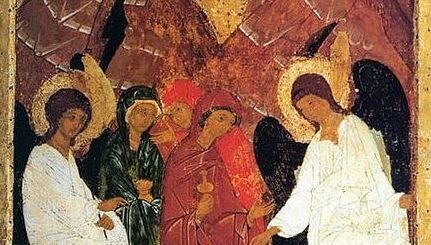
Feast of Corpus Christi
The Feast of Corpus Christi, officially known in Ecclesiastical Latin as Dies Sanctissimi Corporis et Sanguinis Domini Iesu Christi (The Day of the Most Holy Body and Blood of Jesus Christ the Lord), is a significant liturgical solemnity in Christian tradition. This feast is primarily observed by the Latin Church and select Western Orthodox, Lutheran, and Anglican communities. Unlike Maundy Thursday, which commemorates the institution of the Eucharist with a somber tone, Corpus Christi is a celebration of joy and reverence for the real presence of Christ in the Eucharist.
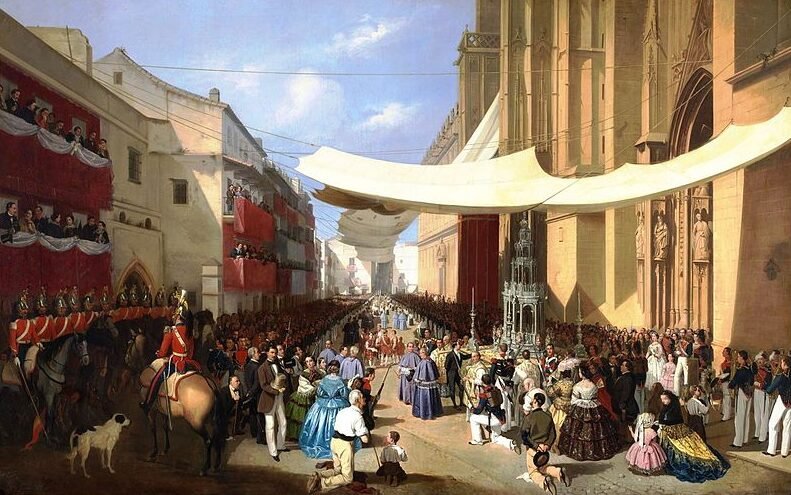
An illustration depicting a 19th century Corpus Christi procession taking place in Seville, Spain.
Origins and Historical Background
Corpus Christi was established as a feast in the Christian calendar due to the efforts of Juliana of Liège, a 13th-century Norbertine canoness. Born in Liège, Belgium, Juliana developed a strong devotion to the Blessed Sacrament. She reported visions of the Church as a full moon with a dark spot, which symbolized the absence of a dedicated feast honoring the Eucharist. Encouraged by her confessor, she petitioned Robert de Thorete, Bishop of Liège, to establish a feast in its honor.
In 1246, Bishop Robert decreed that Corpus Christi would be celebrated annually in the Diocese of Liège on the Thursday following Trinity Sunday. The feast gained further momentum when Jacques Pantaléon, former Archdeacon of Liège, became Pope Urban IV. In 1264, recognizing the Eucharistic Miracle of Bolsena, he issued the papal bull Transiturus de hoc mundo, formally establishing the feast for the entire Latin Church. However, its widespread adoption took time, with universal observance occurring after Pope Clement V included it in Clementines, a collection of canon laws promulgated by Pope John XXII in 1317.
Liturgical Celebration and Rituals
The feast is traditionally observed on the Thursday following Trinity Sunday. However, in regions where it is not a holy day of obligation, it is often celebrated on the following Sunday.
The Eucharistic Procession
A hallmark of Corpus Christi is the Eucharistic procession, in which the Blessed Sacrament, displayed in a monstrance, is carried through the streets with great reverence. The procession is often accompanied by hymns, prayers, and Benediction of the Blessed Sacrament. This public demonstration of faith is especially grand in cities like Rome, where the Pope leads the procession from the Archbasilica of St. John Lateran to the Basilica of Saint Mary Major.
Corpus Christi Wreaths
A unique folk tradition associated with the feast is the making of Corpus Christi wreaths from flowers, which are placed on doors, windows, and gardens as a sign of blessing and devotion. These wreaths are also used to adorn the path of the Eucharistic procession.
Corpus Christi in Different Christian Traditions
Catholic Church
In the Roman Catholic Church, Corpus Christi is one of the most significant solemnities, emphasizing the doctrine of transubstantiation—the belief that the bread and wine become the true Body and Blood of Christ. The feast was one of the few retained by Pope Pius V during the reform of the General Roman Calendar in 1570.
Anglicanism
Corpus Christi was abolished in England in 1548 during the English Reformation. However, in recent years, some Anglican churches have reinstated the observance under the title “Thanksgiving for Holy Communion.” Anglo-Catholic parishes, especially within the Church of England, continue to celebrate the feast with full solemnity.
Lutheranism and Protestant Views
During the Protestant Reformation, most Protestant denominations abandoned the celebration of Corpus Christi due to theological objections, particularly regarding transubstantiation. Martin Luther strongly opposed Corpus Christi processions, describing them as idolatrous. However, some Lutheran communities retain the observance, recognizing the Real Presence of Christ in the Eucharist.
Eastern Orthodox and Eastern Catholic Observance
The Byzantine Rite does not celebrate Corpus Christi in the same manner as the Latin Church. However, some Eastern Catholic communities, particularly the Ukrainian Greek Catholic Church, have integrated elements of the feast, reflecting the Italo-Greek tradition of venerating the Holy Eucharist.
Eucharistic Miracle of Bolsena
A pivotal event linked to Corpus Christi is the Eucharistic Miracle of Bolsena. According to tradition, a priest named Peter of Prague doubted the doctrine of transubstantiation. While celebrating Mass in 1263, the consecrated host began to bleed. This miracle was reported to Pope Urban IV, who was residing in Orvieto at the time. He ordered an investigation, and upon verifying the miracle, he instituted Corpus Christi as a universal feast. The bloodstained corporal is still enshrined in Orvieto Cathedral today.

A woven artwork illustrating the Miracle of Bolsena, showcased during the Corpus Christi parade in Orvieto.
The Feast of Corpus Christi holds a special place in Christian devotion, emphasizing the real presence of Christ in the Eucharist.
Cultural and Folk Traditions
Spain and Latin America
Corpus Christi is widely celebrated in Spain and Latin American countries with grand processions, folk dances, and elaborate street decorations. In Cusco, Peru, the festival is intertwined with indigenous traditions, blending Catholic and Incan elements.
Austria and Germany
In Austria and Germany, Corpus Christi is a public holiday. Towns hold traditional processions, often accompanied by music and banners, while children scatter flower petals along the path.
Poland
Poland is known for its floral carpets created for Corpus Christi processions, particularly in Spycimierz and the Opole region. These intricate designs made from petals and greenery form stunning religious imagery.
The Philippines
In the Philippines, Corpus Christi processions are a major event, often featuring elaborate carriages carrying the Blessed Sacrament through the streets. The Archbishop of Manila presides over one of the largest processions in the country.
Corpus Christi in Art and Music
Sacred Music and Hymns
Saint Thomas Aquinas composed several hymns specifically for Corpus Christi, many of which remain central to Eucharistic liturgies. These include:
- Pange Lingua – A hymn sung during Eucharistic processions, also used on Maundy Thursday.
- Tantum Ergo – Derived from Pange Lingua, frequently used at Benediction.
- Lauda Sion Salvatorem – The sequence for Corpus Christi Mass, praising the Eucharist.
Artistic Representations
The theme of Corpus Christi has inspired numerous works of art. Notable examples include Baroque paintings depicting the Eucharistic Miracle of Bolsena and sculptures of processional monstrances adorned with intricate gold and silver designs.
Modern Observance and Public Holidays
Corpus Christi is recognized as a public holiday in many Catholic-majority countries, including Argentina, Brazil, Austria, Poland, and Spain. In some regions, particularly in Europe and Latin America, the observance remains deeply embedded in cultural traditions, with street festivals and special religious services.
In the modern era, while secularization has affected public observance, Corpus Christi remains a significant feast in the liturgical calendar, reaffirming the belief in the Eucharistic presence of Christ.
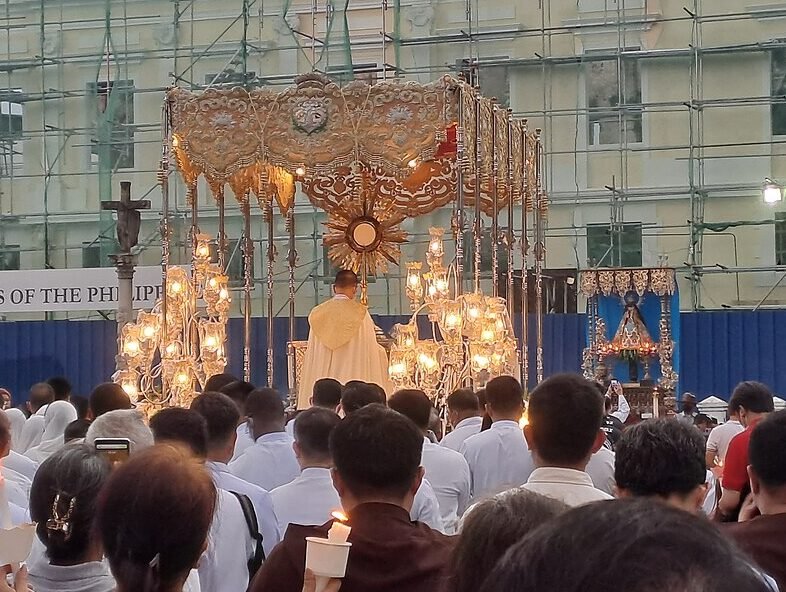
Corpus Christi procession in the city of Manila in Philippines.
Frequently Asked Questions
Who initiated the establishment of Corpus Christi?
Juliana of Liège, a 13th-century Norbertine canoness, promoted the feast after experiencing visions calling for a dedicated celebration of the Eucharist.
Why did Pope Urban IV establish Corpus Christi as a universal feast?
After recognizing the Eucharistic Miracle of Bolsena in 1264 and influenced by the theological work of Thomas Aquinas, Pope Urban IV issued the papal bull Transiturus de hoc mundo to establish the feast for the entire Latin Church.
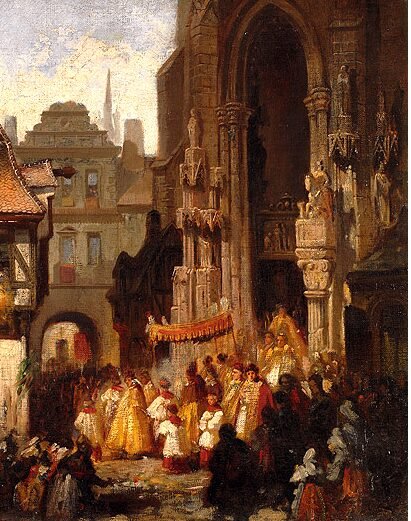
A depiction of Corpus Christi by German artist Carl Emil Doepler.
How is Corpus Christi traditionally celebrated?
It is observed with a solemn Mass followed by a Eucharistic procession where the consecrated host is displayed in a monstrance, accompanied by hymns, prayers, and Benediction of the Blessed Sacrament.
What is the significance of the Eucharistic procession?
The procession publicly honors the Blessed Sacrament, reinforcing the Catholic belief in the real presence of Christ in the Eucharist and serving as a visible act of faith.
How did the Protestant Reformation impact the observance of Corpus Christi?
Most Protestant groups rejected the feast due to theological disagreements on transubstantiation, with only some Lutheran and Anglican communities maintaining elements of the celebration.
What are some unique cultural traditions associated with Corpus Christi?
In Spain and Latin America, the feast includes grand processions and elaborate floral carpets, while in Poland, intricate flower designs adorn the streets for Eucharistic processions.
Is Corpus Christi a public holiday?
It is a public holiday in several Catholic-majority countries, including Austria, Brazil, Poland, and Spain, where it remains an important religious and cultural event.