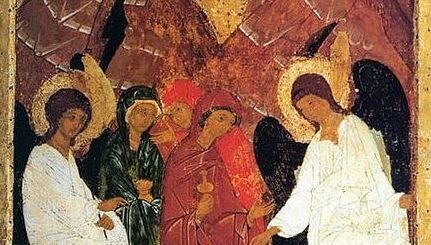
The Seven Sorrows of Mary
Our Lady of Sorrows, also referred to as Mater Dolorosa, Our Lady of Dolours, Mother of Sorrows, or Our Lady of the Seven Sorrows, is a title given to Mary, the mother of Jesus, in relation to her immense suffering and grief during key moments of her life. This title underscores Mary’s profound compassion and emotional connection to the passion of Christ. It holds deep significance in Christian theology and art, particularly within the Catholic Church, and serves as a central theme for devotions and feast days.
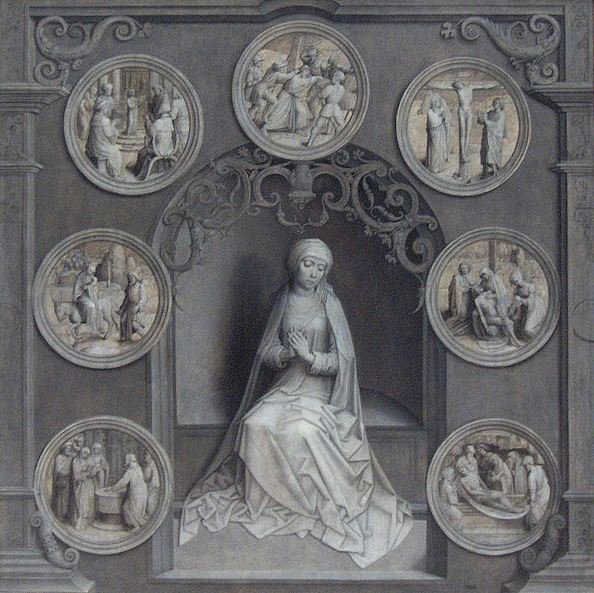
An illustration portrays Mary at the center, surrounded by representations of the Seven Sorrows.
Origin and Significance
The concept of Mary as the “Sorrowful Mother” is deeply rooted in the prophecy of Simeon, found in Luke 2:34–35. Simeon foretold that a sword would pierce Mary’s soul, symbolizing the emotional pain she would endure witnessing her son’s suffering. This prophecy became the foundation for Marian devotions and iconography related to her sorrows. Over time, these devotions were formalized into the theme of the Seven Sorrows of Mary, which represents pivotal moments of grief in her life.
The Seven Sorrows of Mary
The Seven Sorrows are specific events that highlight Mary’s suffering. These are:
- The Prophecy of Simeon (Luke 2:25–35)
Simeon’s words during the presentation of Jesus in the temple foreshadowed Mary’s future anguish. - The Flight into Egypt (Matthew 2:13–15)
Mary and Joseph fled to Egypt to protect Jesus from King Herod’s massacre of infants. - The Loss of the Child Jesus in the Temple (Luke 2:41–50)
Mary and Joseph experienced great anxiety when they could not find Jesus for three days. - Mary Meets Jesus on the Way to Calvary (Luke 23:27–31; John 19:25)
Mary encounters Jesus carrying His cross, overwhelmed by the sight of His suffering. - The Crucifixion and Death of Jesus (John 19:25–30)
Standing at the foot of the cross, Mary witnessed her son’s agony and death. - The Body of Jesus is Taken Down from the Cross (Luke 23:50–54)
Mary cradled her son’s lifeless body in profound sorrow. - The Burial of Jesus (Luke 23:55–56)
Mary accompanied Jesus’ body to the tomb, mourning the loss of her son.
These sorrows have inspired devotional practices and iconographic representations over centuries.
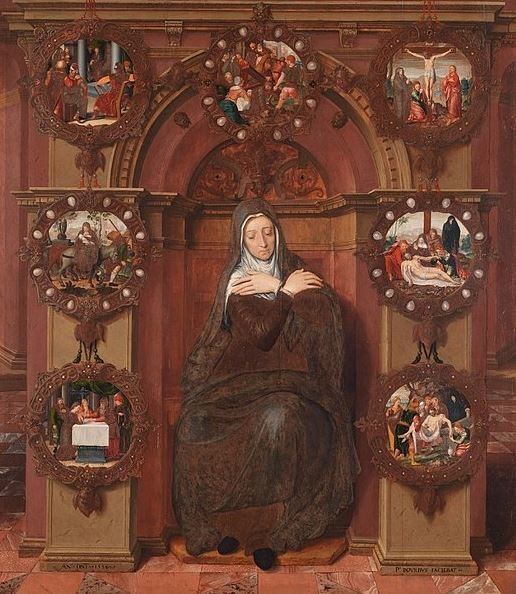
A painting by Flemish painter Pieter Pourbus, entitled “Our Lady of Sorrows”
Devotions to Our Lady of Sorrows
Devotion to Our Lady of Sorrows began around the 11th century, gaining prominence with the foundation of the Servite Order in 1233. The Servite Friars adopted the sorrows of Mary as their principal focus, spreading the devotion through the Rosary of the Seven Sorrows, the Black Scapular, and the Novena to Our Sorrowful Mother.
- Rosary of the Seven Sorrows: This unique rosary features seven groups of seven beads, each set dedicated to a specific sorrow, with prayers and meditations for reflection.
- Black Scapular: A devotional garment symbolizing mourning and a commitment to meditating on Mary’s sorrows.
- Stabat Mater Hymn: Written by Jacopone da Todi, this hymn poignantly portrays Mary’s grief at the crucifixion.
According to tradition, Jesus revealed four promises to devotees of Mary’s sorrows, including true repentance before death, divine protection in tribulations, and eternal remembrance of Christ’s passion. These promises were reported by St. Elizabeth of Hungary and popularized by saints like Alphonsus Liguori.
The Servite Order, established in 1233 in Tuscany, popularized the devotion through their prayers, chaplets, and the promotion of Marian sorrows.
In Eastern Christianity, the devotion centers around icons such as “The Softening of Evil Hearts”, which depict Mary with seven swords piercing her heart. This iconography aligns with Simeon’s prophecy and serves as a focal point for prayers asking Mary to transform sorrow into joy and soften hearts filled with malice.
Liturgical Feast
The Feast of Our Lady of Sorrows is celebrated on September 15 in the Catholic Church, immediately following the Feast of the Holy Cross. Its origins trace back to the 12th century, becoming widespread through the Servite Order. In 1814, Pope Pius VII formalized the feast within the General Roman Calendar.
Earlier, a separate feast, known as Our Lady of Compassion, was celebrated during Passion Week. Over time, the September date became the primary observance. Today, the feast day serves as a reminder of Mary’s co-redemptive role in Christ’s mission.
Artistic Representations
Mater Dolorosa is a central theme in Marian art. Depictions often show Mary weeping, with seven swords piercing her heart, symbolizing the Seven Sorrows. Iconic works include:
- Stabat Mater representations, highlighting Mary’s anguish at the foot of the cross.
- Pietà sculptures, such as Michelangelo’s masterpiece, portraying Mary cradling the dead Christ.
- Paintings by artists like Titian, El Greco, and Pieter Pourbus, which emphasize Mary’s sorrowful expression and compassionate presence.
These artistic interpretations have played a crucial role in fostering devotion and connecting the faithful to Mary’s experiences.
Related Orders and Organizations
Numerous religious orders and groups are dedicated to the veneration of Our Lady of Sorrows, including:
- Servite Order: Founded to promote devotion to Mary’s sorrows.
- Congregation of Holy Cross: Honors Our Lady of Sorrows as its patroness.
- Sisters of Our Lady of Sorrows: Focused on spiritual and charitable works under Mary’s guidance.
Additionally, nations such as Slovakia and regions like Mola di Bari in Italy honor Our Lady of Sorrows as their patroness.
Theological Reflections
Mary’s role as Mater Dolorosa emphasizes her unique participation in Christ’s redemptive mission. Her grief mirrors the suffering of humanity and her unwavering faith serves as a model of spiritual endurance. Devotion to her sorrows fosters compassion and a deeper connection to the Passion of Christ.
Theologians highlight Mary’s sorrows as an expression of her spiritual motherhood, extending her care to all believers. Her ability to unite her suffering with Christ’s offers hope and inspiration for those facing trials.
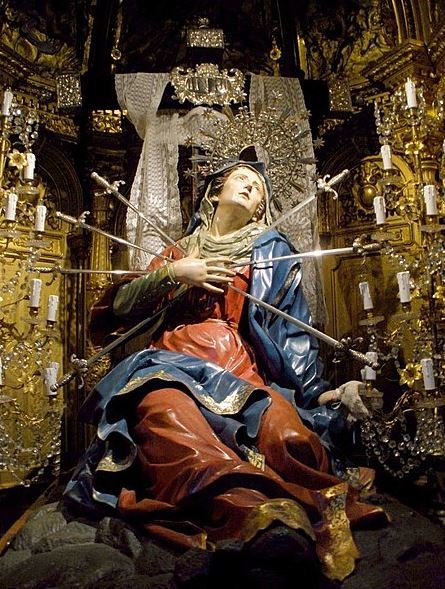
In the Church of the Holy Cross in Salamanca, Spain, an image depicts Mary’s sorrowful heart pierced by seven swords.
Global Celebrations
Devotions to Our Lady of Sorrows are widespread, with processions, novenas, and public celebrations marking her feast day. Notable examples include:
- Brooklyn’s Carroll Gardens Procession: Italian immigrants brought the tradition of honoring Our Lady of Sorrows to the United States, where it remains a vibrant cultural and religious event.
- Philippine Celebrations: Devotions such as the Turumba Festival in Pakil, Laguna, highlight Mary’s role as a source of consolation and intercession.
Patronage
Our Lady of Sorrows is the patroness of numerous individuals, organizations, and locations, including:
- People named Dolores, Lola, or Pia.
- Slovakia, where September 15 is a public holiday.
- Churches and shrines across the world, such as the Basilica of Our Lady of Sorrows in Chicago and the National Shrine of Our Lady of Sorrows in Dolores, Quezon, Philippines.
Frequently Asked Questions
What are the Seven Sorrows of Mary?
The Seven Sorrows are events in Mary’s life that reflect her suffering: the Prophecy of Simeon, the Flight into Egypt, the Loss of Jesus in the Temple, Mary meeting Jesus on the Via Dolorosa, the Crucifixion, the Descent from the Cross, and the Burial of Jesus.
What is the feast of Our Lady of Sorrows?
This feast is celebrated on September 15, commemorating Mary’s sorrows and her compassionate participation in Christ’s Passion. It originated in the 12th century and gained prominence in the 18th century.
What devotions are associated with Our Lady of Sorrows?
Devotions include the Chaplet of the Seven Sorrows, the Black Scapular of the Seven Dolours, the Stabat Mater hymn, and the Novena to Our Sorrowful Mother.
What does Mater Dolorosa imagery depict?
Mater Dolorosa is often depicted with seven swords piercing her heart, symbolizing her seven sorrows, or shown weeping in anguish, reflecting Simeon’s prophecy in Luke 2:34–35.
What are the promises tied to the devotion of the Seven Sorrows?
According to tradition, Jesus promised blessings such as protection, true repentance, and grace to those devoted to Mary’s sorrows, as revealed to St. Elizabeth of Hungary.
What role does art play in the devotion?
Marian art, including works like the Pietà and the Stabat Mater, frequently depicts Our Lady of Sorrows, emphasizing her emotional and spiritual agony during Christ’s Passion.