First Liberian Civil War
The First Liberian Civil War was a devastating conflict that engulfed Liberia from December 1989 to August 1997. The war arose from political and ethnic tensions exacerbated by corruption, totalitarian rule, and economic decline under President Samuel Doe.
The conflict was marked by mass violence, significant civilian casualties, and the involvement of multiple factions vying for control.
The war eventually resulted in the intervention of regional and international forces and culminated in the election of Charles Taylor as president in 1997. However, the fragile peace was short-lived as Liberia descended into another civil war in 1999.
Below, World History Edu a comprehensive look at the almost 8-year First Liberian Civil War, including its background, key events, international interventions, peace agreements, and long-term impact.
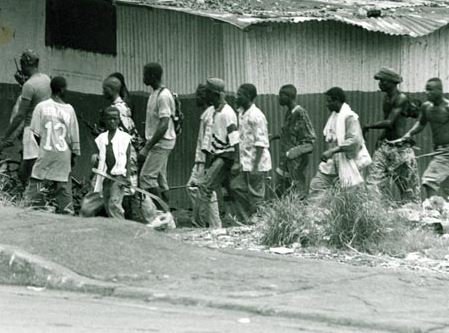
The fighters of the National Patriotic Front of Liberia in Monrovia.
The Rise of Samuel Doe
Samuel Doe, a member of the Krahn ethnic group, seized power in 1980 through a coup that overthrew President William R. Tolbert. As the first indigenous leader of Liberia, Doe initially had widespread support. However, his rule soon became characterized by authoritarianism, human rights abuses, and favoritism toward the Krahn people. Doe’s consolidation of power led to increased opposition, particularly from marginalized ethnic groups such as the Gio and Mano.

Samuel Doe in 1982.
The 1985 Elections and Political Unrest
Despite promises of democratic governance, Doe manipulated the 1985 elections to remain in power. The election was widely condemned as fraudulent, sparking increased resentment among opposition groups. That same year, Thomas Quiwonkpa, a former military commander and close associate of Doe, attempted a coup but failed. Quiwonkpa was subsequently executed, and his death intensified ethnic tensions as Doe’s forces targeted Gio and Mano communities in retaliation.
Charles Taylor and the Formation of the NPFL
Charles Taylor, a former government official under Doe, fled Liberia in 1983 after being accused of embezzling government funds. He later escaped from a U.S. prison and regrouped in Côte d’Ivoire, where he formed the National Patriotic Front of Liberia (NPFL) with the aim of overthrowing Doe. Taylor’s rebel group launched an invasion into Liberia on December 24, 1989, marking the beginning of the First Liberian Civil War.

A 2004 photo of Charles Taylor
Outbreak of War
The NPFL quickly gained ground, particularly in Nimba County, where Doe’s forces had committed atrocities against the local population. Many Gio and Mano fighters joined Taylor’s rebellion, seeking revenge against the government. The Liberian Army responded brutally, indiscriminately targeting civilians suspected of supporting the NPFL.
By mid-1990, the NPFL had gained control over much of the country. However, internal divisions led to the emergence of the Independent National Patriotic Front of Liberia (INPFL), a splinter group led by Prince Johnson. The war evolved into an ethnic conflict, with Doe’s Krahn-dominated forces fighting against Gio and Mano factions. In July 1990, the worst atrocity of the war occurred when government forces massacred over 600 civilians in St. Peter’s Lutheran Church in Monrovia.
Taylor’s forces laid siege to Monrovia in mid-1990, while the INPFL also sought control of the capital. Chaos engulfed the city as rival factions and government troops looted and killed indiscriminately. International pressure mounted as humanitarian conditions deteriorated, leading to the evacuation of foreign nationals by the U.S. Navy.

ECOWAS Intervention and the Execution of Doe
In August 1990, the Economic Community of West African States (ECOWAS) deployed the Economic Community Monitoring Group (ECOMOG), a peacekeeping force led by Nigeria. The intervention was aimed at stopping the fighting and stabilizing the country. However, ECOMOG itself became embroiled in conflicts with Taylor’s NPFL.
On September 9, 1990, Samuel Doe was captured by the INPFL while visiting the ECOMOG headquarters at the Freeport of Monrovia. Prince Johnson’s forces brutally tortured and executed Doe, an event that was filmed and widely circulated. Following Doe’s death, the war continued as various factions vied for power.
Attempts at Peace and Continued Fighting
Following Doe’s death, ECOWAS established an Interim Government of National Unity (IGNU) under Amos Sawyer. However, Taylor refused to recognize the new government, controlling vast territories outside of Monrovia.
In 1991, the United Liberation Movement of Liberia for Democracy (ULIMO) was formed by former government loyalists. ULIMO launched offensives against Taylor’s NPFL, further fragmenting the conflict. The war also spread into neighboring Sierra Leone, where Taylor backed the Revolutionary United Front (RUF).
In October 1992, Taylor launched ‘Operation Octopus,’ a major assault on Monrovia. The offensive led to fierce battles between NPFL fighters and ECOMOG forces, but Taylor failed to capture the capital. The conflict dragged on with intermittent ceasefires and continued violence.
Peace Agreements and the End of the War
In 1993, ECOWAS brokered the Cotonou Peace Agreement, leading to the deployment of the United Nations Observer Mission in Liberia (UNOMIL). Despite international efforts, fighting persisted as factions broke ceasefire agreements.
A significant breakthrough occurred in 1995 when the Abuja Peace Accord was signed. Under the agreement, a transitional government was formed, and preparations began for elections. However, sporadic fighting continued, particularly in Monrovia in 1996.
Elections were held in July 1997, with Charles Taylor emerging victorious. His party, the National Patriotic Party (NPP), won a majority in both legislative chambers. Many Liberians, exhausted by war, voted for Taylor, hoping he would bring stability. Taylor assumed the presidency in August 1997, officially ending the First Liberian Civil War.

Aftermath and Long-Term Impact
The war claimed over 210,000 lives and displaced nearly one million people. Liberia’s economy collapsed, infrastructure was destroyed, and child soldiers were widely recruited by various factions. The war also destabilized neighboring countries, contributing to regional conflicts.
Despite the formal end of the war, Liberia remained volatile. Taylor’s rule was marked by authoritarianism, human rights abuses, and involvement in Sierra Leone’s civil war. In 1999, a new rebel group, the Liberians United for Reconciliation and Democracy (LURD), launched an insurgency, igniting the Second Liberian Civil War.
10 significant events that shaped African history during the 20th century
Frequently Asked Questions
What were the main causes of the First Liberian Civil War?
The war was primarily caused by ethnic tensions, political corruption, and authoritarian rule under Samuel Doe, exacerbated by economic decline and human rights abuses.
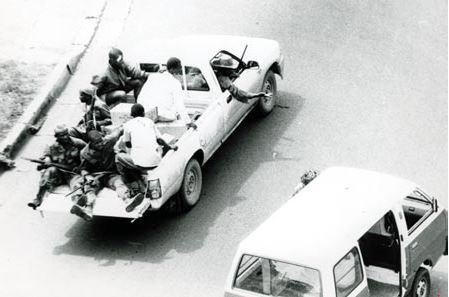
A 1990 photo of INPFL fighters after securing control over much of Monrovia.
Who were the major factions involved in the conflict?
The primary factions included Charles Taylor’s National Patriotic Front of Liberia (NPFL), Prince Johnson’s Independent National Patriotic Front of Liberia (INPFL), and the United Liberation Movement of Liberia for Democracy (ULIMO), alongside the government’s Armed Forces of Liberia (AFL).
How did Charles Taylor rise to power during the war?
Taylor led the NPFL invasion in 1989 and gained widespread support from marginalized ethnic groups. After years of conflict, he won the 1997 elections, largely due to war fatigue and his control over vast territories.
What role did ECOWAS and ECOMOG play in the war?
ECOWAS deployed ECOMOG, a peacekeeping force, in 1990 to stabilize Liberia and prevent regional spillover. They protected Monrovia and brokered peace agreements despite facing resistance from rebel groups.
How did Samuel Doe die?
Doe was captured in September 1990 by Prince Johnson’s INPFL while visiting the ECOMOG base. He was tortured and executed, an event that was filmed and widely circulated.
What were the key peace agreements that helped end the war?
The Cotonou Peace Agreement (1993), the Akosombo Agreement (1994), and the Abuja Peace Accord (1995) were significant efforts leading to the 1997 elections and Taylor’s presidency.
What was the impact of the war on Liberia?
Over 210,000 people were killed, nearly one million displaced, and the country’s infrastructure and economy were devastated. Child soldiers were widely recruited, and regional stability suffered.
Why did the Second Liberian Civil War break out?
Despite Taylor’s election, political repression, economic hardship, and his involvement in regional conflicts led to renewed rebellion in 1999, starting another devastating war.
Joseph Jenkins Roberts – the African-American merchant who became Liberia’s first President





