First Olynthian War: History and Major Facts
The First Olynthian War, fought from 382 to 379 BC, was a significant conflict in ancient Greece involving Sparta, the Chalcidian League, and Macedonia. It marked a pivotal moment in the struggle for dominance in Northern Greece and reflected the broader tensions of the period. This war showcased the growing ambitions of Olynthus, the vulnerabilities of Macedonia, and Sparta’s determination to maintain its hegemony in the Greek world.
Background and Causes
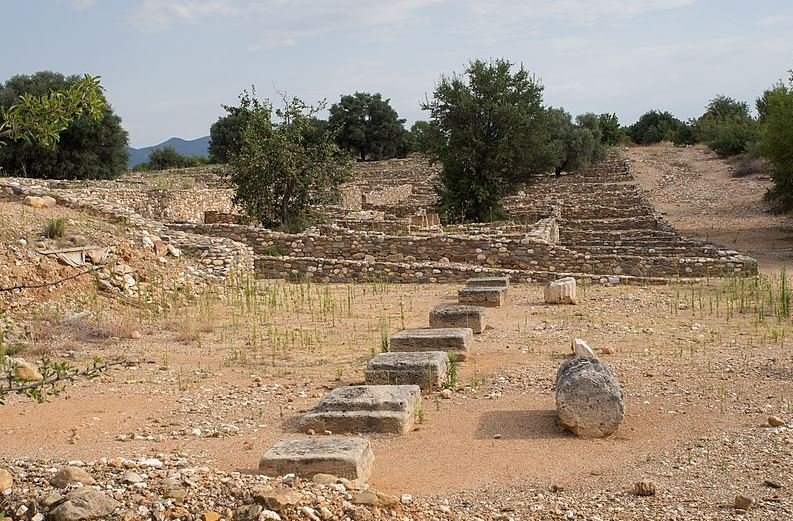
Image: Ruins of the ancient city of Olynthus.
The Rise of Olynthus and the Chalcidian League
Olynthus, located in the region of Chalcidice, emerged as a powerful city-state during the early 4th century BC. By forming the Chalcidian League, Olynthus united several city-states in the region, including Potidaea and Toroni. This confederation enhanced its military and economic power, enabling it to dominate trade and politics in Northern Greece.
The Chalcidian League was a federation that provided member states with economic and defensive benefits, fostering regional unity. However, its growing influence alarmed neighboring powers, including Macedonia and Sparta, as well as cities like Apollonia and Akanthos, which felt coerced into joining the League.
Macedonia’s Vulnerability
Macedonia, under King Amyntas III, was in a precarious position during this period. Repeated invasions by the Illyrians had weakened the kingdom. In 393/392 BC, the Illyrians defeated Amyntas and briefly drove him from his throne. Desperate for support, Amyntas ceded some Macedonian territories to Olynthus, seeking military assistance. However, Olynthus did not intervene to aid Macedonia.
After regaining his throne with Thessalian support, Amyntas faced a new challenge: Olynthus’ expansion. By annexing Macedonian cities, including the capital Pella, Olynthus reduced Amyntas’ domain to the ancestral heartland of the Argead dynasty around Aegae in Pieria. This territorial loss severely weakened Macedonia.
Spartan Concerns
Sparta, the leading power in Greece after the Peace of Antalcidas (387 BC), sought to preserve its hegemony. The rise of Olynthus threatened this dominance, particularly because the Chalcidian League had the potential to align with Sparta’s rivals, Athens and Thebes. Additionally, cities like Apollonia and Akanthos, seeking to escape Olynthian control, appealed to Sparta for assistance. These combined factors motivated Sparta to intervene.
The Outbreak of War
In 382 BC, Amyntas III, along with representatives from Apollonia and Akanthos, sent embassies to Sparta, requesting military intervention against Olynthus. They argued that the Chalcidian League’s expansion posed a direct threat to Spartan interests, potentially leading to a coalition between Olynthus, Athens, and Thebes. Sparta, concerned about this possibility, agreed to act.
Initial Spartan Campaigns
Sparta initially dispatched a small force of 2,000 troops under the command of Eudamidas, consisting of neodamodes (freed helots) and perioeci (non-citizen inhabitants). This force arrived in Chalcidice in 382 BC and secured key positions, including Potidaea, recently annexed by the Chalcidian League. Eudamidas focused on defending allied cities rather than engaging in offensive operations, as his forces were insufficient for a major campaign.
Major Engagements
Arrival of Spartan Reinforcements
Later in 382 BC, Sparta sent reinforcements under Teleutius, the brother of King Agesilaus II. This larger force included contingents from Spartan allies and a Macedonian cavalry unit led by Derda II, ruler of Elymyotis in Western Macedonia. The combined army totaled over 10,000 men, giving Sparta a significant numerical advantage.
Teleutius launched an attack on Olynthus, defeating the Chalcidian forces near the city walls and devastating the surrounding countryside. The cavalry led by Derda played a crucial role in this victory. However, Olynthus’ defenders avoided major losses by retreating behind their fortified walls, prolonging the conflict.

Image: An illustration depicting King Agesilaus II (left)
Second Battle of Olynthus (381 BC)
In the spring of 381 BC, Olynthian forces conducted successful raids on Spartan allies. Teleutius, determined to retaliate, advanced on Olynthus again in May. This battle demonstrated the tactical ingenuity of the Olynthians:
- The Olynthian cavalry feigned retreat, luring Spartan peltasts (light infantry) across a river.
- Once the peltasts were isolated on the far bank, the Olynthians turned and attacked, killing their commander Tlepolid and about 100 soldiers.
- Enraged, Teleutius ordered his troops to pursue the enemy to the city walls. This rash decision exposed them to missile fire from the fortifications. In the ensuing chaos, Olynthian forces launched a sortie, killing Teleutius and routing the Spartan army.
The Spartans suffered heavy losses, with over 1,200 soldiers killed, according to Diodorus. This marked a significant setback for Sparta.
Final Phase and Spartan Victory
Agesipolis’ Campaign
In 380 BC, Sparta organized a new army under King Agesipolis I to continue the war. Agesipolis captured Toroni, an ally of Olynthus, and advanced on the city itself. However, his campaign was cut short when he fell ill and died during the siege. Command passed to the Spartan harmost Polybiades, who implemented a strategy of attrition.
Siege and Surrender of Olynthus
Polybiades blockaded Olynthus, cutting off its supplies and starving the city into submission. By autumn 379 BC, the Chalcidian League capitulated. The terms of surrender included:
- The dissolution of the Chalcidian League.
- Olynthus becoming a Spartan ally.
- The return of Macedonian territories previously ceded to Olynthus.
Consequences of the War
For Olynthus and the Chalcidian League
The dissolution of the Chalcidian League ended Olynthus’ ambitions for regional dominance. While Olynthus survived as a city, its power was significantly diminished, and it became a subordinate ally of Sparta.
For Macedonia
Macedonia regained some of the territories lost to Olynthus, stabilizing its position temporarily. However, Amyntas III’s kingdom remained weak and vulnerable, setting the stage for future conflicts.
For Sparta
Sparta’s victory reinforced its hegemony in Greece and demonstrated its ability to project power beyond the Peloponnesus. However, the war strained Spartan resources and alienated other Greek city-states. Sparta’s dominance was increasingly viewed as oppressive, leading to rising opposition.
For the Greek World
The Spartan victory in the First Olynthian War temporarily consolidated its position, but the underlying tensions it created contributed to the eventual decline of Spartan hegemony. The cynical exploitation of other states, including the occupation of Thebes’ Cadmea, fueled resentment, culminating in Thebes’ resurgence and Sparta’s defeat at the Battle of Leuctra (371 BC).
Legacy
The First Olynthian War illustrates the volatile nature of power dynamics in ancient Greece. It highlights the following themes:
- Fragility of Alliances: The conflict demonstrated how alliances, such as those between Macedonia and Olynthus, could quickly dissolve when interests diverged.
- Regional Ambitions: Olynthus’ rise and fall underscore the difficulties faced by smaller powers in challenging dominant states like Sparta.
- Spartan Overreach: While Sparta’s intervention was successful, its heavy-handed policies sowed the seeds of its decline.
- Prelude to Macedonian Ascendancy: The war exposed Macedonia’s vulnerabilities but also set the stage for its eventual rise under Philip II, who would unify Greece and end Spartan dominance.

Image: Bust of Philip II.
In hindsight, the First Olynthian War was a precursor to significant shifts in Greek geopolitics, foreshadowing the rise of Thebes, the decline of Sparta, and the eventual emergence of Macedon as the dominant power in Greece.
Frequently Asked Questions
What triggered the Macedonian-Illyrian conflicts in 393/392 BC?
The Illyrians invaded Macedonia, defeated King Amyntas III, and drove him from his kingdom. This invasion created a major crisis for Macedonia, forcing Amyntas to seek assistance and temporarily cede territories to the Chalcidian League.
How did Amyntas regain control of Macedonia?
After being expelled by the Illyrians, Amyntas fled to Thessaly, where he found supporters who helped him reclaim his throne. There is no evidence that the Chalcidian League provided any military assistance during this period.
What was the significance of the 50-year treaty between Macedonia and the Chalcidian League?
Concluded around 391 BC, the treaty:
- Established a military alliance.
- Regulated timber trade, granting Chalcidian cities rights to export resin and wood while reserving spruce exports for Macedonian approval and taxation.
- Restricted alliances with rival cities like Amphipolis and Akanthos, isolating Olynthus’ competitors and consolidating its dominance.
How did the treaty impact Macedonia and Olynthus differently?
While the treaty provided Macedonia with temporary stability, it primarily benefited Olynthus by enhancing its trade privileges and isolating rivals, allowing the Chalcidian League to strengthen politically and economically.
How did Olynthus expand its influence after the treaty?
Olynthus aggressively annexed neighboring territories, including key Macedonian cities like Pella, further reducing Amyntas’ control to the Argead heartland in Pieria.
Why did Amyntas seek Spartan assistance?
With Olynthus expanding and refusing to return ceded territories, Amyntas turned to Sparta for help. Sparta, concerned about Olynthus potentially allying with Athens and Thebes, saw this as an opportunity to counterbalance Olynthus’ growing power.
What prompted Sparta to intervene against Olynthus?
Along with Amyntas’ appeal, cities like Apollonia and Akanthos, coerced into the Chalcidian League, requested Spartan aid. They warned that Olynthus might join forces with Athens and Thebes, threatening Spartan hegemony.
In 382 BC, Sparta sent a force of 2,000 troops under Eudamidas, who secured strategic cities like Potidaea. However, with limited resources, Eudamidas focused on defense rather than offensive operations against Olynthus.
What were the results of Teleutius’ campaign against Olynthus?
Teleutius, commanding Spartan reinforcements, launched an assault on Olynthus. His forces defeated Chalcidian troops near the city and devastated the surrounding countryside, but Olynthus’ defenders avoided heavy losses by retreating behind fortified walls.
What happened in the second battle of Olynthus (381 BC)?
Olynthian forces outmaneuvered the Spartans by feigning retreat and ambushing Spartan peltasts. This led to heavy Spartan losses, including the death of Teleutius, who made a tactical error by pursuing the enemy too close to the city walls.
How did Sparta eventually secure victory over Olynthus?
In 380 BC, Sparta sent a new army under King Agesipolis I, later succeeded by harmost Polybiades. Polybiades blockaded Olynthus, cutting off supplies and forcing the city into submission by autumn 379 BC.
What were the terms of Olynthus’ surrender?
Olynthus capitulated under the following conditions:
- The dissolution of the Chalcidian League.
- Olynthus becoming a Spartan ally.
- The return of territories ceded to Olynthus back to Macedonia.
What were the immediate consequences of the First Olynthian War?
- Weakened Olynthus: The Chalcidian League was dissolved, ending Olynthus’ regional ambitions.
- Strengthened Spartan Hegemony: Sparta consolidated its control over Northern Greece.
- Macedonian Recovery: Amyntas regained some lost territories and stabilized his kingdom temporarily.
How did Spartan dominance after the war affect other Greek city-states?
Spartan dominance alienated other city-states like Thebes and Athens, leading to resentment. This fueled the formation of anti-Spartan alliances and eventually contributed to Sparta’s decline.
How did the First Olynthian War set the stage for Spartan decline?
Despite its victory, Sparta’s heavy-handed policies, such as occupying Thebes’ Cadmea, provoked widespread opposition. This culminated in Thebes’ resurgence and Sparta’s defeat at the Battle of Leuctra in 371 BC.





