Founding Father Edmund Jennings Randolph
Edmund Jennings Randolph is best remembered for playing a crucial role in shaping the early United States. As a Founding Father, his contributions to the drafting of the Constitution, his service in Washington’s cabinet, and his work in law and governance cemented his legacy. Though his political career ended in controversy, his impact on American legal and political structures remains significant.
Below, World History Edu explores the life and major accomplishments of Founding Father Edmund Randolph.
Early Life and Education
Edmund Jennings Randolph was born on August 10, 1753, in Williamsburg, Virginia, into the influential Randolph family. He was the son of John Randolph and part of a well-established lineage that played a significant role in the early governance of the colony. His education at the College of William and Mary prepared him for a career in law, which he pursued under the tutelage of his father and his uncle, Peyton Randolph.
The outbreak of the American Revolution in 1775 divided his family. While his father, a staunch Loyalist, fled to Britain, Edmund remained in America and joined the Continental Army as an aide-de-camp to General George Washington. Following the death of his uncle Peyton Randolph in 1775, Edmund returned to Virginia to manage the estate. His return marked the beginning of his political career, as he was soon elected as a delegate to the Fourth Virginia Convention. He also served as the mayor of Williamsburg and later as the attorney general of Virginia until 1786.
In 1776, Randolph married Elizabeth Nicholas, daughter of Robert C. Nicholas. Their marriage produced six children, including Peyton Randolph, who would later serve as the Governor of Virginia from 1811 to 1812.
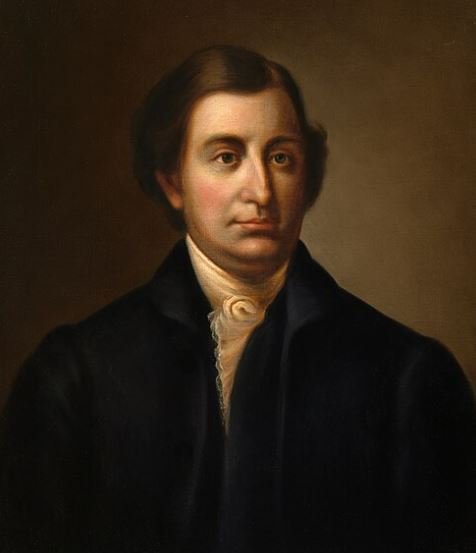
Portrait of Edmund Randolph. Created by portrait painter Casimir Gregory Stapko.
Political Career
Early Political Roles
Randolph’s political influence grew rapidly. In 1779, he was appointed as one of 11 delegates from Virginia to the Continental Congress, serving until 1782. Throughout this period, he maintained an active legal practice, providing legal counsel to notable figures such as George Washington.
In 1786, he was elected as the Governor of Virginia, a position he held until 1788. That same year, he attended the Annapolis Convention. A key part of his legacy was mentoring the young John Marshall, whom he took on as a law student and later as a partner. When Randolph assumed the governorship, he transferred his legal practice to Marshall, as Virginia law prohibited executive officers from practicing law.
The Constitutional Convention
Randolph played a crucial role at the Constitutional Convention in 1787. At 34 years old, he introduced the Virginia Plan, which outlined a strong national government with a bicameral legislature, where both houses would be based on population. The plan also proposed a national judiciary, an idea that later influenced Article III of the U.S. Constitution.
Despite being an enslaver, Randolph argued against the continued importation of enslaved people. He also proposed a three-executive system representing different regions of the country, though this idea was ultimately rejected.
Randolph was a member of the Committee of Detail, which converted the Virginia Plan’s 15 resolutions into the first draft of the Constitution. However, he refused to sign the final document, citing concerns over the balance of power, the strength of the Senate, and the broad authority granted to Congress. He feared the lack of sufficient checks and balances and advocated for a second convention to revise the document. His objections were detailed in a publication in October 1787.
Role in Ratification of the Constitution
Despite his initial opposition, Randolph played a pivotal role in the Virginia Ratifying Convention in 1788. Presiding over a nearly evenly divided assembly, he ultimately changed his stance, believing that Virginia risked being excluded from the new government. He argued that the Constitution, as it stood, could be amended more easily if ratified first.
His change of position angered fellow Virginian George Mason and other Anti-Federalists, including Patrick Henry. However, Randolph’s advocacy helped sway several undecided delegates, leading to Virginia’s ratification of the Constitution by a narrow five-vote margin.
Washington’s Cabinet
Attorney General
President George Washington rewarded Randolph’s support by appointing him as the first Attorney General of the United States in 1789. Randolph aimed to mediate disputes rather than escalate ideological battles, particularly between Alexander Hamilton and Thomas Jefferson.
As Attorney General, Randolph played a key role in shaping legal frameworks for the young nation. He sought to balance state and federal powers while maintaining the integrity of the new Constitution.
Secretary of State
When Jefferson resigned as Secretary of State in 1793, Randolph was appointed as his successor. His tenure saw significant diplomatic challenges, including the negotiation of the Jay Treaty with Britain in 1794. While Hamilton played the central role in crafting the treaty, Randolph was responsible for its implementation.
Randolph opposed the Jay Treaty, believing it favored British interests at the expense of American sovereignty. However, he failed to convince Washington to reject it. This disagreement foreshadowed his departure from the administration.
The Fauchet Scandal and Resignation
Randolph’s tenure as Secretary of State ended abruptly in 1795 due to the Fauchet scandal. The British Navy intercepted correspondence from Joseph Fauchet, the French ambassador, which implied that Randolph had shared confidential cabinet discussions with France and possibly accepted bribes.
Though no direct evidence confirmed bribery, the implication of impropriety was enough to damage his reputation. In August 1795, Washington confronted Randolph with the intercepted letters in the presence of the entire cabinet. Shocked and unable to offer an immediate defense, Randolph resigned on the spot.
Randolph later published a defense, Vindication, in which he insisted he had been wrongfully accused. He secured a public retraction from Fauchet, but the damage to his career was irreversible. Additionally, an audit of his accounts as Secretary of State concluded that he owed over $49,000 to the government. He eventually repaid the debt, though it further strained his financial situation.
Personal Life and Marriage
Randolph’s marriage to Elizabeth Nicholas was a significant aspect of his personal life. They shared a deep bond, and Randolph often wrote about his admiration for her. After Elizabeth’s death in 1810, he was profoundly affected, describing his grief in letters to his children.
He recounted how they had known each other since childhood and how their marriage had been one of mutual respect and affection. His writings reflect the 18th-century emphasis on reputation and personal honor.
As Attorney General, Edmund Randolph helped shape early legal frameworks and supported the establishment of a national judiciary, which later became Article III of the Constitution.
Later Life and Legacy
Following his resignation, Randolph returned to Virginia and resumed his law practice. He played a crucial role in the legal community, most notably serving as defense counsel for Aaron Burr during his 1807 trial for treason.
In 1791, he was elected to the American Philosophical Society, reflecting his intellectual contributions beyond politics and law.
Randolph spent his final years at Carter Hall, the estate of his friend Nathaniel Burwell, in Clarke County, Virginia. He suffered from paralysis in his later years and died on September 12, 1813, at the age of 60. He was buried in the Burwell family cemetery near Old Chapel.
Honors and Memorials
Several locations were named in Randolph’s honor, reflecting his contributions to American history:
- Randolph County, Virginia (now in West Virginia) was established in 1787.
- Randolph County, Illinois was named after him due to his role in Virginia’s cession of the Illinois territory to the federal government.
- Randolph, Vermont also bears his name.
Additionally, the Edmund J. Randolph Award, the highest honor given by the U.S. Department of Justice, recognizes outstanding contributions to the department’s mission.
Frequently Asked Questions
What role did Edmund Jennings Randolph play in the Constitutional Convention?
Randolph introduced the Virginia Plan, which proposed a strong central government with a bicameral legislature. He also served on the Committee of Detail but ultimately refused to sign the final Constitution due to concerns over checks and balances.
Why did Randolph change his stance on the Constitution at the Virginia Ratifying Convention?
Initially opposing the Constitution, he later supported ratification, fearing that Virginia would be left out of the new national government. He believed amendments could be made more effectively after ratification.
What positions did Randolph hold in George Washington’s administration?
Randolph served as the first U.S. Attorney General and later as the second Secretary of State after Thomas Jefferson resigned.
What was the Fauchet scandal, and how did it affect Randolph?
Intercepted French correspondence suggested that Randolph leaked cabinet discussions. Though there was no definitive proof of wrongdoing, the scandal led to his resignation as Secretary of State in 1795.
What was Randolph’s involvement in the Aaron Burr trial?
After leaving public office, Randolph resumed practicing law and was part of the defense team for Aaron Burr during his 1807 treason trial.

Aaron Burr, US Vice President between 1801-1805.
What places or honors were named after Randolph?
Randolph County, Virginia (now in West Virginia), Randolph County, Illinois, and Randolph, Vermont, were named in his honor. The U.S. Department of Justice also created the Edmund J. Randolph Award for significant contributions to justice.
How did Randolph spend his final years?
He lived in Virginia, practicing law and suffering from paralysis in his later years. He died in 1813 and was buried in Clarke County, Virginia.





