The Founding Fathers of the United States played an essential role in the creation of the nation, overcoming immense obstacles as they worked to forge a new country from the remnants of British colonial rule. Their vision and leadership were tested by numerous challenges, both external and internal, as they fought for independence, navigated political divisions, and built a stable government that would endure.
In this comprehensive exploration, WHE examines the greatest challenges faced by the Founding Fathers, covering issues related to independence, governance, social conflicts, and external pressures.
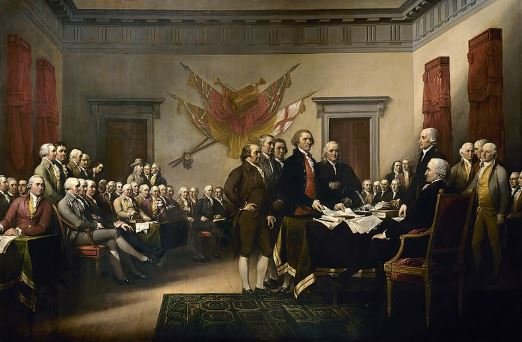
The Founding Fathers had to build a new government, stabilize the economy, and establish international credibility in the face of foreign threats and internal divisions. Founding Fathers of the U.S. Image: The Committee of Five presents their draft of the Declaration of Independence to the Second Continental Congress in Philadelphia
Securing Independence from Britain
One of the most significant challenges faced by the Founding Fathers was securing independence from Great Britain, the world’s most powerful empire at the time. The decision to pursue independence was neither easy nor inevitable. Many colonists were initially loyal to the British crown, and there were deep divisions about whether breaking away was the right course of action.
Lord North: the British Prime Minister Who Lost the American Colonies
Convincing the Colonies to Unite
The first hurdle was convincing all 13 colonies to unite in the pursuit of independence. Each colony had its own government, economic interests, and relationships with Britain, which made the idea of forming a united front challenging.
The Founding Fathers had to persuade the colonies that they had common interests and that unity was essential for success. This required extraordinary diplomatic skills, particularly during the meetings of the Continental Congress, where men like John Adams, Benjamin Franklin, and Thomas Jefferson argued for solidarity.

Convincing the 13 colonies to unite and fight for independence was difficult, as many colonists were initially loyal to Britain or unsure about the prospects of self-governance.
Building a Revolutionary Movement
The Founding Fathers, particularly figures like Samuel Adams, John Hancock, and Patrick Henry, played key roles in building a revolutionary movement that could rally the colonists around the idea of independence. They organized protests, published pamphlets, and formed secret groups like the Sons of Liberty to resist British policies such as the Stamp Act and the Tea Act.

Samuel Adams is usually acclaimed as the founder of the Sons of Liberty
Military Resistance Against Britain
Once the decision to declare independence was made in 1776, the Founding Fathers faced the daunting task of resisting Britain’s powerful military. The Continental Army, led by George Washington, was poorly equipped, underfunded, and often outnumbered. Washington had to overcome numerous logistical challenges, including shortages of weapons, supplies, and trained soldiers. In addition to military difficulties, the Revolutionary cause faced the constant threat of internal dissent, as many colonists (known as Loyalists) remained loyal to Britain, undermining the unity needed to sustain the war effort.
Securing Foreign Alliances
One of the most significant achievements of the Founding Fathers was securing foreign alliances, particularly with France. Benjamin Franklin, as an American diplomat in Paris, was instrumental in persuading the French government to support the revolutionaries. France’s military and financial aid proved crucial in turning the tide of the war, culminating in the decisive victory at the Battle of Yorktown in 1781. Without foreign alliances, the Continental Army may not have been able to withstand the might of the British Empire.
Drafting the Declaration of Independence
Once the decision to seek independence was made, the Founding Fathers faced the challenge of justifying this decision to both the colonies and the world. Drafting the Declaration of Independence was one of the most significant tasks the Founding Fathers undertook. This document needed to articulate the philosophical justifications for independence while uniting the colonies behind a common cause.
Balancing Philosophical Ideals with Political Realities
Thomas Jefferson, the principal author of the Declaration, drew heavily on Enlightenment ideals, particularly those of John Locke, who emphasized natural rights such as life, liberty, and property (which Jefferson famously adapted to “the pursuit of happiness”).
However, Jefferson also had to balance these high ideals with the political realities of the time. The Declaration needed to resonate with colonists who had different motivations for supporting independence, including economic, political, and social concerns.
Addressing Grievances Against the British Crown
Another major challenge was drafting a list of grievances against King George III that would justify the colonies’ decision to break away. The Founding Fathers needed to present their case in a way that would not only justify their actions to the colonists but also appeal to potential foreign allies. This required careful wording and diplomacy to frame the revolution as a defense of basic human rights rather than an act of rebellion.
Achieving Consensus
Achieving consensus among the delegates of the Continental Congress was no easy task. Not all colonies were initially enthusiastic about the idea of independence, with some preferring reconciliation with Britain. Figures like John Adams and Benjamin Franklin played a key role in lobbying reluctant delegates to support the Declaration, while Jefferson worked to incorporate suggestions and revisions from the Congress. The result was a document that, while imperfect, became a powerful statement of the colonies’ commitment to independence.
Creating a Stable Government
After achieving independence, the Founding Fathers faced the even more daunting challenge of building a stable government for the newly formed United States. The Articles of Confederation, the first constitution, was adopted in 1777 but proved inadequate, leading to significant challenges that culminated in the drafting of the U.S. Constitution in 1787.
The Weaknesses of the Articles of Confederation
The Articles of Confederation created a loose alliance of states with a weak central government. The federal government had limited powers, such as the inability to levy taxes or regulate commerce between states. Each state retained significant sovereignty, which led to conflicts over trade, currency, and foreign policy. The lack of a strong central government left the nation vulnerable to internal strife and foreign intervention.
One of the greatest challenges the Founding Fathers faced was overcoming the failures of the Articles of Confederation while preserving the independence and rights of individual states. The states were deeply suspicious of centralized power, having just fought a war to free themselves from a distant and overbearing government in Britain. Convincing the states to support a stronger national government required careful negotiation and compromise.
Drafting the U.S. Constitution
The Constitutional Convention of 1787 was convened to address the weaknesses of the Articles of Confederation. The Founding Fathers, particularly James Madison, Alexander Hamilton, and George Washington, played crucial roles in drafting the new Constitution. They had to strike a delicate balance between creating a stronger federal government while safeguarding individual liberties and states’ rights.

The Founding Fathers faced numerous challenges, including creating a constitution that balanced state and federal powers, while protecting individual rights, was a monumental task.
Key challenges included:
- Balancing Federal and State Power: The Constitution had to carefully delineate the powers of the federal government and the states, ensuring that neither would become too powerful.
- Separation of Powers: To prevent the concentration of power in any one branch of government, the Founding Fathers created a system of checks and balances, dividing power among the executive, legislative, and judicial branches.
- Representation: One of the most contentious issues was how states would be represented in the new government. The Great Compromise resulted in a bicameral legislature, with the Senate providing equal representation for each state and the House of Representatives allocating seats based on population.
- Slavery: Slavery was a deeply divisive issue among the Founding Fathers. The Constitution included compromises, such as the Three-Fifths Compromise (which counted enslaved people as three-fifths of a person for representation) and provisions allowing the slave trade to continue until 1808. These compromises would later prove insufficient, leading to tensions that contributed to the American Civil War (1861 – 1865).

Scene at the Signing of the Constitution of the United States on September 17, 1787, a 1940 portrait by American illustrator Howard Chandler Christy depicting the signing of the Constitution in Philadelphia
What were the sociocultural effects of the American Civil War?
Securing Ratification
After drafting the Constitution, the Founding Fathers faced the challenge of securing its ratification by the states. The debate over ratification was fierce, with opponents (known as Anti-Federalists) arguing that the Constitution gave too much power to the federal government and lacked sufficient protections for individual rights. Federalists, led by Alexander Hamilton, James Madison, and John Jay, wrote a series of essays known as The Federalist Papers to defend the Constitution and argue for its ratification.
The eventual inclusion of the Bill of Rights, the first ten amendments to the Constitution, helped address Anti-Federalist concerns and secure the Constitution’s ratification. These amendments, championed by Madison, guaranteed fundamental rights such as freedom of speech, religion, and the press, as well as protections against arbitrary government power.
Navigating Political Divisions
The Founding Fathers also faced the challenge of navigating deep political divisions that emerged after the revolution. While they had united around the cause of independence, they were divided over the structure of the new government and its policies.
Federalists vs. Democratic-Republicans
The most significant political division in the early United States was between the Federalists, led by Alexander Hamilton and John Adams, and the Democratic-Republicans, led by Thomas Jefferson and James Madison. These two factions had fundamentally different visions for the country:
- Federalists favored a strong central government, a national bank, and closer ties with Britain. They believed that a powerful government was necessary to maintain order and promote economic development.
- Democratic-Republicans favored states’ rights, a limited federal government, and an agrarian-based economy. They were wary of centralized power and feared that the Federalists’ policies favored wealthy elites at the expense of ordinary citizens.
These political divisions led to fierce debates over issues such as the role of the federal government, foreign policy, and economic strategy. The election of 1800, in which Jefferson defeated Adams, marked the first peaceful transfer of power between opposing political parties in U.S. history, setting a crucial precedent for future elections.
The Alien and Sedition Acts
One of the most contentious political battles during the early years of the republic was over the Alien and Sedition Acts, passed by the Federalist-controlled Congress in 1798. These laws, which made it more difficult for immigrants to become citizens and criminalized criticism of the government, were widely seen as an attempt to suppress the opposition. Jefferson and Madison responded by drafting the Virginia and Kentucky Resolutions, which argued that states had the right to nullify unconstitutional federal laws. This conflict highlighted the growing tension between the federal government and states’ rights, a theme that would continue to shape American politics.
Addressing Social Conflicts and Inequalities
The Founding Fathers also faced the challenge of addressing deep social conflicts and inequalities that existed in the new nation. While the Declaration of Independence proclaimed that “all men are created equal,” this ideal was not realized for many people living in the United States, including women, Native Americans, and enslaved Africans.
Slavery
One of the most significant and troubling issues faced by the Founding Fathers was the institution of slavery. Although some Founding Fathers, such as Benjamin Franklin and John Adams, were vocal critics of slavery, others, including George Washington, Thomas Jefferson, and James Madison, owned slaves. The economic and political power of the Southern states, where slavery was deeply entrenched, made it difficult to address the issue head-on during the nation’s founding.
The compromises on slavery in the Constitution, such as the Three-Fifths Compromise and the continuation of the slave trade until 1808, allowed the nation to move forward but left a legacy of conflict that would eventually lead to the Civil War. The Founding Fathers’ inability to resolve the issue of slavery during their time has been a source of ongoing debate and criticism.
Native American Relations
The Founding Fathers also faced the challenge of managing relations with Native American tribes. The expansion of the United States westward led to increased conflict with Native Americans, whose lands were encroached upon by settlers.
While some Founding Fathers, such as Thomas Jefferson, advocated for peaceful coexistence and the assimilation of Native Americans into American society, others favored more aggressive policies that resulted in the displacement of Native peoples. The tension between expansion and respect for Native American sovereignty was never fully resolved during the Founding Era.
Women’s Rights
Women were largely excluded from the political process during the Founding Era, despite their contributions to the Revolutionary cause. Figures like Abigail Adams advocated for women’s rights, famously urging her husband, John Adams, to “remember the ladies” when drafting new laws. However, the Founding Fathers did not extend the rights of citizenship, such as voting, to women, reflecting the societal norms of the time. The struggle for women’s rights would continue into the 19th and 20th centuries, culminating in the passage of the 19th Amendment in 1920.
Maintaining Foreign Relations and Neutrality
In addition to domestic challenges, the Founding Fathers faced significant difficulties in navigating foreign relations. The new nation was vulnerable to external threats from European powers, particularly Britain, France, and Spain, all of which had interests in North America.
Neutrality and the French Revolution
One of the key challenges was maintaining neutrality during the French Revolution and the subsequent wars between France and Britain. While many Americans supported the French Revolution as an extension of the ideals of liberty, others, including George Washington, believed that the United States should remain neutral to avoid being drawn into European conflicts.
Washington’s Proclamation of Neutrality in 1793 was a controversial decision that angered both Federalists, who favored Britain, and Democratic-Republicans, who supported France. The struggle to maintain neutrality while protecting American interests overseas, particularly in matters of trade, remained a significant challenge throughout the early years of the republic.
READ MORE: 9 Most Significant Causes of the French Revolution
Jay’s Treaty
Another challenge in foreign relations was negotiating Jay’s Treaty with Britain in 1794. The treaty, which sought to resolve lingering issues from the Revolutionary War, including British occupation of forts in the Northwest Territory and disputes over trade, was deeply unpopular with many Americans, particularly Democratic-Republicans who saw it as a betrayal of the French alliance.
However, the treaty helped avoid a potential war with Britain and secured important trade concessions, reflecting the difficult balance the Founding Fathers had to strike in maintaining peace with foreign powers.
What triggered the rivalry between John Adams and Thomas Jefferson?
Conclusion
The Founding Fathers faced extraordinary challenges in their efforts to create a new nation. From securing independence and drafting the Declaration of Independence to crafting a stable government and navigating political divisions, they had to overcome immense obstacles to establish the United States. Their vision, leadership, and willingness to compromise laid the foundation for a nation that, despite its flaws and contradictions, has endured for more than two centuries.
However, their legacy is also marked by the challenges they left unresolved, particularly in relation to slavery, Native American relations, and women’s rights. The compromises made during the Founding Era would continue to shape and sometimes haunt the nation’s future, leading to further struggles for equality and justice.
The Founding Fathers’ ability to navigate these challenges, while imperfect, remains one of the most remarkable achievements in history. Their work created a government that has withstood the test of time, and their ideas continue to influence not only American society but also democratic movements around the world.





