Most Famous Sky Deities From Around the World
The sky has long been a source of awe and mystery, leading many cultures to associate it with divine beings. Sky deities are among the most powerful gods in mythology, often ruling over the heavens, weather, celestial bodies, and even fate. These deities vary in function and importance, but they consistently represent cosmic order and celestial power.
Below, World History Edu explores some of the most famous sky gods and goddesses from around the world.
Greek Mythology: Zeus – The King of the Gods

A statue depiction of Zeus, the sky and thunder god.
Zeus, the chief deity of the Greek pantheon, is the quintessential sky god. As the ruler of Mount Olympus, he governs the heavens, weather, and thunder. His signature weapon, the thunderbolt, symbolizes his dominion over storms and divine justice. Zeus was also associated with law, order, and kingship, reinforcing his role as the supreme deity. He was worshiped across Greece, particularly at Olympia, where the grand Olympic Games were held in his honor.
READ ALSO: 15 Lesser-Known Greek Gods and Goddesses
Norse Mythology: Thor – The Storm God

A painting by Swedish artist Mårten Eskil Winge entitled “Thor’s Fight with the Giants”.
In Norse mythology, Thor is one of the most famous deities, known as the god of thunder, lightning, and storms. He wields Mjölnir, a magical hammer capable of summoning thunder and striking down giants. While Odin, his father, represents wisdom and sovereignty, Thor is the protector of gods and humans alike. He is deeply connected to the sky through his control over storms and his chariot, which is drawn by goats. His role as a sky deity highlights his importance in maintaining cosmic balance and protecting the world from chaos.
Mesopotamian Mythology: Anu – The Primeval Sky God

Depictions of multiple deities, such as Anu (second row, far right), featured on a kudurru belonging to Ritti-Marduk from ancient Sippar, Iraq, dating back to 1125–1104 BCE.
Anu, or An, was the supreme sky god in Sumerian and Akkadian mythology. He was considered the original ruler of the heavens and the father of many deities. As the god of the firmament, Anu’s influence was vast, though he often delegated responsibilities to other gods like Enlil. His role in the Mesopotamian pantheon was foundational, establishing the order of divine authority.
READ ALSO: Wisdom Literature in Ancient Near East
Egyptian Mythology: Ra – The Sun God

Ra-Horakhty, a distinct manifestation of the sun god Ra.
Ra, the ancient Egyptian god of the sun, ruled the sky and played a fundamental role in creation. He was believed to travel across the sky during the day in his solar barque and descend into the underworld at night to battle darkness. His worship was widespread, with temples dedicated to him, including the famous temple at Heliopolis. Ra was often merged with other deities, such as Amun-Ra, reinforcing his supreme status among the Egyptian gods.
Roman Mythology: Jupiter – The Thunder God

This statue of Jupiter is located at the Hermitage Museum in Russia.
Jupiter, the Roman counterpart of Zeus, inherited many of the Greek god’s characteristics. As the god of the sky and thunder, Jupiter held supreme authority among the Roman gods. His name was invoked in political and military matters, emphasizing his role as a protector of Rome. The great temple on Capitoline Hill in Rome was dedicated to Jupiter, showcasing his prominence in Roman religion.
READ ALSO: The Seven Hills on which ancient Rome was built
Hindu Mythology: Indra – The Storm King
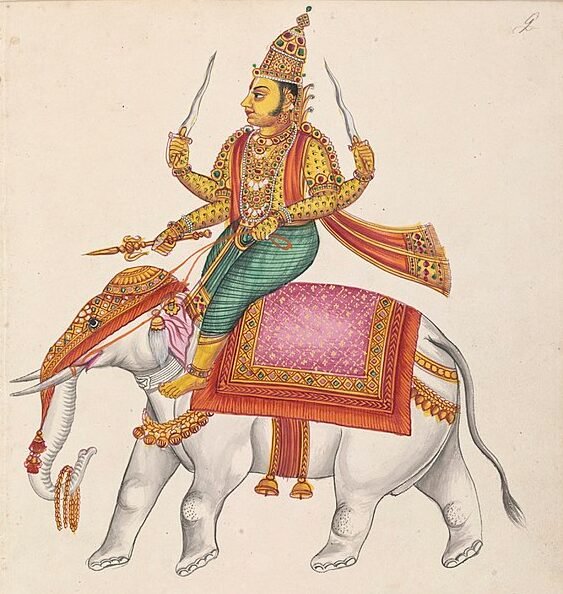
An illustration depicting Indra seated on an elephant.
Indra is the Vedic god of the sky, thunder, and rain. In Hindu mythology, he is known as the king of the gods and the ruler of Svarga (heaven). Indra wields the vajra, a thunderbolt weapon, and is celebrated for his victories over demons, particularly Vritra, the dragon of drought. Although later Hindu traditions diminished his prominence in favor of Vishnu and Shiva, Indra remains an important deity in Vedic texts and Hindu rituals.
Chinese Mythology: Shangdi – The Supreme Sky Deity

The Temple of Heaven in Beijing.
Shangdi, meaning “Supreme Emperor,” is the celestial ruler in early Chinese religious beliefs. He was associated with the heavens, cosmic order, and the destiny of humanity. In later Taoist traditions, he was assimilated into the Jade Emperor, who governs the heavens and oversees the divine bureaucracy. Shangdi was venerated in imperial rituals, particularly during the sacrifices at the Temple of Heaven in Beijing.
Japanese Mythology: Amaterasu – The Sun Goddess

Sun goddess Amaterasu emerging from a cave
Amaterasu is one of the most significant deities in Shintoism, revered as the goddess of the sun and the universe. She is believed to be the direct ancestor of the Japanese imperial family, reinforcing her importance in Japanese culture. Her retreat into a cave, plunging the world into darkness, and her subsequent return is one of the most famous myths in Japanese lore, symbolizing the balance of light and darkness.
READ ALSO: Top 10 Japanese Gods and Goddesses
Slavic Mythology: Perun – The Thunder God

A 12th-century statue of Perun discovered in Veliky Novgorod.
Perun is the chief god in Slavic mythology, associated with the sky, thunder, and war. He is often depicted wielding an axe or a hammer, similar to Thor. Perun was worshiped by many Slavic tribes as a protector deity, and his name was invoked in oaths and military conflicts. His dominion over the sky and his thunderous power made him one of the most revered gods in Slavic paganism.
Kongo Spirituality: Nzambi a Mpungu – Supreme Sky Father

Nzambi a Mpungu
Nzambi a Mpungu, also known simply as Nzambi, is the Supreme God in Kongo spirituality, recognized as the eternal Sky Father and the God of the Sun and fire. His female counterpart, Nzambici, is the Sky Mother and Goddess of the Moon.
Unlike some sky deities, Nzambi Mpungu was not seen as an authoritarian ruler but as a sovereign force present in both the spiritual world (Ku Mpémba) and the physical realm (Ku Nseke).
Among the Central African Bantu peoples, including the Chokwe and those of the Kingdom of Ndongo, Nzambi Mpungu was sometimes referred to as Kalunga, a god associated with fire and transformation. This name may be linked to Bakongo cosmology, where Kalûnga represents the spark of life that initiated the universe. Nzambi Mpungu was viewed as the force that governs all existence, immanent in creation yet transcendent in nature.

Native American Mythology: Thunderbird – The Storm Bringer

Thunderbird
Among various Native American tribes, the Thunderbird is a powerful sky spirit that governs storms and lightning. It is often depicted as a giant bird with wings that create thunderclaps when they flap. The Thunderbird is both a protector and a punisher, using lightning to enforce justice. Many indigenous cultures across North America, including the Lakota and Ojibwe, honor the Thunderbird as a significant spiritual force.
Polynesian Mythology: Tangaroa – The Sky and Sea Deity
Tangaroa is one of the great gods in Polynesian mythology, governing the sky and the sea. In some traditions, he is the creator of the world, while in others, he plays a crucial role in maintaining cosmic balance. He is associated with the vastness of the heavens and the oceans, highlighting his role as a deity of boundless expanse. His worship was widespread across the Pacific islands, emphasizing his importance in Polynesian cosmology.
READ MORE: 13 Most Famous Polynesian Gods and Goddesses
Finnish Mythology: Ukko – The Thunder God

A depiction of Ukko (top) by Robert Ekman.
Ukko is the supreme god in Finnish mythology, ruling over the sky, weather, and fertility. He is similar to Thor and Perun, wielding a hammer or an axe to summon thunder and rain. Ukko was deeply respected in Finnish pagan traditions, and his name was invoked for agricultural success and protection against storms.
Frequently Asked Questions
What is the significance of the sky in religion?
The sky is often considered sacred in many religions, symbolizing divinity, transcendence, and cosmic order. Many polytheistic religions associate deities with the sky, distinguishing between daytime and nighttime gods.
How are daytime and nighttime sky gods different?
Daytime deities are often associated with the sun, weather, and supreme rulership, while nighttime gods oversee the moon, stars, and darkness, sometimes linked to mystery or the underworld.
Who is the Greek primordial sky god?
Uranus is the primordial Greek sky god, later replaced by Zeus, who became the ruler of the heavens and king of the Olympian gods.
What is the role of a ‘sky father’ deity?
A sky father is typically the supreme deity in a pantheon, ruling over the sky and often serving as a patriarchal figure, paired with an earth mother goddess.
Which Egyptian gods are associated with the sky?
Nut is the goddess of the sky, while Ra rules the sun. Horus, associated with the sky and kingship, is another major sky deity in Egyptian mythology.
What are some key sky deities in Mesopotamian mythology?
Anu, the Sumerian god of the sky, and Enlil, the god of wind and storms, are central deities in Mesopotamian religion.
Which gods rule the sky in Norse mythology?
Thor, the thunder god, and Tyr, an early sky god linked to law and order, are prominent Norse deities associated with the sky.
What role do celestial deities play in Hinduism?
Hindu sky gods include Dyaus Pita (sky father), Indra (god of storms and rain), and Surya (sun god), with goddesses like Ushas representing dawn.
Who is the supreme sky god in African mythology?
Many African traditions have sky gods, such as Nyame in Akan mythology and Olorun in Yoruba belief, who are seen as supreme deities.
What is the role of the Jade Emperor in Chinese mythology?
The Jade Emperor is the supreme ruler of heaven in Taoism, overseeing the celestial realm and maintaining cosmic order.
Which Japanese deities are linked to the sky?
Amaterasu, the sun goddess, is the most significant sky deity, while Tsukuyomi represents the moon and Izanagi is a sky father figure.
What are some Native American sky deities?
Many Native American traditions honor sky spirits, such as Wi (Lakota sun spirit), Inti (Incan sun god), and Atahensic (Iroquois sky goddess).
Who is the main sky god in Slavic mythology?
Perun, the god of thunder and storms, is the chief sky deity in Slavic mythology, akin to Zeus and Thor.
What role do sky deities play in Polynesian belief?
Polynesian mythology includes gods like Tangaloa, a sky father and creator deity, and Tāwhirimātea, the Maori god of storms and winds.





