Centaurs in Greek Mythology: Origin Story & Significance
Centaurs, one of the most iconic creatures in Greek mythology, are fascinating beings that combine human and animal forms—half-man and half-horse. Their dual nature reflects a balance between civilization and chaos, rationality and savagery.
They appear in numerous myths, symbolizing both the wild and untamed aspects of nature as well as the struggles of human virtue against base desires. While centaurs are often portrayed as unruly, violent creatures, their mythology is rich with complexity, involving stories of both brutality and wisdom.
In this comprehensive examination of centaurs, World History Edu delves into their origin myths, explores their symbolism, and analyzes their role in Greek mythology.
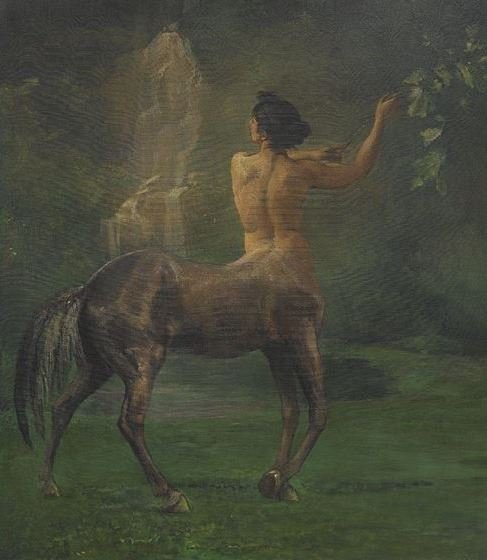
In Greek mythology, Centaurs (Kentauroi) were half-man, half-horse beings living in the mountains and forests of Thessaly. Image: A painting depicting a female Centaur.
Origin Story of Centaurs
There are several origin myths about centaurs, each contributing to their multifaceted nature. The most well-known myth traces their lineage back to Centaurus, a mythical figure who fathered the centaurs. According to this story, Centaurus was the son of King Ixion of Thessaly and a cloud nymph named Nephele, who had been created by Zeus to resemble his wife, Hera.
The story begins with Ixion, who was invited to dine with the gods on Mount Olympus. However, during this time, he became infatuated with Hera. Enraged by his impudence, Zeus created a cloud in the likeness of Hera, which Ixion then seduced. This cloud nymph, named Nephele, gave birth to Centaurus, who grew up to be wild and untamed. According to myth, Centaurus later mated with the Magnesian mares, and their offspring became the centaurs—creatures that inherited the bestiality of their horse ancestors and the human qualities of their father.
Another variation of the origin story suggests that Centaurus himself was part horse and part human, a result of his divine parentage. His offspring with the mares carried on this dual nature, which reflects the complexity of centaurs’ existence, balancing between human intelligence and animalistic instincts.

Image: A statue of Hera.
Chiron and the Daughters of Chiron
The myth of Centaurus gives an explanation for the wild and unruly nature of centaurs. However, not all centaurs were depicted as chaotic and barbaric. A notable exception was Chiron, the wisest and most civilized of the centaurs. Chiron’s lineage set him apart from his wild brethren. According to myth, Chiron was born to the nymph Philyra and the Titan Cronus, making him divine in origin.
Unlike the other centaurs, who were typically depicted as lustful and driven by their animalistic nature, Chiron was known for his wisdom, knowledge of healing, and his role as a mentor to many Greek heroes.
It is said that Chiron, being a teacher and healer, raised his fellow centaurs in the early days of their creation. His daughters, in some stories, were responsible for raising the centaurs left on Mount Pelion, further reinforcing his influence in nurturing a more civilized nature among some of the centaurs.
Centaurs as Followers of Dionysus
Centaurs are commonly associated with Dionysus, the god of wine, revelry, and chaos. As followers of Dionysus, centaurs were often depicted as rowdy, drunken creatures who embraced their animalistic side. Their association with wine and their frequent portrayal as reckless revelers reinforced the image of centaurs as beings driven by impulse and instinct.
The centaurs’ tendency for violence under the influence of wine is highlighted in the story of the wedding of Pirithous, King of the Lapiths. Pirithous was a half-brother of the centaurs, and during his wedding feast, he invited them to attend the celebration.
However, the centaurs, after consuming large amounts of wine, became drunk and attempted to abduct the bride and other female guests. A violent battle ensued, with the hero Theseus, who was in attendance, helping Pirithous to defend his guests. Many of the centaurs were killed during the skirmish, and the event became symbolic of the centaurs’ lack of self-control and inability to suppress their violent nature when intoxicated.
This episode is crucial to understanding the role of centaurs in Greek mythology. Their behavior at the wedding of Pirithous reflects a common theme in myth: the struggle between civilization and barbarism. The Lapiths, representing order and structure, stand in opposition to the centaurs, who symbolize primal chaos. This dichotomy was central to many myths involving centaurs, and the wedding of Pirithous became a cautionary tale about the dangers of excess, particularly through indulgence in wine.
Symbolism of Centaurs in Greek Mythology
Centaurs in Greek mythology are rich in symbolism. Their hybrid nature, being part human and part horse, embodies the tension between two opposing forces: reason and instinct, or civilization and savagery. While they have the upper bodies of men, their lower halves are entirely animalistic, which often suggests their struggle to balance human intellect with primal urges.
Centaurs are typically portrayed as wild and unruly, reflecting the untamed forces of nature. They inhabit forests and mountains, living in remote areas away from human society. This placement emphasizes their distance from civilization, both physically and metaphorically. In art, they are often depicted with primitive weapons such as rocks and tree branches, further symbolizing their barbaric nature.
At the same time, centaurs can also be seen as cautionary figures in myths, warning against overindulgence in pleasures such as wine and unchecked desires. The way centaurs are often depicted as losing control when drunk aligns with Greek views on moderation and the importance of self-control. The Greeks believed that indulgence without restraint could lead to chaos and ruin, and centaurs embodied that concept.
However, centaurs were not always negative symbols. The character of Chiron represents the potential for wisdom and civilization within this dual-natured creature. While most centaurs gave in to their base instincts, Chiron, through his divine lineage and wisdom, became a revered figure in Greek mythology. His knowledge of medicine, healing, and education made him a mentor to many of Greece’s most important heroes, including Achilles, Hercules, and Jason. In this way, Chiron symbolizes the possibility of mastering one’s baser instincts and using intellect and virtue for the greater good.
The Role of Chiron in Greek Mythology
Chiron’s role in Greek mythology sets him apart from the typical centaur. While the majority of centaurs were portrayed as violent and impulsive, Chiron was wise, knowledgeable, and calm. His reputation as a healer and teacher made him one of the most respected figures in myth, despite his animalistic form.
According to legend, Chiron resided on Mount Pelion, where he served as a mentor to many Greek heroes. His wisdom in medicine and combat made him the perfect tutor for young warriors and demigods. Achilles, one of the greatest Greek heroes, was entrusted to Chiron’s care during his youth. Chiron not only taught him the art of war but also gave him a Pelian ash spear, which Achilles would later use during the Trojan War.
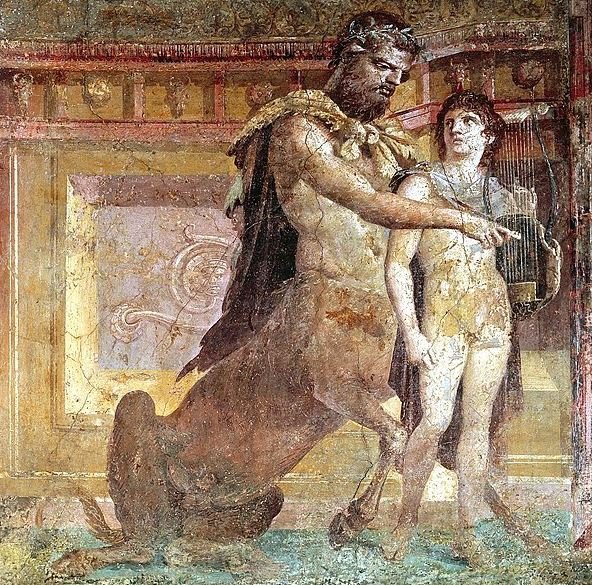
Image: Chiron (left) with Achilles.
Chiron’s wisdom extended beyond military training. He was also skilled in music, poetry, and healing, and these arts were often passed down to his pupils. The duality of his nature—part man and part beast—served as a metaphor for the blending of reason and physical prowess. His relationship with his students emphasized the importance of balancing intellect and strength, a concept that was central to Greek heroic ideals.
Tragically, Chiron’s life ended in pain, despite his immortality. According to myth, Hercules accidentally wounded Chiron with a poisoned arrow while battling other centaurs. The poison, derived from the blood of the Hydra, caused Chiron immense suffering. Although immortal, Chiron could not heal himself and eventually chose to die rather than continue living in agony. He sacrificed his immortality in exchange for the freedom of Prometheus, a Titan who had been punished by Zeus. This act of selflessness further elevated Chiron’s status as a noble figure, and his death marked him as a martyr of sorts, willing to endure great personal loss for the benefit of others.
Other Famous Centaur Myths
Centaurs are featured in several other prominent myths that further explore their nature and the tensions between civilization and barbarism.
Pholos and Hercules
Another notable centaur in Greek mythology is Pholos, who is depicted as a hospitable and kind figure, much like Chiron. Pholos appears in the myth of Hercules during one of the hero’s Twelve Labors. While hunting the Erymanthian Boar, Hercules visited Pholos, who offered him food and wine.
However, the wine attracted other centaurs, who, much like in the wedding of Pirithous, became intoxicated and violent. A battle ensued between the centaurs and Hercules, who accidentally wounded Chiron during the chaos. Pholos, too, met an unfortunate end when he accidentally dropped one of Hercules’ poisoned arrows on his foot, killing himself.
This myth once again highlights the dangers associated with centaurs and wine. The overindulgence of the centaurs and the resulting violence reflect the chaos that can arise from a lack of restraint, a theme consistent with other centaur myths.

Image: Italian painter Sebastiano Ricci’s painting depicts centaurs at the marriage of Pirithous, king of the Lapithae.
Caeneus and the Centaurs
The myth of Caeneus, a hero who was invulnerable to weapons, further explores the savage nature of centaurs. Caeneus, once a woman named Caenis who had been transformed into an invulnerable man by Poseidon, became a great warrior. In one version of the story, centaurs attacked Caeneus, wielding primitive weapons such as stones and tree branches. Unable to pierce his skin, they eventually resorted to beating him into the ground, a testament to their savage and brutal tendencies.
This myth contrasts Caeneus, a symbol of strength and invulnerability, with the centaurs, who are depicted as wild and barbaric creatures attacking out of desperation. The battle between Caeneus and the centaurs epitomizes the struggle between civilization and barbarism, a recurring theme in Greek mythology.
Female Centaurs (Centauresses)
While male centaurs are more frequently depicted in Greek mythology, there are also mentions of female centaurs, or centauresses. These figures are less common in ancient Greek art and literature but began appearing in later classical works and Roman mythology.
One of the earliest representations of centauresses can be found in a Macedonian mosaic from the fourth century BC. In Roman mythology, the poet Ovid mentions a centauress named Hylonome, who appears in his work Metamorphoses.
Hylonome, in contrast to the violent behavior typically associated with centaurs, is portrayed as a more sympathetic figure. She is depicted as a devoted wife who mourns the death of her husband and chooses to die by suicide rather than live without him.
The inclusion of female centaurs adds another layer of complexity to the mythology, challenging the traditional depiction of centaurs as purely barbaric and violent creatures. The stories of centauresses highlight different aspects of centaur nature, including loyalty, love, and grief.
Centaurs in Roman Mythology and Later Traditions
The mythology of centaurs did not end with the decline of ancient Greece. The Romans adopted many elements of Greek mythology, and centaurs continued to appear in Roman art and literature.
In Roman mythology, centaurs maintained much of their Greek characterization, symbolizing the wild, untamed forces of nature. However, some Roman writers also began to explore more nuanced portrayals of centaurs, focusing on their capacity for love and devotion, as seen in the story of Hylonome.
In later periods, centaurs also found their way into medieval bestiaries, where they were often depicted as symbols of lust, violence, and unchecked desires.
These representations carried forward the ancient Greek association of centaurs with chaos and barbarism, but they also took on new Christian connotations, where centaurs became moral warnings against the dangers of giving in to sinful behavior.
Theories on the Origins of the Centaur Myth
There are several theories regarding the origin of the centaur myth. One popular theory suggests that the idea of centaurs arose from the first encounters between a non-riding culture and people who rode horses. In ancient Greece, particularly in regions like Thessaly, horseback riding was not common until later periods. Early encounters with mounted riders may have led to the creation of the centaur myth, as non-riding cultures might have perceived horse and rider as a single, composite creature.
Another theory suggests that centaurs were originally bull-hunters. The word “centaur” may derive from a pre-Greek language and could have originally meant “bull-killer.” This theory is supported by the fact that Thessaly, where centaurs were said to live, was known for its bull-hunting traditions.
Regardless of their exact origin, centaurs became a powerful symbol in Greek mythology, embodying the tension between nature and civilization, instinct and intellect. Their stories reveal much about ancient Greek values, particularly the importance of self-control and the dangers of excess.
Conclusion: The Significance of Centaurs in Greek Mythology
Centaurs occupy a unique place in Greek mythology as creatures that straddle the line between human and animal, reason and instinct, civilization and chaos.
While most centaurs are depicted as wild and violent, characters like Chiron and Pholos demonstrate that there is more to their nature than savagery.
These complex beings reflect the Greeks’ understanding of the duality of human existence, where intellect and virtue must constantly contend with base desires and primal instincts.
The myths of centaurs served as cautionary tales for the ancient Greeks, warning against the dangers of excess, indulgence, and losing control over one’s passions. At the same time, the centaur Chiron stands as a reminder that wisdom, knowledge, and self-discipline can elevate even the most primal of beings to greatness.

Image: A painting titled “Battle of Centaurs and Wild Beasts” located at the Staatliche Museen zu Berlin in Germany.
Questions and Answers

Chiron, Peleus and infant Achilles
What is one origin myth of centaurs?
One myth suggests that Centaurus, son of King Ixion, mated with the cloud nymph Nephele, created by Zeus to resemble Hera. Their offspring, the centaurs, were raised on Mount Pelion by Chiron’s daughters.
Who were centaurs followers of, and how were they often portrayed?
Centaurs were followers of Dionysus, the God of Wine, and were often depicted as rowdy, savage, and ruled by their animalistic nature.
What event led to a battle involving centaurs at a wedding?
At the wedding of their half-brother Pirithous, King of the Lapiths, the centaurs became drunk and attempted to abduct the bride and female guests, leading to a battle in which Theseus helped kill many centaurs.
What did centaurs symbolize in Greek mythology?
Centaurs symbolized chaos and barbarism, often depicted in Greek sculpture, pottery, and myths.
How did alcohol play a role in centaur behavior in myths?
Some centaurs acted violently and lustfully only when under the influence of alcohol, serving as a cautionary tale for the ancient Greeks.
Who was the most well-known centaur, and what made him different from others?
Chiron was the most well-known centaur, distinguished by his wisdom, civilized nature, and lineage as the son of Philyra and the Titan Cronus. He did not drink and possessed superior knowledge.
Which heroes did Chiron tutor?
Chiron tutored famous heroes like Hercules, Achilles, and Jason.

The Education of Achilles by Chiron by Jean-Baptiste Regnault (1754-1829)
How did Chiron die, according to myth?
Chiron was accidentally wounded by Hercules with a poisoned arrow. Although immortal, Chiron chose to die in Prometheus’s place to end his unbearable suffering.
What is the story involving Hercules and Pholos?
While hosting Hercules during his hunt for the giant boar, Pholos and Hercules drank wine, attracting other centaurs. The ensuing fight led to the accidental wounding of Chiron and Pholos’s death.

Image: Hercules
How are centaurs depicted in Roman mythology and medieval bestiaries?
Centaurs continued to be depicted in Roman mythology and medieval bestiaries, often symbolizing barbarism and untamed nature.
What theory explains the origin of the centaur myth?
One theory suggests that the centaur myth arose from the reaction of non-riding cultures when they first encountered people mounted on horseback.