Dutch Golden Age Painter Frans Hals
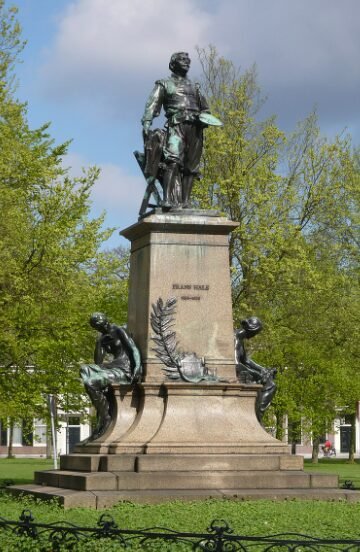
Statue of Frans Hals in Florapark, Haarlem
Frans Hals the Elder, born around 1582 and passing in 1666, was a pioneering Dutch painter whose lively and expressive portraits set him apart from his contemporaries. He is remembered as a leading artist of the Dutch Golden Age, an era when the Netherlands experienced an unprecedented flourishing of commerce, science, and art.
Hals’ distinctive painting style, which captured the personality and vivacity of his subjects, made him one of the most admired portraitists of his time.
Primarily working and living in Haarlem, Hals developed a strong connection to his local community, often portraying its wealthy burghers, civic leaders, and local militias. His career and works tell a story not only of individual artistic innovation but also of the broader social and cultural trends of the period.
In the article below, World History Edu explores the life and major works of Frans Hals, highlighting his contributions to Dutch art and the lasting legacy of his paintings.
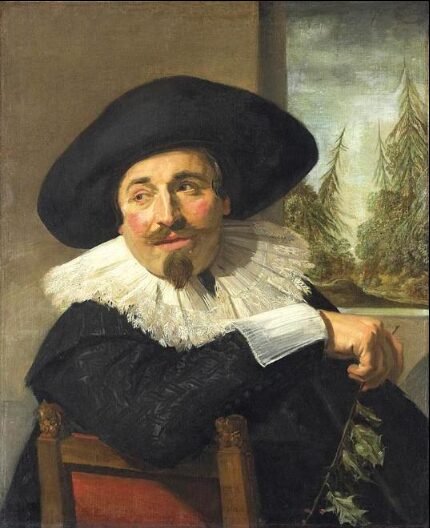
A 1626 portrait by Frans Hals
Early Life and Background
Frans Hals was likely born in Antwerp, in the Spanish Netherlands, around 1582 or 1583. During this time, the region was embroiled in the Eighty Years’ War (1568–1648), as the Dutch fought for independence from Spanish rule. The war caused considerable upheaval in the area, leading many families to flee to safer regions.
Around 1585, the Hals family moved north to Haarlem in the Dutch Republic, where Frans would spend most of his life and establish his career.
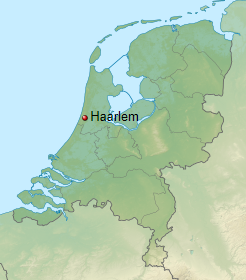
Haarlem in the Netherlands
Growing up in Haarlem, Hals trained under Karel van Mander, a Flemish-born artist and art historian who had fled to the Netherlands. Van Mander was a well-regarded painter and a significant influence on Hals, introducing him to the styles and techniques of both Flemish and Italian Renaissance masters.
However, Hals soon developed a unique approach, diverging from the refined and idealized forms seen in the Renaissance and opting for a more direct and expressive style. His distinctive method would become the hallmark of his career.
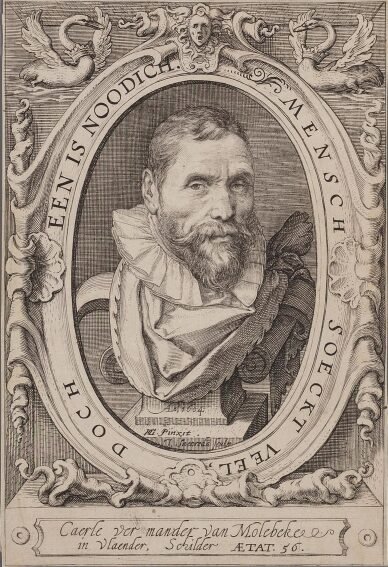
Flemish painter and poet Karel van Mander
Artistic Style and Techniques
Hals’ technique was groundbreaking for his time, characterized by loose, visible brushstrokes and an ability to capture spontaneous moments. This approach gave his portraits a lively, almost conversational quality, making his subjects appear as if they were caught in a moment of real life.
His style was notably different from the smooth, carefully blended painting methods used by his contemporaries, such as Rembrandt, who preferred chiaroscuro (the contrast of light and dark) to create depth and drama. Instead, Hals used natural light and a softer, silvery palette, focusing on creating an atmosphere of immediacy and vitality in his portraits.

The Rommel Pot Player, c. 1618–1622 by Frans Hals
Hals was also a master of “alla prima” painting, a technique where the paint is applied directly to the canvas without layering or underpainting. This method requires confidence and skill, as it does not allow for extensive revision. Hals’ alla prima approach allowed him to complete portraits relatively quickly, capturing the essence of his subjects with minimal strokes.
His visible brushwork was considered unorthodox at the time, as it defied the prevailing standards of polished and precise finish in portraiture. Yet, this bold technique would later inspire artists in the Impressionist movement, who valued spontaneity and expressive brushwork.
Personal Life and Marriages
In 1610, Hals married Anneke Harmensdochter, with whom he had three children. Unfortunately, two of their children died in infancy, and Anneke herself passed away in 1615, shortly after the birth of their third child. Following her death, Hals faced unproven accusations of mistreating his wife, but these were later found to be based on mistaken identity.
Around 1617, Hals married Lysbeth Reyniers, a fishmonger’s daughter. This marriage was recorded in the village of Spaarndam to avoid Haarlem’s regulations, as Lysbeth was already eight months pregnant at the time. The couple would go on to have eight more children, and Hals became a dedicated family man.
Despite his growing reputation, Hals experienced financial difficulties throughout his life. Unlike some artists of the period, such as Rembrandt, who moved frequently to follow wealthy patrons, Hals remained loyal to Haarlem, rarely leaving the city. His refusal to relocate likely limited his earnings, as it required patrons to travel to Haarlem to sit for their portraits.
Over time, he supplemented his income by working as an art dealer, restorer, and tax expert for Haarlem’s city council. Despite his financial troubles, Hals maintained his artistic integrity, continuing to develop his distinctive style.
Major Works and Contributions

Frans Hals’ Boy with a lute c. 1625 The Metropolitan Museum of Art
The Banquet of the Officers of the St. George Militia Company (1616)
One of Hals’ earliest major works, The Banquet of the Officers of the St. George Militia Company, is a large group portrait that captures a gathering of the local militia. Painted in 1616, this piece illustrates Hals’ skill in conveying individuality within a group setting. Each militiaman is depicted with unique facial expressions, postures, and gestures, creating a lively scene that feels almost theatrical. This work set the standard for later Dutch group portraits and showcased Hals’ ability to blend realism with a sense of narrative.
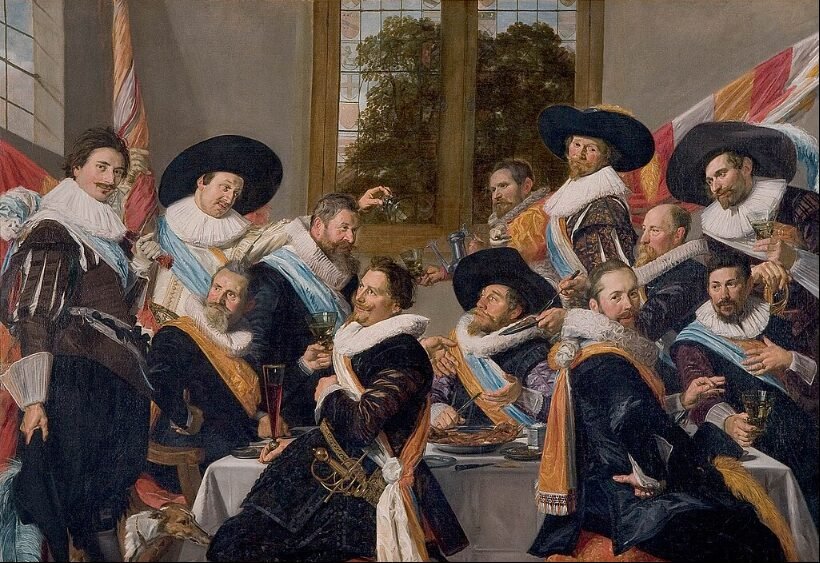
Banquet of the Officers of the Calivermen Civic Guard, Haarlem (1627) by Frans Hals
The Laughing Cavalier (1624)
Perhaps one of Hals’ most famous paintings, The Laughing Cavalier exemplifies his skill in capturing personality and emotion. The subject, a young man with a mustache, sports an elaborate, embroidered outfit and a confident expression. His face, marked by a slight smirk, conveys a sense of charm and self-assurance.
Hals’ brushwork is particularly notable in this piece, with the intricate details of the cavalier’s clothing contrasting against the smoothness of his skin. The subject’s eyes seem to follow the viewer, creating an engaging interaction between the painting and its audience. This portrait has become an iconic image of the Dutch Golden Age and remains celebrated for its vivacity and style.
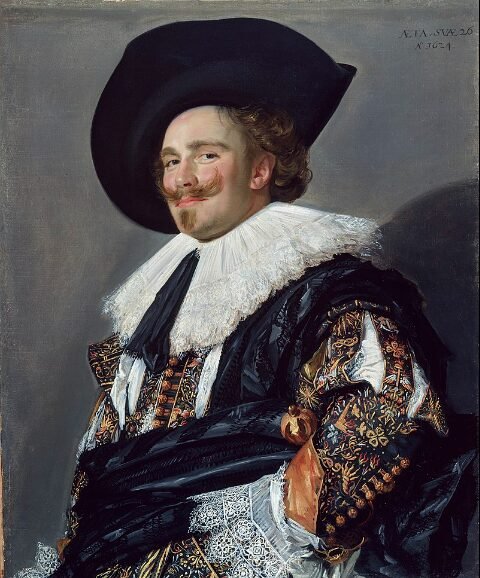
The Laughing Cavalier (1624)
The Jolly Drinker (c. 1628-1630)
The Jolly Drinker is another popular example of Hals’ genre portraits, showcasing his ability to capture the essence of ordinary individuals. The painting features a man holding a mug, looking directly at the viewer with a friendly grin and an outstretched hand.
Hals’ quick, loose brushstrokes bring the scene to life, creating an impression of spontaneity and cheerfulness. This piece reflects the Dutch culture of the time, celebrating everyday life and the pleasures of companionship and drink.
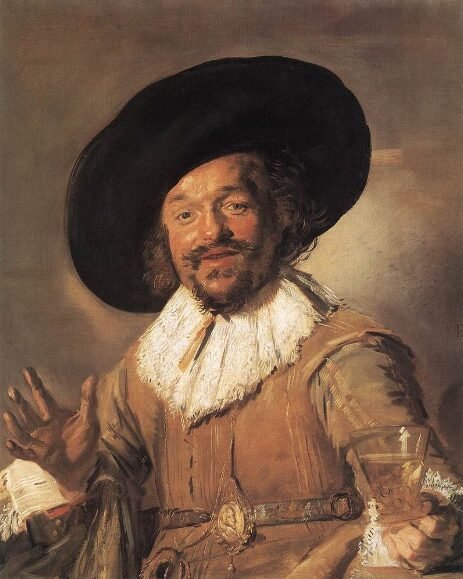
The Merry Drinker, c. 1628–1630
Portrait of Pieter van den Broecke (1633)
In this portrait of Pieter van den Broecke, a prominent Dutch merchant and explorer, Hals captures the personality of his subject with remarkable skill. Van den Broecke, portrayed with disheveled hair and a knowing smile, exudes a sense of adventure and worldliness.
This portrait highlights Hals’ ability to convey character and individuality, making each subject feel like a real person with a unique story. The informal, almost playful expression of van den Broecke contrasts with the formal portraits typical of the time, demonstrating Hals’ innovative approach to portraiture.

Pieter van den Broecke, by Frans Hals (Kenwood House)
The Regents of the Old Men’s Almshouse (1664)
Late in his career, Hals painted The Regents of the Old Men’s Almshouse, a group portrait of the wealthy citizens responsible for managing a Haarlem charity for the elderly. Unlike his earlier, more vibrant works, this painting has a somber, almost monochromatic palette, reflecting the serious nature of the subjects and the sobering responsibilities of their role.
The faces of the regents are marked by age, and their expressions are serious, embodying the dignity and solemnity of their position. This painting illustrates the shift in Hals’ style over the years, as he adapted his approach to match the mood and character of his subjects.
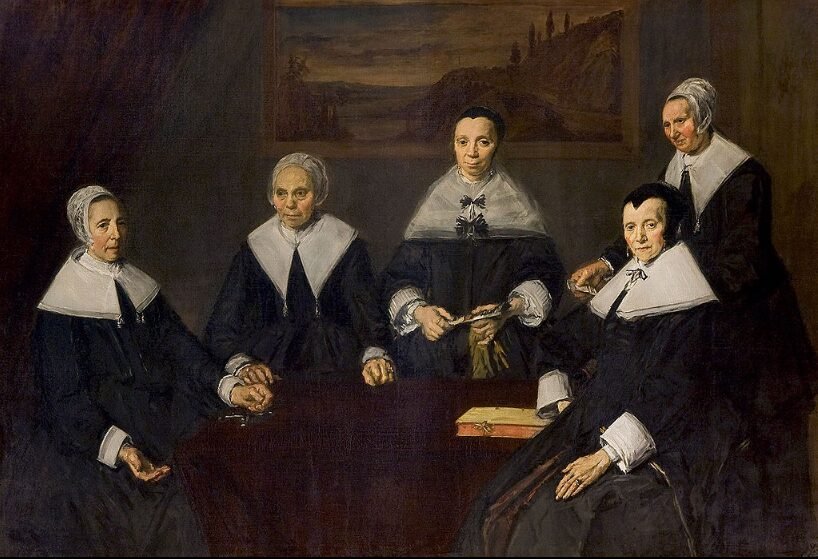
The Regentesses of the Old Men’s Almshouse Haarlem (c. 1664) by Frans Hals
Influence and Legacy
Frans Hals’ approach to portraiture was revolutionary for his time, and his influence extended far beyond the Dutch Golden Age. His focus on spontaneity, emotion, and individuality set him apart from other artists and has earned him admiration from art historians and painters across the centuries.
Hals’ visible brushstrokes and loose, expressive technique were later embraced by artists of the Impressionist movement in the 19th century, who saw his work as a precursor to their own efforts to capture fleeting moments and sensations.
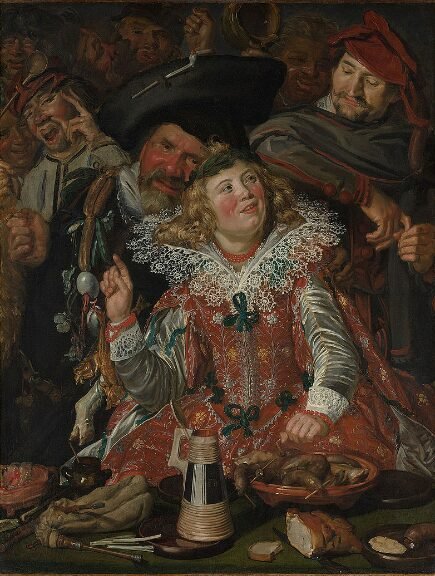
Frans Hals, Merrymakers at Shrovetide, The Metropolitan Museum of Art
In the 19th century, the art critic Théophile Thoré-Bürger played a significant role in reviving interest in Hals’ work. Thoré-Bürger praised Hals for his naturalism and vitality, helping to elevate his reputation and bring his paintings to the attention of a wider audience. This renewed interest in Hals led to a reevaluation of his contributions to art history, solidifying his status as one of the Dutch Golden Age’s most important painters.
Hals excelled in a loose, painterly style, contrasting with the neat portraiture of others like Verspronck.
Among Hals’ admirers were Impressionist painters like Édouard Manet and Claude Monet, who were inspired by his bold use of color and loose brushwork. Manet, in particular, was struck by Hals’ ability to convey character with minimal detail, and he often emulated Hals’ technique in his own portraits. Other artists, such as Vincent van Gogh and James Abbott McNeill Whistler, also looked to Hals as a source of inspiration, appreciating his direct and expressive style.
Today, Frans Hals’ works are celebrated in major art museums around the world, including the Rijksmuseum in Amsterdam, the Louvre in Paris, and the Metropolitan Museum of Art in New York. His paintings are especially well represented in the Frans Hals Museum in Haarlem, which houses some of his most famous pieces and serves as a tribute to his enduring legacy.
Key Characteristics of Hals’ Art

Jester with a Lute, 1620–1625, canvas, Musée du Louvre, Paris.
- Expressive Brushstrokes: Hals’ use of loose, visible brushstrokes was groundbreaking for the time, lending his paintings a sense of immediacy and energy.
- Lifelike Expressions: Hals had an uncanny ability to capture the personality and emotion of his subjects, making them appear lively and approachable.
- Group Portraits: Hals was a master of group portraits, creating compositions where each figure retained a unique identity. His group portraits of militias and civic leaders are considered masterpieces of the genre.
- Use of Natural Light: Rather than relying on dramatic contrasts of light and shadow, Hals preferred a natural, softer light, giving his paintings a realistic and approachable feel.
- Evolution of Style: Over his career, Hals’ work became more restrained and somber, reflecting the changing tastes of his clientele and his own financial difficulties.
Challenges and Final Years
Despite his artistic success, Hals faced numerous personal and financial struggles. As tastes changed, his style fell out of favor, and his work was no longer in high demand. By the mid-17th century, more refined and polished techniques, exemplified by artists like Gerard ter Borch and Rembrandt, had become popular, leaving Hals’ loose, spontaneous style somewhat outdated. In addition, the economic downturn in the Netherlands reduced the demand for portraits, and Hals struggled to find new patrons.
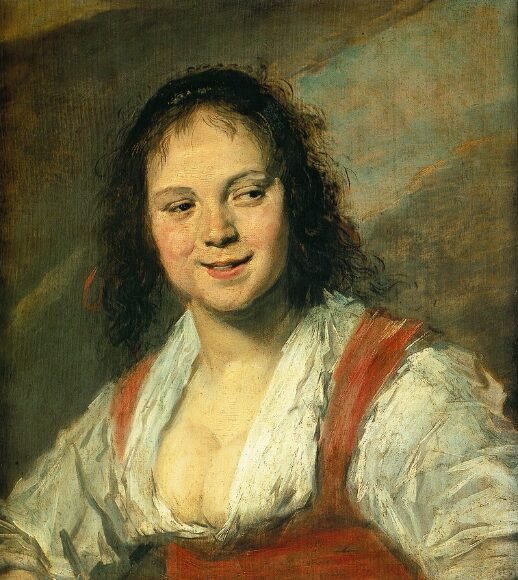
The Gypsy Girl (1628)
In his later years, Hals faced increasing financial hardship, and he was forced to sell his belongings to pay his debts. In 1664, the city of Haarlem granted him a modest pension, a rare honor that acknowledged his contributions to Dutch art.
Despite these difficulties, Hals continued to paint, producing some of his most introspective and solemn works in his old age. His final known works, including The Regents of the Old Men’s Almshouse, reveal a maturity and depth that speak to his resilience and dedication to his craft.
Hals passed away in 1666 and was buried in the Grote Kerk in Haarlem. Although he died in relative obscurity, his reputation would be revived in the centuries following his death, as art historians and critics came to recognize his pioneering contributions to portraiture.
Conclusion
Frans Hals’ life and work embody the spirit of the Dutch Golden Age, a period of innovation and prosperity that transformed Dutch society and culture. His portraits stand out for their realism, emotional depth, and spontaneity, capturing not only the physical appearance but also the personalities of his subjects.
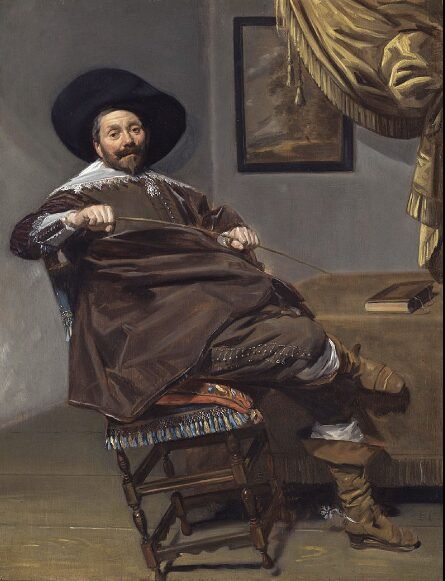
Willem van Heythuysen by Frans Hals
Hals’ ability to infuse his paintings with vitality and immediacy has made him one of the most celebrated painters of his time, and his influence has extended far beyond his own era, inspiring generations of artists from the Impressionists to modern painters.
Hals’ subjects, often wealthy citizens and émigrés, display lively expressions and subtle smiles, reflecting their personalities.
In capturing the lives of Haarlem’s citizens—from wealthy burghers and militia officers to everyday people like The Jolly Drinker—Hals provided a unique window into Dutch society. His portraits reflect a society that valued individuality, civic pride, and personal accomplishment, qualities that remain central to the Dutch cultural identity.
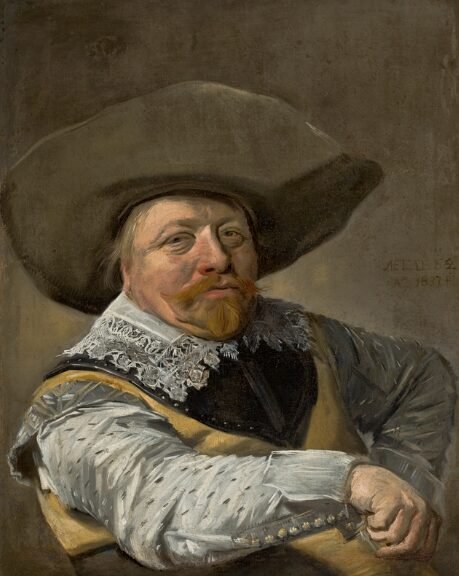
1631 Painting by Frans Hals
Despite the challenges he faced, Hals’ dedication to his art and his innovative approach to portraiture have cemented his place as one of the great masters of European art. Through his works, Frans Hals continues to bring his subjects to life, ensuring his legacy as a painter of humanity and spirit.
Frequently Asked Questions

Self-portrait of Dutch painter Frans Hals
Who was Frans Hals and why is he celebrated?
Frans Hals was a prominent Dutch Golden Age painter, renowned for his expressive, lively portraits that captured the personalities of his subjects. His work contrasted with the more refined, restrained styles of his contemporaries.
Where did Frans Hals spend most of his life?
Hals lived primarily in Haarlem, Netherlands, where he gained recognition for his portraits of local citizens and civic leaders.
How did Haarlem’s civic culture affect Hals’s work?
While Haarlem discouraged religious artwork in public spaces, citizens embraced personal portraits for their homes, creating a demand that Hals met with his vibrant portraiture.

Portrait of Jacob Pietersz Olycan (1596–1638), 1625, Mauritshuis.
Who were Hals’s primary patrons?
Hals was sought after by wealthy patrons and émigrés who appreciated his lively portrayals, full of subtle expressions and personality.
What is known about Hals’s first marriage?
Hals married Anneke Harmensdochter around 1610, but records are limited due to lost city archives. They had three children, with only one surviving infancy. Anneke passed away in 1615.
Unfounded stories claimed Hals mistreated his first wife and had a heavy drinking problem. Both rumors were later disproven or shown to be exaggerations.
Who was Hals’s second wife, and how many children did they have?
After Anneke’s death, Hals married Lysbeth Reyniers in 1617, with whom he had eight children. They wed in Spaarndam to avoid Haarlem’s marriage regulations.
How did Hals differ from his contemporaries in terms of working locations?
Unlike painters like Rembrandt, who traveled to clients, Hals insisted that clients come to Haarlem for their portraits, even refusing high-profile work outside his city.
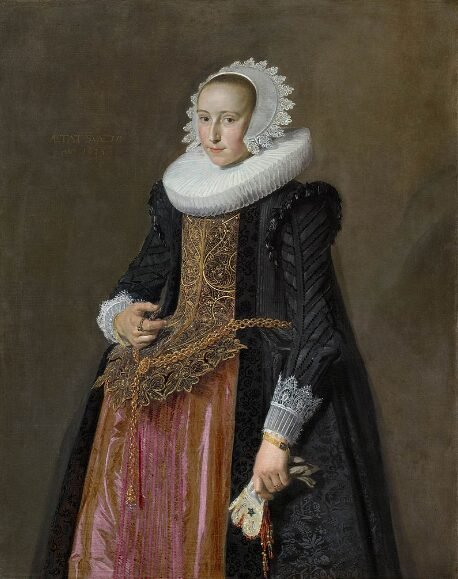
Portrait of Aletta Hanemans (1606–1653), bride of Jacob Olycan, 1625, Mauritshuis.
How did Hals support himself in later years?
Besides painting, Hals worked as a restorer, art dealer, and art tax expert for Haarlem’s city council. Despite his reputation, he faced financial hardship, which led to a city pension in 1664.
What was distinctive about Hals’s group portraits?
Hals captured the individuality of each subject through posture, gesture, and facial expression, making each figure in his group portraits uniquely identifiable.
How did Hals’s approach to light and color differ from Rembrandt’s?
Hals preferred natural light and soft, silvery tones, contrasting with Rembrandt’s use of dramatic shadows and deep color contrasts.

Paulus van Beresteyn, 1629, Louvre.
What themes are seen in Hals’s wedding portraits?
His wedding portraits were popular among patrons, depicting couples with a focus on individuality and often painted separately. However, he did paint one couple together in the celebrated Couple in a Garden.
How did Hals’s painting style evolve over time?
Early works by Hals conveyed cheerfulness, but later paintings took on a monochromatic, dignified restraint, possibly reflecting both economic limitations and the modest tastes of his Protestant clients.

Hals used visible, deliberate brushstrokes rather than blending them, a style uncommon at the time and later adopted by artists like Édouard Manet. Image: Catharina Both van der Eem, bride of Paulus Beresteyn, 1629, Louvre.
Who were some of Hals’s students and admirers?
Hals influenced many, including his brother Dirck, five of his sons, and Haarlem painters like Judith Leyster. His biographer Theodorus Schrevelius praised Hals’s energy and vitality in painting.
What happened to Hals’s reputation after his death?
For centuries, Hals’s work was undervalued, and some paintings sold for minimal prices. However, art critic Théophile Thoré-Bürger revived his reputation in the 19th century, raising the value of his paintings significantly.

Portrait of Stephan Geraedts, husband of Isabella Coymans, 1652, Royal Museum of Fine Arts, Antwerp.
Where can Hals’s work be found today?
Hals’s paintings are celebrated in museums worldwide, particularly in the Frans Hals Museum in Haarlem, and have influenced generations of artists for their lively immediacy and expressive brushwork.
What lasting impact did Hals have on the art world?
Hals’s vibrant brushstrokes, unique style, and ability to capture human personality cemented his legacy as a pioneering artist whose influence continues from the Dutch Golden Age to today.

Isabella Coymans, wife of Stephan Geraedts, 1652, Private Collection.





