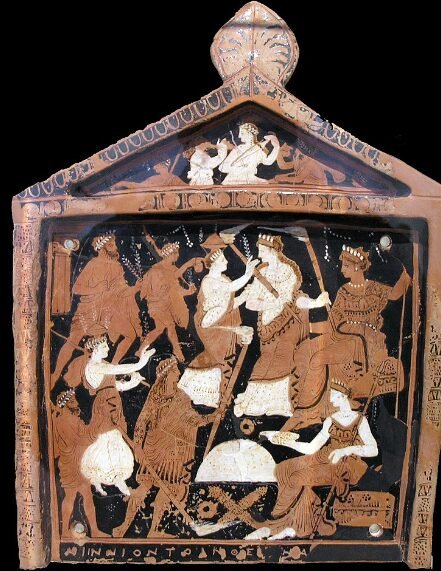
This hydria, a water jug with three handles, not only served a functional purpose but also held symbolic and ritualistic value, illustrated through its artwork. Created during the Classical period of ancient Greece, this hydria features a black, glossy surface with a metallic sheen, and its decoration intricately illustrates a central scene from the Eleusinian Mysteries.
This ceremonial scene represents characters and themes significant to the cult and myths surrounding Demeter and Persephone, particularly focusing on ideas of life, death, and rebirth.

The Eleusinian Mysteries hydria from Capua is a 4th-century BCE red-figure Greek vase depicting Demeter and Persephone’s spring reunion, symbolizing nature’s rebirth.
Purpose and Significance of the Hydria
Hydriai (plural of hydria) were commonly used for carrying water, featuring two side handles for lifting and a third, vertical handle for pouring. However, some hydriai went beyond their practical use, becoming canvases for artistic expression, religious devotion, and storytelling.
The Eleusinian Mysteries Hydria is one such example, showing that it likely served a commemorative or ritualistic purpose.
The detailed mythological imagery on the hydria reflects the religious and symbolic beliefs of the time, especially those associated with the Eleusinian Mysteries. The imagery brings the myth of Demeter and Persephone to life, serving as both a tribute to these goddesses and a reminder of the cyclical nature of life and renewal.
The Eleusinian Mysteries: A Religious Background
The Eleusinian Mysteries were initiatory rites held annually at Eleusis, a town near Athens, where initiates, called mystai, engaged in secret rituals to honor Demeter and her daughter Persephone.
These mysteries were based on the myth of Persephone’s abduction by Hades, god of the underworld, and her mother Demeter’s relentless search for her.

Demeter mourning Persephone by Evelyn de Morgan, 1906.
According to the myth, Demeter’s grief over her daughter’s disappearance brought barrenness to the earth, and only Persephone’s partial return restored fertility, creating a balance between the underworld and the earth.
Persephone’s cyclical return each spring symbolized the rebirth of nature, making her an emblem of renewal, while Demeter’s sorrow in winter represented the death and dormancy of the natural world.
Initiates into the Eleusinian Mysteries believed that participating in these rites allowed them to gain a deeper understanding of the cycles of life and nature and, importantly, to be granted a promise of a blessed afterlife.
Characters and Symbols Depicted on the Hydria
The hydria presents five central figures in a ceremonial arrangement: Persephone, Demeter, Dionysus, Triptolemus, and a maenad. Each character’s posture, attire, and adornments help identify them within the mythological context and convey the interconnected themes of the Eleusinian Mysteries.
Persephone

Persephone
Standing at the center of the scene, Persephone, the goddess who represents both the underworld and renewal, is the focal point of the hydria’s decoration. She is dressed in a soft pink chiton (a type of ancient Greek garment) and a sea-green himation (a cloak), crowned with golden leaves symbolizing her divine status.
Her hair is tied in a neat bun, and she is adorned with jewelry, including earrings, a necklace, bracelets, a brooch or clasp, and gold buttons. Persephone holds two golden torches, which link her to the underworld she leaves each year to rejoin her mother, Demeter, and bring new life to the world. Persephone’s presence embodies the cycle of life and death that is central to the Eleusinian Mysteries.
Demeter

A marble statue of Demeter; National Roman Museum
To Persephone’s left sits her mother, Demeter, the goddess of harvest and fertility. Demeter’s role in the mysteries is foundational, as she symbolizes the nurturing aspect of the earth. Like her daughter, Demeter wears a pink chiton and is adorned with golden jewelry—a diadem with decorative rays and bosses, earrings, a brooch, and bracelets.
She sits with her left arm resting on a seat decorated with alternating bands of white and pink, while her right hand holds a golden scepter, indicating her authority and status. Demeter’s reunion with Persephone each spring signifies the renewal of the earth and the promise of fruitful harvests, which is the core theme of the Eleusinian Mysteries.
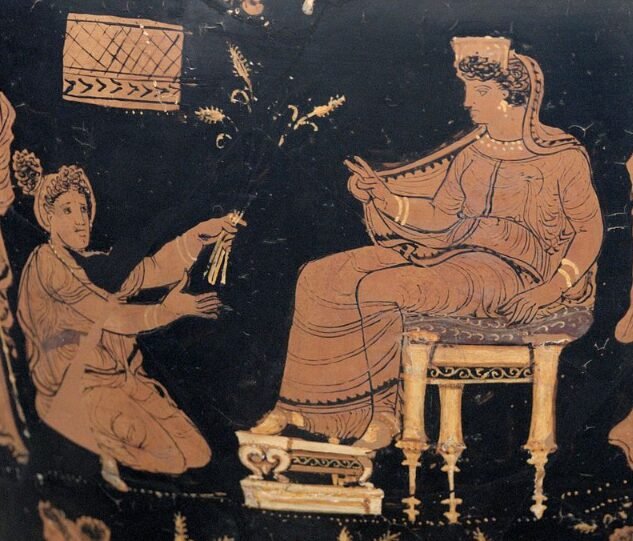
Demeter sits enthroned, blessing the kneeling Metaneira, who presents wheat—a recurring symbol in the mysteries—on a red-figure hydria by the Varrese Painter (c. 340 BC, Apulia).
Dionysus

Dionysus extending a drinking cup (kantharos) (late 6th century BC)
On the right side of Persephone stands Dionysus, the god of wine, vine, and ecstasy. Dionysus is identifiable by his thyrsus—a staff wrapped in leaves, topped with a pine cone, and decorated with pink stripes.
Though not originally part of the Demeter-Persephone myth, Dionysus became associated with the Eleusinian Mysteries over time. His inclusion on the hydria reflects his later role in the cult, symbolizing altered states of consciousness and themes of life, death, and rebirth.
Dionysus’ crown of golden ivy also alludes to his divinity and connection to the natural world. He sits upon the omphalos, or “navel of the world,” a symbolic stone representing the earth’s center, suggesting his integration into Eleusis as a sacred figure.
Triptolemus
On the far right, Triptolemus, a prominent figure in Eleusinian mythology, is shown dancing. According to myth, Demeter chose Triptolemus to spread her knowledge of agriculture to humanity.
As the symbolic “king of Eleusis,” Triptolemus represents the transmission of agricultural wisdom and the spread of civilization. His depiction on the hydria emphasizes the Eleusinian Mysteries’ agricultural theme, as he serves as an intermediary between the divine knowledge of Demeter and the mortal realm.
His presence reinforces the theme of the seasonal cycle, underscoring the connection between nature’s rhythms and human prosperity.
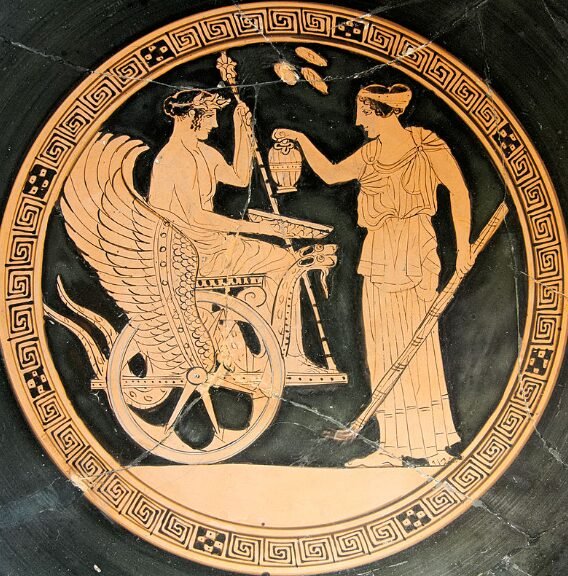
Triptolemus and Persephone, tondo of a red-figure Attic cup
Maenad
To the far left stands a maenad, a female follower of Dionysus, energetically playing a tambourine. Maenads were often depicted as joyous or ecstatic, embodying Dionysian celebration and vitality.
The maenad’s presence signifies Dionysian influence within the Eleusinian Mysteries, and her tambourine represents festivity, fertility, and the life-affirming spirit of the rites.
Her role within the scene frames the celebratory aspect of the mysteries, highlighting the importance of joy and vitality in the cult’s rituals.
Artistic Elements and Symbolism
The Eleusinian Mysteries Hydria is not only a religious artifact but also an artistic masterpiece. The artist’s careful use of colors—green, pink, grey, white, and gold—adds depth to the depiction, allowing each figure to be individually identified while contributing to the overall harmony of the composition.
The glossy black background with a metallic sheen enhances the scene, giving the figures a lifelike quality. The distinct colors and details reflect the figures’ status as deities and mythological figures, highlighting their symbolic significance.
The hydria’s illustration is not a straightforward narrative from Greek mythology but rather a symbolic representation of the Eleusinian Mysteries’ central themes. Persephone and Demeter, as the primary figures, emphasize the cycle of rebirth and the renewal of life, while Dionysus and the maenad bring in elements of ecstasy and celebration.
Triptolemus underscores the role of agriculture, conveying how the mysteries connected divine blessings to the prosperity of the human community. The characters and their attributes illustrate the seasonal cycle, reminding viewers of nature’s rhythms and humanity’s dependency on them.
Provenance and Historical Journey of the Hydria
The Eleusinian Mysteries Hydria has a well-documented history tracing back to the 19th century. It was initially part of the collection of Alessandro Castellani, an influential Italian antiquities dealer known for his extensive collection of classical artifacts.
Discovered in 1883 in a Capua tomb, the Eleusinian Mysteries Hydria likely belonged to an Eleusis pilgrim. Painted in the Kerch style, it’s now housed in the Museum of Fine Arts, Lyon.
In 1884, the hydria was included in a sale at the Palazzo Castellani in Rome, where it was acquired by Michał Tyszkiewicz, a nobleman and avid collector from Poland-Lithuania with a strong interest in classical antiquities. Tyszkiewicz’s collection was later auctioned in Paris in 1898, where the hydria was purchased by the Museum of Fine Arts of Lyon, France, where it remains today.
Did you know…?
Similar hydriai with Eleusinian themes exist in other collections, including the National Archaeological Museum in Athens, the Istanbul Museum of Classical Antiquities, and the Hermitage Museum in St. Petersburg.
Cultural Significance and Legacy
The Eleusinian Mysteries Hydria holds great cultural significance as it encapsulates the essence of the Eleusinian Mysteries, an ancient tradition that was central to Greek spirituality.
The mysteries were not merely religious rites but a profound cultural institution that influenced the Greek understanding of life, death, and renewal. The hydria’s detailed depiction of the mythological figures reminds viewers of the fundamental beliefs that shaped Greek society, particularly the reverence for seasonal cycles and the promise of rebirth.
For the ancient Greeks, the Eleusinian Mysteries provided a sense of comfort, hope, and continuity. The myth of Persephone’s return symbolized life’s renewal after death, reassuring initiates of a blessed afterlife. This hydria likely served a dual role, both as a practical vessel and as a symbolic or ritualistic object, perhaps owned by someone with a personal connection to the mysteries. Its intricate design would have reminded the owner of the divine cycles governing life and nature, reinforcing the spiritual beliefs central to Greek culture.
The presence of Dionysus and the maenad in the scene also illustrates how Greek spirituality was interconnected, blending multiple deities and rituals. While the Eleusinian Mysteries focused primarily on Demeter and Persephone, the inclusion of Dionysian elements highlights the Greek practice of integrating diverse religious traditions. This synthesis of beliefs is reflected in the hydria, where agricultural and ecstatic symbols coexist harmoniously.
Today, the Eleusinian Mysteries Hydria remains an important artifact, offering insights into the symbolic world of ancient Greece and the role of myth in shaping cultural identity. Housed in the Museum of Fine Arts of Lyon, the hydria stands as a testament to the enduring legacy of the Eleusinian Mysteries, continuing to captivate viewers with its beauty and cultural depth.
As an artistic representation of a deeply spiritual ritual, it bridges the gap between the modern viewer and ancient Greek spirituality, highlighting the timeless themes of life, death, and renewal that resonate across cultures and epochs.
READ MORE: Athenian Black-and-Red-Figure Vases