French Painter and Sculptor Paul Gauguin
Paul Gauguin (1848–1903) was a French artist whose groundbreaking works transformed modern art. Known for his bold use of color, innovative techniques, and cultural exploration, Gauguin left a profound legacy despite living a life fraught with controversy, struggle, and isolation. His contributions to painting, sculpture, and printmaking resonate with themes of spirituality, primitivism, and rebellion against conventional European norms.
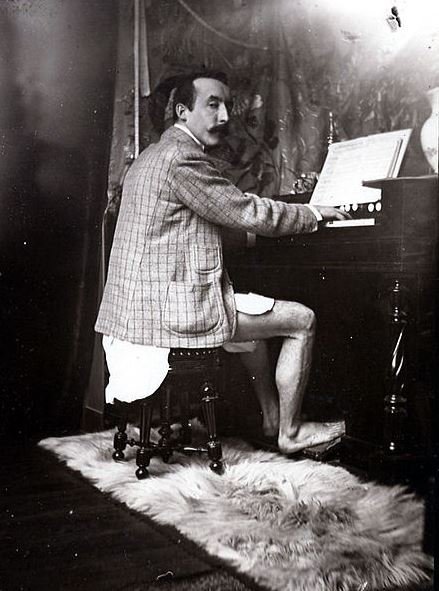
An 1895 photograph of Paul Gauguin.
Early Life and Cultural Exposure
Born in Paris in 1848, a year marked by political revolutions, Gauguin came from a family with intellectual and artistic roots. His mother, Aline Chazal, was the daughter of Flora Tristan, a noted socialist and feminist writer. His father, Clovis Gauguin, a liberal journalist, died en route to Peru when Paul was an infant. Gauguin spent his early childhood in Peru, an experience that left an indelible impression on his imagination, instilling a fascination with exotic cultures.
After political upheaval in Peru, the family returned to France, where financial struggles forced Gauguin’s mother to work as a dressmaker. Gauguin attended Catholic schools and briefly served in the French navy. In his early 20s, he became a stockbroker, leading a stable bourgeois life. Despite financial success, Gauguin cultivated an interest in art, inspired by galleries and the Impressionist movement.
Mentorship and Early Work
In the 1870s, Gauguin began painting as a hobby. Camille Pissarro, a prominent Impressionist, became his mentor, introducing him to avant-garde artists and techniques. Gauguin exhibited with the Impressionists in the early 1880s but soon found their focus on naturalism and fleeting light inadequate for his artistic vision.
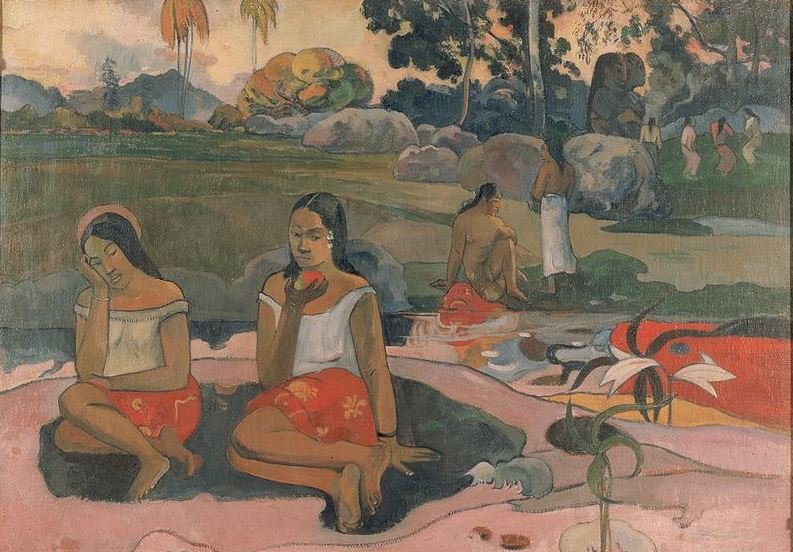
“Nave nave moe”, an 1894 painting by Gauguin
Financial Crisis and Full-Time Painting
The 1882 stock market crash ended Gauguin’s career as a broker. Forced to paint full-time, Gauguin developed a more experimental style, emphasizing bold color, simplified forms, and emotional depth. His self-imposed artistic mission was to break away from European traditions and delve into universal themes of humanity and spirituality.
Artistic Breakthroughs
In the late 1880s, Gauguin spent time in Brittany, France, where he began formulating his unique style. Inspired by rural life and Celtic traditions, he created works like The Yellow Christ, emphasizing symbolic content over naturalistic detail. A stay in Martinique further deepened his fascination with non-European cultures, as seen in vibrant tropical landscapes and depictions of local life.
Paul Gauguin is renowned for his bold use of color, the Synthetist style, and his contributions to Post-Impressionism and Symbolism. He also influenced modern art and artists like Picasso and Matisse.
Gauguin adopted Cloisonnism, a technique using bold outlines and flat areas of color, influenced by Japanese prints and medieval art. His synthesis of emotional expression and symbolic motifs, termed “Synthetism,” marked a departure from Impressionism. This approach culminated in works like Vision After the Sermon (Jacob Wrestling the Angel).
Tahiti: Searching for the “Primitive”
Disillusioned with European industrialization, Gauguin left for Tahiti in 1891, seeking an unspoiled paradise. While Tahiti was already influenced by French colonialism, Gauguin envisioned it as a spiritual and artistic refuge. His works from this period, such as Ia Orana Maria (Hail Mary), depict Tahitian life with vibrant colors, symbolic imagery, and a blend of indigenous and Western motifs.
Gauguin’s personal life in Tahiti was controversial. He formed relationships with teenage girls, fathered children, and adopted aspects of Polynesian culture, which critics view as both cultural appropriation and exploitation. Despite his idealization of Tahiti, Gauguin often struggled with poor health, financial troubles, and a sense of alienation.
Later Years and Marquesas Islands
In 1893, Gauguin briefly returned to France to exhibit his Tahitian works. Although the exhibition gained some recognition, it failed to provide financial stability. Disheartened, he returned to Polynesia in 1895, settling in the Marquesas Islands in 1901. There, he continued to paint, sculpt, and write, producing masterpieces such as Where Do We Come From? What Are We? Where Are We Going?
Health Decline and Death
Gauguin’s later years were marked by declining health due to syphilis, injuries, and poverty. Despite his physical struggles, he maintained his artistic output and defied colonial authorities, becoming a vocal critic of the missionary system. He died in 1903 on the Marquesas island of Hiva Oa, leaving behind a complex legacy.
Artistic Legacy of Gauguin
Gauguin’s bold departure from naturalism influenced numerous 20th-century art movements, including Fauvism, Cubism, and Expressionism. Artists such as Pablo Picasso and Henri Matisse drew inspiration from his innovative use of color, form, and primitivist themes. His works challenged the boundaries of Western art, encouraging artists to explore spirituality, symbolism, and cultural diversity.
Gauguin’s legacy is not without controversy. While celebrated for his artistic achievements, his relationships with underage girls and romanticized depictions of Tahitian life have sparked debates about colonialism, power dynamics, and the ethics of his actions. Scholars continue to reassess his work in light of these issues, recognizing both its artistic significance and its problematic aspects.
Key Works and Techniques
Major Paintings
- The Yellow Christ (1889): A symbolic depiction of Breton faith using bold color and simple forms.
- Spirit of the Dead Watching (1892): A haunting portrayal of a young Tahitian girl, blending Polynesian spirituality with Gauguin’s personal mythologies.
- Where Do We Come From? (1897): Gauguin’s magnum opus, exploring existential questions through symbolic imagery and vivid color.
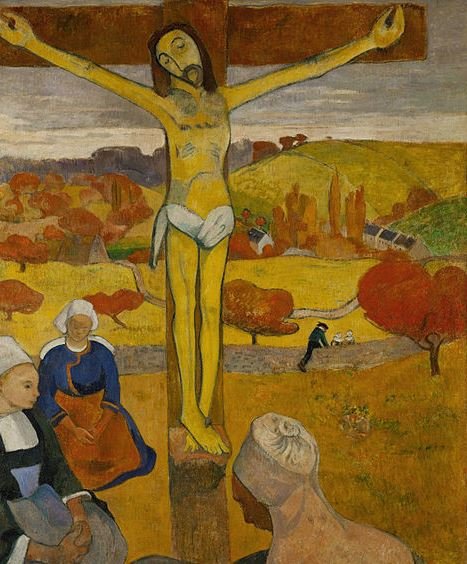
A view of the “The Yellow Christ” painting.
Gauguin’s techniques included Cloisonnism, woodcuts, and monotypes, which emphasized simplicity, abstraction, and texture. He often incorporated elements of folk art and non-European aesthetics, rejecting traditional Western academic methods.
Cultural Significance
Gauguin’s fascination with “primitive” cultures reflected 19th-century European colonialist attitudes. His works romanticized indigenous life while critiquing Western materialism. Despite their aesthetic beauty, these depictions perpetuated stereotypes, prompting ongoing debates about their cultural implications.
Paul Gauguin remains a polarizing figure in art history. His innovative techniques, daring compositions, and exploration of spiritual and cultural themes reshaped the trajectory of modern art.
Gauguin’s revolutionary approach to art inspired the avant-garde movements of the early 20th century. His synthesis of imagination, emotion, and symbolism paved the way for artists to break free from realism and embrace abstraction and experimentation.
Frequently Asked Questions
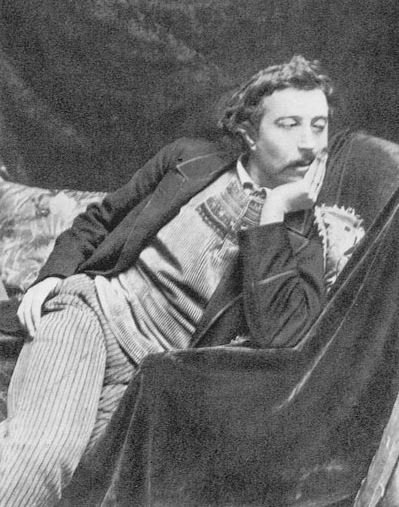
An 1891 photo of Paul Gauguin.
What defined Gauguin’s unique artistic style?
He used simplified forms, bold outlines, and vibrant, non-naturalistic colors inspired by folk art, Japanese prints, and Polynesian culture, moving away from Impressionism.
What role did Tahiti play in Gauguin’s art?
Tahiti inspired Gauguin’s exploration of themes like primitivism, spirituality, and the relationship between humans and nature, which became central to his work.
Why did Gauguin’s relationship with Impressionism change?
Gauguin distanced himself from Impressionism, seeking deeper symbolic meaning and adopting a more abstract and imaginative approach.
How did Gauguin’s personal life affect his legacy?
His controversial relationships with adolescent Tahitian girls and his colonialist depictions of Polynesians have sparked criticism, complicating his artistic legacy.
What was Gauguin’s relationship with Van Gogh?
Gauguin and Van Gogh had a turbulent friendship, culminating in their nine-week stay in Arles, during which Van Gogh famously cut off his ear after an argument.
How did Gauguin influence modern art?
His experimental techniques and focus on emotional depth inspired movements like Fauvism, Cubism, and Primitivism, shaping 20th-century art.
What was Gauguin’s impact after his death?
Gauguin’s works gained popularity posthumously, with exhibitions and collectors recognizing his revolutionary contributions to art.
Most Renowned French Romantic Painters and their Masterpieces





