The Peace Treaties That Brought WWI to an End
The peace treaties that followed World War I reshaped the political landscape of Europe and much of the world. These treaties aimed to establish a lasting peace after four years of devastating conflict, but they also laid the groundwork for future tensions, contributing to the outbreak of World War II.
The most famous of these treaties is the Treaty of Versailles, but several other agreements, including the Treaties of Saint-Germain, Trianon, Neuilly, and Sèvres, also played crucial roles in redrawing borders and dictating terms to the defeated Central Powers.
In this analysis, our team of WWI historians provide a detailed overview of the key treaties that brought an official end to World War I, their immediate effects, and their long-term consequences.
Context and the Road to Peace
The First World War, which lasted from 1914 to 1918, involved many of the world’s most powerful nations and resulted in the deaths of millions of people. By the time the war ended, Europe was in ruins, economies were shattered, and political systems had collapsed. The Central Powers, led by Germany, had been decisively defeated, and the Allied Powers sought to impose terms that would ensure Germany and its allies could never again pose such a threat.
The armistice that brought an end to the fighting on November 11, 1918, was not a peace treaty but a ceasefire agreement. It marked the cessation of hostilities on the Western Front, but formal peace treaties had to be negotiated in the months that followed. The Paris Peace Conference, which began in January 1919, was the venue for these negotiations. The conference was dominated by the “Big Four”—the United States, Great Britain, France, and Italy—though the United States, represented by President Woodrow Wilson, played a key role in shaping the post-war settlement.
Wilson’s vision of peace was outlined in his Fourteen Points, which called for self-determination for nations, free trade, disarmament, and the establishment of an international organization to preserve peace.
However, the other Allied leaders, particularly French Prime Minister Georges Clemenceau and British Prime Minister David Lloyd George, were more focused on punishing the Central Powers and ensuring their nations’ security. These competing goals created tensions during the peace negotiations and influenced the outcomes of the treaties.

During peace negotiations, fighting continued in various regions as nationalist, revolutionary, and counter-revolutionary forces pursued their goals. In Russia, a civil war erupted, resulting in more deaths than the world war itself. Image: A photograph of Woodrow Wilson in 1919.
The Treaty of Versailles (1919)
The Treaty of Versailles, signed on June 28, 1919, is the most famous of the peace treaties that ended World War I. It dealt specifically with Germany and was by far the most contentious of the agreements. The treaty was named after the Palace of Versailles, where the negotiations took place, and its terms were largely dictated by the Allied powers, particularly France and Britain.
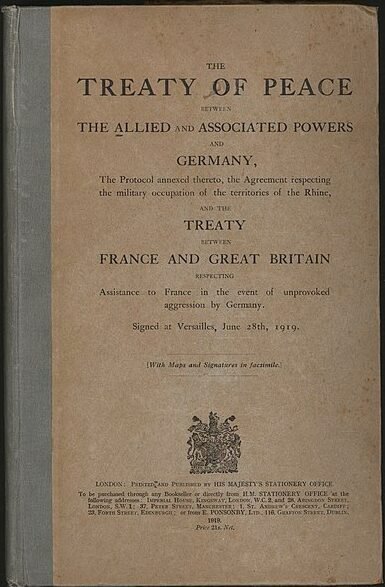
Image: Cover of the Treaty of Versailles.
Main Terms of the Treaty of Versailles
- War Guilt Clause (Article 231): One of the most controversial provisions of the Treaty of Versailles was the “war guilt clause,” which placed full responsibility for the war on Germany and its allies. This clause provided the legal basis for demanding reparations from Germany and was a source of great resentment in the country.
- Reparations: Germany was required to pay reparations to the Allied powers to compensate for the damage caused during the war. The total amount was later set at 132 billion gold marks (approximately $33 billion at the time), a figure that crippled the German economy and contributed to widespread hardship and instability in the years following the war.
- Territorial Losses: The treaty stripped Germany of significant territory:
- Alsace-Lorraine was returned to France.
- The Saar Basin was placed under the administration of the League of Nations for 15 years, with the coal mines given to France.
- The Rhineland was demilitarized, meaning Germany could not station military forces there.
- Germany’s overseas colonies were confiscated and placed under the control of the League of Nations, to be administered as mandates by the victorious powers.
- Parts of eastern Germany were ceded to the newly created Poland, creating the “Polish Corridor” that gave Poland access to the Baltic Sea and separated East Prussia from the rest of Germany.
- Military Restrictions: The treaty imposed severe limitations on the size and strength of the German military. The German army was limited to 100,000 troops, conscription was banned, and Germany was prohibited from possessing tanks, aircraft, and submarines. The German navy was also sharply reduced.
- The League of Nations: The Treaty of Versailles established the League of Nations, an international organization intended to maintain peace and prevent future conflicts. However, the League’s effectiveness was undermined by the fact that the United States never joined, as the U.S. Senate refused to ratify the treaty.
The League of Nations and the reason why the United States refused joining
Reactions to the Treaty of Versailles
The Treaty of Versailles was met with widespread criticism and dissatisfaction. In Germany, it was seen as a “Diktat” (dictated peace) because the German government was forced to sign the treaty without being allowed to negotiate its terms. The war guilt clause and reparations, in particular, were deeply resented by the German people and political elites, contributing to the instability of the Weimar Republic and the eventual rise of Adolf Hitler and the Nazi Party.
In France, the treaty was seen as a necessary measure to weaken Germany and ensure that it could never again threaten French security. However, some French leaders, including Clemenceau, believed the treaty did not go far enough in punishing Germany.
How and Why Adolf Hitler Failed in his Attempt to Seize Power in 1923
In Britain, public opinion was divided. While many supported the idea of holding Germany accountable for the war, others, including economist John Maynard Keynes, warned that the harsh reparations and economic terms would lead to disaster. Keynes argued in his book, The Economic Consequences of the Peace, that the treaty’s terms would cripple Germany’s economy and destabilize Europe, predictions that proved to be prescient.
In the United States, President Wilson had played a key role in shaping the treaty, particularly with his advocacy for the League of Nations. However, the U.S. Senate refused to ratify the Treaty of Versailles, largely due to opposition to the League, and the United States never became a member of the organization.
The Treaty of Saint-Germain (1919)
The Treaty of Saint-Germain, signed on September 10, 1919, dealt with Austria, one of the successor states of the Austro-Hungarian Empire. Like the Treaty of Versailles, it imposed harsh terms on the defeated Central Powers.
Main Terms of the Treaty of Saint-Germain
- Dissolution of the Austro-Hungarian Empire: The treaty formally dissolved the Austro-Hungarian Empire, creating several new nation-states in its place. Austria was reduced to a small, landlocked republic, and Hungary became a separate state. The empire’s former territories were divided among new or expanded countries, including Czechoslovakia, Yugoslavia, Poland, and Romania.
- Territorial Losses: Austria lost significant territory as a result of the treaty:
- South Tyrol and Trentino were ceded to Italy.
- Bohemia and Moravia were incorporated into the new state of Czechoslovakia.
- Galicia was ceded to Poland.
- Bosnia and Herzegovina, Dalmatia, and other territories were ceded to Yugoslavia.
- Military Restrictions: Austria’s military was limited to 30,000 troops, and the country was forbidden from uniting with Germany, a provision aimed at preventing the creation of a powerful German-speaking state in Central Europe.
- War Guilt and Reparations: Austria was held responsible for its role in the war and was required to pay reparations, though the economic collapse of the Austrian state made it difficult for the country to meet these obligations.
Consequences of the Treaty of Saint-Germain
The Treaty of Saint-Germain had profound effects on Central Europe. The dissolution of the Austro-Hungarian Empire created a number of new states, but these new countries were often ethnically diverse and faced internal conflicts and border disputes. The prohibition on Austria’s unification with Germany, known as the “Anschluss,” was a source of resentment in both countries and would later be violated when Nazi Germany annexed Austria in 1938.
The loss of its empire and the territorial concessions imposed by the treaty left Austria a much smaller and weaker state. The country struggled with economic hardship in the years following the war, and the instability created by the treaty contributed to the rise of authoritarian regimes in the region.
The Treaty of Trianon (1920)
The Treaty of Trianon, signed on June 4, 1920, dealt with Hungary, the other major successor state of the Austro-Hungarian Empire. Like the other treaties, it imposed significant territorial losses and military restrictions on the defeated Central Power.

Image: Pages of Treaty of Trianon
Main Terms of the Treaty of Trianon
- Territorial Losses: Hungary lost about two-thirds of its pre-war territory and over half of its population as a result of the treaty. Key territorial changes included:
- Transylvania was ceded to Romania.
- Slovakia and Ruthenia were ceded to Czechoslovakia.
- Croatia and Slovenia were ceded to the Kingdom of Serbs, Croats, and Slovenes (later known as Yugoslavia).
- Military Restrictions: Hungary’s military was limited to 35,000 troops, and conscription and the possession of an air force were prohibited.
- War Guilt and Reparations: Like Austria and Germany, Hungary was held responsible for the war and was required to pay reparations. However, Hungary’s economic difficulties made it difficult to fulfill these obligations.
Impact of the Treaty of Trianon
The Treaty of Trianon was deeply resented in Hungary, where it was seen as a national humiliation. The loss of such a large portion of Hungary’s territory and population created lasting bitterness, particularly among ethnic Hungarians who found themselves living in foreign countries as a result of the new borders.
The treaty left Hungary economically and politically weakened, and the desire to regain lost territories became a major factor in Hungary’s alliance with Nazi Germany in the lead-up to World War II.
The Treaty of Neuilly (1919)
The Treaty of Neuilly, signed on November 27, 1919, dealt with Bulgaria, another of the Central Powers that had been defeated in the war. Like the other treaties, it imposed territorial losses and reparations on Bulgaria.

Image: Treaty of Neuilly, showing signatures from several dignitaries including Boris III of Bulgaria.
Main Terms of the Treaty of Neuilly
- Territorial Losses: Bulgaria lost territory to several neighboring countries:
- Western Thrace was ceded to Greece, cutting Bulgaria off from access to the Aegean Sea.
- Parts of Macedonia were ceded to the Kingdom of Serbs, Croats, and Slovenes (Yugoslavia).
- Parts of western Bulgaria were ceded to Romania.
- Reparations: Bulgaria was required to pay reparations to the Allied powers, amounting to 2.25 billion gold francs.
- Military Restrictions: Bulgaria’s military was limited to 20,000 troops, and the country was prohibited from possessing an air force.
Consequences of the Treaty of Neuilly
The Treaty of Neuilly left Bulgaria feeling aggrieved and humiliated, particularly because the country had been promised territorial gains by the Allies during the war in exchange for joining their side, but these promises were not fulfilled. The territorial losses imposed by the treaty and the economic burden of reparations contributed to political instability in Bulgaria in the years following the war.
The Treaty of Sèvres (1920) and the Treaty of Lausanne (1923)
The Treaty of Sèvres, signed on August 10, 1920, dealt with the Ottoman Empire, which had fought alongside the Central Powers during World War I. However, the terms of the treaty were so harsh that they provoked widespread opposition in Turkey and were never fully implemented. The Treaty of Sèvres was eventually replaced by the Treaty of Lausanne in 1923, following the Turkish War of Independence.
Main Terms of the Treaty of Sèvres
- Territorial Losses: The Ottoman Empire lost most of its territory as a result of the treaty:
- The empire’s Arab territories were divided between Britain and France as mandates under the League of Nations.
- Eastern Thrace and much of western Anatolia were ceded to Greece.
- The Dodecanese Islands were ceded to Italy.
- Armenia and Kurdistan were granted autonomy, though these provisions were never implemented.
- Military Restrictions: The Ottoman military was severely restricted, with the number of troops limited to 50,000 and the empire’s navy and air force dismantled.
- Reparations: The Ottoman Empire was required to pay reparations, though the collapse of the empire made this difficult.
The Treaty of Lausanne (1923)
The Treaty of Sèvres was met with fierce opposition in Turkey, leading to the Turkish War of Independence, led by Mustafa Kemal Atatürk. The Treaty of Lausanne, signed on July 24, 1923, replaced the Treaty of Sèvres and established the borders of modern Turkey. It recognized Turkish sovereignty over Anatolia and eastern Thrace, while relinquishing claims to the Arab territories and the Dodecanese Islands.
Legacy of the Peace Treaties
The peace treaties that ended World War I reshaped the political landscape of Europe and the Middle East, creating new states and redrawing borders. However, they also sowed the seeds of future conflicts. The harsh terms imposed on the Central Powers, particularly Germany, created widespread resentment and economic hardship, which contributed to the rise of authoritarian regimes and the outbreak of World War II.
The Treaty of Versailles, in particular, has been widely criticized for its punitive approach toward Germany, which many historians argue was a key factor in the rise of Adolf Hitler and the Nazi Party. The territorial changes imposed by the treaties also created new ethnic and political tensions, particularly in Central and Eastern Europe, where the newly created states often contained significant minority populations.
The League of Nations, established by the Treaty of Versailles, was intended to prevent future wars, but its inability to enforce its decisions and the absence of key powers like the United States limited its effectiveness.
In the Middle East, the treaties dismantled the Ottoman Empire and created new mandates under British and French control. These mandates, particularly in Iraq, Syria, and Palestine, created long-term tensions that continue to affect the region today.
Questions and Answers

What event marked the official end of fighting in World War I?
The signing of the armistice on November 11, 1918, marked the official end of fighting in World War I, although formal peace treaties were signed later.
What was the purpose of the Paris Peace Conference in 1919?
The Paris Peace Conference was convened to negotiate the formal peace treaties that would officially end World War I and determine the post-war order, particularly the treatment of the defeated Central Powers.
Which nations played the most significant role in shaping the post-war peace treaties?
The “Big Four” nations—the United States, Great Britain, France, and Italy—played the most significant role in shaping the peace treaties after World War I.
What was the Treaty of Versailles, and when was it signed?
The Treaty of Versailles, signed on June 28, 1919, was the peace treaty that officially ended the war between the Allied Powers and Germany, imposing severe terms on Germany.
What was the “War Guilt Clause” in the Treaty of Versailles?
The War Guilt Clause (Article 231) placed full responsibility for World War I on Germany and its allies, providing the legal justification for reparations payments.
What reparations did Germany have to pay under the Treaty of Versailles?
Germany was required to pay substantial reparations to the Allied powers, initially set at 132 billion gold marks (around $33 billion), which contributed to economic instability in post-war Germany.
Germany lost about 13% of its territory and 10% of its population. Notable territorial losses included Alsace-Lorraine to France, parts of East Prussia to Poland, and the Saar Basin to the League of Nations.
What military restrictions were imposed on Germany by the Treaty of Versailles?
Germany’s military was restricted to 100,000 troops, conscription was banned, and the country was prohibited from possessing tanks, aircraft, and submarines.
What international organization was created by the Treaty of Versailles?
The Treaty of Versailles established the League of Nations, an international organization aimed at maintaining peace and preventing future conflicts.
How was the Treaty of Versailles received in Germany?
The Treaty of Versailles was deeply unpopular in Germany, where it was viewed as a “Diktat” or dictated peace, contributing to political instability and resentment that would later fuel the rise of the Nazi Party.
What was the Treaty of Saint-Germain, and what did it do?
The Treaty of Saint-Germain, signed on September 10, 1919, formally dissolved the Austro-Hungarian Empire and imposed territorial losses and military restrictions on Austria.
The Treaty of Saint-Germain led to the creation of several new countries from the former Austro-Hungarian Empire, including Czechoslovakia and the Kingdom of Serbs, Croats, and Slovenes (later Yugoslavia).
Austria was limited to a 30,000-troop military and was prohibited from forming a union (Anschluss) with Germany.
What was the Treaty of Trianon, and how did it affect Hungary?
The Treaty of Trianon, signed on June 4, 1920, significantly reduced Hungary’s territory and population, transferring large areas to Romania, Czechoslovakia, and the Kingdom of Serbs, Croats, and Slovenes.
Hungary lost about two-thirds of its territory and over half its population, including Transylvania to Romania, Slovakia to Czechoslovakia, and parts of Croatia and Slovenia to the Kingdom of Serbs, Croats, and Slovenes.
Hungary’s military was restricted to 35,000 troops, and conscription and the possession of an air force were prohibited.
Why were the treaties that ended World War I criticized?
The treaties, particularly the Treaty of Versailles, were criticized for being too punitive toward the defeated powers, contributing to economic instability and fostering resentment that helped lead to World War II.
What role did the Treaty of Versailles play in the rise of Adolf Hitler and the Nazi Party?
The harsh terms of the Treaty of Versailles, including the war guilt clause and reparations, fueled nationalist resentment in Germany, which was exploited by Adolf Hitler and the Nazi Party to gain political support.

Image: Adolf Hitler
What was the League of Nations, and why was it considered weak?
The League of Nations was an international organization created to maintain peace, but it was considered weak because it lacked enforcement mechanisms and key powers like the United States never joined.
What were the long-term effects of the treaties that ended World War I?
The long-term effects included political and economic instability in Europe, particularly in Germany and Central Europe, which created the conditions for the rise of fascist regimes and the outbreak of World War II.

Neville Chamberlain: The British Prime Minister whose appeasement policy emboldened Hitler





