Summary
Good Friday commemorates the crucifixion of Jesus Christ at Calvary and his death, which is central to the Christian faith. Observed during Holy Week, it is part of the Paschal Triduum, the three-day period leading up to Easter Sunday.
Christians around the world observe Good Friday with prayer, fasting, and church services. Many denominations, including Catholics, Protestants, and Orthodox Christians, mark this day with unique traditions reflecting the passion, suffering, and sacrifice of Jesus Christ. The day is also a legal holiday in numerous countries, with certain restrictions placed on public activities.
Easter: Origin Story and Significance of the Christian Celebration
Historical and Biblical Accounts
The events of Good Friday are detailed in the Gospels of Matthew, Mark, Luke, and John. Jesus was arrested in the Garden of Gethsemane after being betrayed by Judas Iscariot for thirty pieces of silver. He was then taken before the Jewish Sanhedrin, where he was accused of blasphemy for claiming to be the Son of God.
Good Friday is a solemn Christian holy day commemorating the crucifixion and death of Jesus Christ at Calvary. It is observed during Holy Week as part of the Paschal Triduum.
Since the Jewish authorities did not have the legal power to execute Jesus, they brought him before Pontius Pilate, the Roman governor. Despite finding no fault in Jesus, Pilate ultimately succumbed to public pressure and sentenced him to death by crucifixion. The people demanded the release of Barabbas, a criminal, instead of Jesus.

“Judas’ Remorse”, an 1880 painting by Brazilian artist Almeida Júnior.
The Crucifixion
Jesus was brutally flogged and forced to carry his own cross to Golgotha (Calvary). Along the way, Simon of Cyrene was compelled to help him carry it. He was nailed to the cross between two criminals and suffered for hours before dying.
During this time, he spoke seven last words, including the well-known cry, which is found in Matthew 27:46:
My God, my God, why have you forsaken me?
After his death, a Roman soldier pierced his side, fulfilling the prophecy that none of his bones would be broken. Joseph of Arimathea and Nicodemus, both secret followers of Jesus, took his body and buried it in a new tomb, rolling a large stone to seal the entrance.
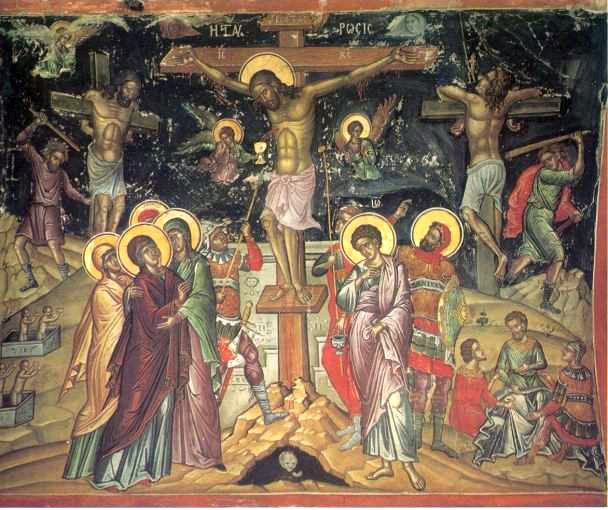
Crucifixion icon, 16th century, by Greek painter Theophanes the Cretan.
Theological Significance
Good Friday holds immense theological importance in Christianity. It is seen as the culmination of God’s plan for salvation, where Jesus willingly sacrificed himself for the sins of humanity.
- Atonement for Sin: Christian doctrine teaches that Jesus’ death was a sacrificial atonement for humanity’s sins, fulfilling Old Testament prophecies (Isaiah 53:5).
- Victory Over Death: The crucifixion was not the end. Christians believe that Jesus’ resurrection on Easter Sunday conquered sin and death.
- The Cross as a Symbol: The cross, once an instrument of execution, became a symbol of hope and redemption for believers.
The Apostle Paul emphasized the significance of the cross in 1 Corinthians 1:18:
For the message of the cross is foolishness to those who are perishing, but to us who are being saved, it is the power of God.
Good Friday Observances Around the World
Christian Denominational Observances
Roman Catholic Church
In the Catholic tradition, Good Friday is marked by:
- The Liturgy of the Passion, which includes the reading of the Passion narrative, the Veneration of the Cross, and Holy Communion using pre-consecrated hosts.
- Stations of the Cross, a devotional practice where believers meditate on Christ’s suffering.
- Fasting and Abstinence, where Catholics eat only one full meal and refrain from meat.
Eastern Orthodox Church
In Orthodox Christianity, Good Friday is known as Great and Holy Friday and observed with:
- Royal Hours, a special prayer service.
- Processions with the Epitaphios, an embroidered cloth symbolizing Jesus’ burial shroud.
- Strict fasting, often with no food consumed until the evening.
Protestant Traditions
- Lutheran and Anglican Churches hold the Three Hours’ Agony, a solemn service from noon to 3 p.m.
- Methodist and Reformed Churches observe Good Friday with sermons on Jesus’ last words and Tenebrae (darkness) services.
Moravian Church
A unique tradition among Moravian Christians is cleaning gravestones in cemeteries, symbolizing the hope of resurrection.
Good Friday as a Public Holiday
Many Christian-majority countries recognize Good Friday as a legal holiday. In places such as Germany, Australia, Canada, and the Philippines, most businesses and schools are closed.
Some countries enforce restrictions on entertainment and public activities, such as banning dancing, horse racing, or loud music. This is intended to preserve the solemnity of the day.
For believers, Good Friday is not just about mourning Jesus’ death but reaffirming faith in his resurrection and the promise of eternal life.
Cultural and Local Traditions
Passion Plays
- The Philippines: Devotees participate in real-life reenactments of the crucifixion, including self-flagellation and actual crucifixions (though the Catholic Church discourages this).
- Germany: The Oberammergau Passion Play, performed every ten years, attracts visitors from around the world.
Food Traditions
- United Kingdom, Australia, and Canada: Hot Cross Buns, spiced sweet buns with a cross on top, are traditionally eaten.
- Latin America: Many abstain from meat and eat fish-based meals.
- Poland: Churches display life-size tombs of Christ, and the faithful spend time in prayer and reflection.
Differences in Date Calculations
The date of Good Friday varies each year because it is linked to Easter, which is determined by the lunar calendar.
- Western Christianity (Catholic and Protestant) follows the Gregorian calendar, so Good Friday can fall between March 20 and April 23.
- Eastern Orthodox Christianity uses the Julian calendar, so Good Friday can be observed as late as May 6.
Modern Perspectives on Good Friday
Interfaith and Secular Views
While Good Friday is primarily a Christian observance, it is respected by many outside the faith. In predominantly secular societies, the holiday serves as a time for reflection on themes of sacrifice, injustice, and redemption.
Some interfaith dialogues use Good Friday as an opportunity to discuss shared spiritual values, such as the meaning of suffering and forgiveness.
Controversies and Legal Challenges
In some secular countries, legal challenges have arisen regarding Good Friday’s status as a public holiday, arguing that it gives preferential treatment to Christianity. Some regions have renamed it Spring Holiday to be more inclusive.
Frequently Asked Questions
How is Good Friday observed?
Christians worldwide observe Good Friday through fasting, prayer, and church services. Some traditions include the Three Hours’ Agony, Stations of the Cross, and veneration of the cross.
Why is it called “Good” Friday?
The term “Good” in Good Friday refers to the old meaning of “pious” or “holy.” It does not mean “good” in the modern sense but rather signifies the sacred nature of the day.
What events took place on Good Friday?
According to the Gospels, Jesus was arrested, tried, sentenced to death, crucified, and buried. Darkness covered the land for three hours, and the temple curtain was torn at the moment of his death.
How do different Christian denominations observe Good Friday?
Catholics, Protestants, and Orthodox Christians observe Good Friday differently. Catholics hold the Liturgy of the Passion, Protestants emphasize sermons and hymns, while Orthodox Christians conduct solemn services with processions and fasting.
Is Good Friday a public holiday?
Good Friday is a public holiday in many Christian-majority countries, including Australia, Canada, Germany, the UK, and parts of the U.S. Some places restrict entertainment and business activities to maintain its solemn nature.
How is the date of Good Friday determined?
Good Friday falls on the Friday before Easter, which is calculated based on the first Sunday after the Paschal Full Moon, leading to varying dates each year in both the Gregorian and Julian calendars.
What role does fasting play on Good Friday?
Fasting is a central practice on Good Friday, observed differently across denominations. Catholics traditionally eat one full meal and two smaller ones, while Orthodox Christians may abstain from food and drink entirely.





