Death of Judas Iscariot

Judas Iscariot, one of Jesus Christ’s original Twelve Apostles, is widely known for betraying Jesus to the Sanhedrin for 30 pieces of silver. Image: Judas Iscariot (between 1886 and 1894) by French painter James Tissot
The story of Judas Iscariot’s death is complex and often viewed through a lens of betrayal, despair, and divine justice. Judas, known for his infamous betrayal of Jesus, met a tragic end after turning Jesus over to the authorities, an act that became central to the Passion narrative in Christianity.
Various accounts of his death exist in early Christian texts, each contributing to a nuanced and at times contradictory picture of his final moments. Scholars, theologians, and historians have analyzed these accounts over centuries, leading to a broad array of interpretations that cover both theological and literary perspectives.
Judas’s Role in Betrayal and Motivation
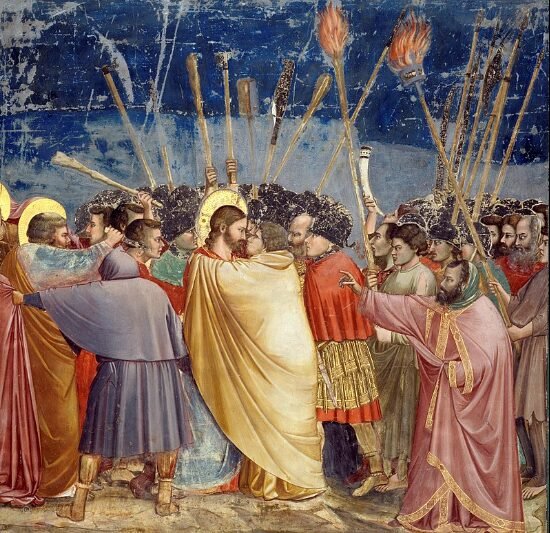
According to the canonical Gospels, Judas identified Jesus with a kiss in the Garden of Gethsemane, enabling his arrest. This act of betrayal has turned Judas’s name into a byword for treason. Image: The Kiss of Judas by Italian painter Giotto di Bondone (between 1304 and 1306) depicts Judas’s identifying kiss in the Garden of Gethsemane
Judas Iscariot, one of Jesus’s twelve apostles, agreed to betray Jesus to the religious authorities, allegedly in exchange for thirty pieces of silver, as noted in the Gospel of Matthew.
His motivation remains debated among scholars. Some texts suggest greed, while others imply deeper, perhaps even ideological, reasons. In the Gospel of John, Judas is depicted as managing the disciples’ funds, with insinuations of financial dishonesty.
Additionally, both Luke and John suggest that Satan entered Judas, implying a supernatural force behind his actions, which would align with some early Christian understandings of sin and moral failure as partly due to external demonic influence.
The traditional view in Christian theology portrays Judas’s act as a profound betrayal of the Messiah. However, a less conventional interpretation emerges in apocryphal texts such as the Gospel of Judas, a Gnostic text dating from the 2nd century.
In this text, Judas’s betrayal is framed as an act of obedience to Jesus’s instructions, positioning Judas as a disciple who uniquely understood Jesus’s mission. Despite this alternative viewpoint, mainstream Christianity has traditionally cast Judas as a symbol of ultimate treachery, his name synonymous with betrayal.
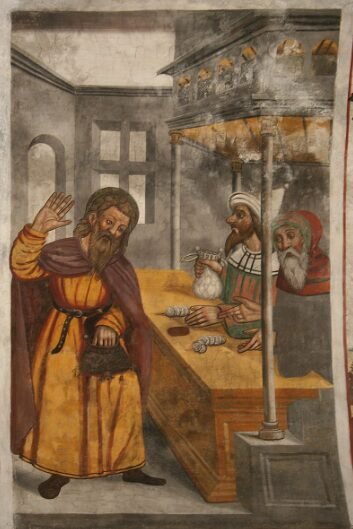
The Gospel of Mark does not specify a motive, while Matthew mentions the payment. In Luke and John, Judas’s actions are attributed to Satan’s influence. Image: A 16th century fresco depicting Judas being paid the 30 pieces of silver.
Differing Accounts of Judas’s Death
The Gospels and the Book of Acts provide differing accounts of Judas’s death. Each account has theological nuances and symbolic undertones, leading to significant interpretative challenges for readers seeking a single, harmonized narrative.
The Gospel of Matthew
In the Gospel of Matthew, Judas experiences profound remorse after learning that Jesus would be condemned. He attempts to return the thirty pieces of silver to the chief priests, admitting his wrongdoing. When they refuse to accept the money, Judas throws it into the temple and departs.
According to the Gospel of Matthew, after realizing Jesus would be crucified, Judas tried to return the silver to the chief priests and then hanged himself in despair.
The text then states that he hanged himself. The chief priests, in turn, use the “blood money” to buy a potter’s field, which subsequently became known as the “Field of Blood.” This purchase is linked to prophecy, adding a theological layer to the narrative by positioning Judas’s actions within a divine framework of fulfillment and consequence.
The Book of Acts
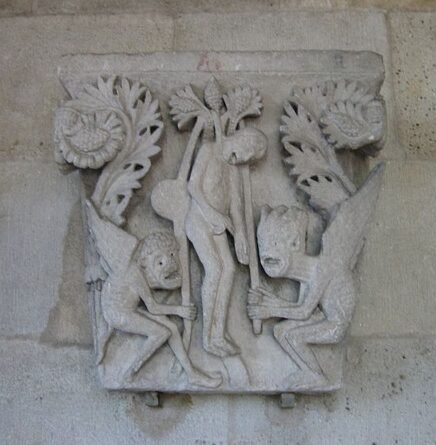
The priests used the money to buy a burial field, known as the “Field of Blood.” In the Book of Acts, a different account describes Judas purchasing the field himself and meeting a gruesome death. Image: Judas hangs himself; Cathédrale Saint-Lazare, Autun, France
In the Book of Acts, written by Luke, Judas’s death is depicted quite differently. Rather than expressing remorse and hanging himself, Judas buys a field with the money he received for the betrayal. While in the field, he falls headlong, and his body ruptures, spilling his intestines.
This graphic depiction has often been interpreted as a form of divine punishment or as a metaphorical expression of his moral corruption. Notably, this account does not mention Judas attempting to return the money, and his role in purchasing the field directly contrasts with Matthew’s version, where the priests purchase the field. This field, also called the “Field of Blood” in Acts, is linked to Judas’s death rather than to a subsequent purchase by the priests.
Papias’s Account
Early Christian writer Papias of Hierapolis provides an additional, vivid description of Judas’s death, blending theological symbolism with a form of divine retribution.
According to Papias, Judas’s body became grotesquely swollen, and he suffered a prolonged and humiliating death, his body unable to pass through narrow passageways due to its bloated state. The account describes Judas’s eyes as unrecognizable, his body oozing with pus and worms—a portrayal symbolizing spiritual decay and physical corruption.
Though Papias’s account does not align directly with either Matthew or Acts, it illustrates the depth of moral degradation associated with Judas’s character, creating a stark warning against betrayal and sin.
The Apocryphal Gospel of Nicodemus
In the apocryphal Gospel of Nicodemus, written in the 4th century, Judas confesses to his wife that he is going to kill himself because he fears Jesus will rise and punish him.
In a strange twist, his wife laughs, stating that Jesus could no sooner rise from the dead than the chicken roasting on their fire could come to life. The chicken promptly resurrects, crowing and thus foreshadowing Jesus’s resurrection.
Judas, overcome by fear and despair, then kills himself. This imaginative narrative underscores Judas’s sense of guilt and dread, connecting his fate to broader themes of divine retribution and the triumph of Jesus’s message.
Harmonization Challenges and Theological Interpretations
For centuries, theologians and scholars have grappled with the contradictory accounts of Judas’s death. Literal interpretations attempt to reconcile the differences by suggesting that Judas first hanged himself (Matthew’s account) and then his body fell and burst open (Acts).
However, these harmonization attempts often overlook the individual theological intentions of each author. Matthew’s version may emphasize Judas’s remorse and the ritual of returning the silver as a commentary on repentance and sin, while Acts focuses more on Judas’s final, ignominious end as a punishment for his betrayal.
The theological implications of Judas’s death extend into issues of destiny, free will, and divine foreknowledge. In Christian theology, Judas’s actions are often viewed as both necessary for the fulfillment of the Passion and as a tragic failure of loyalty.
This dual perspective raises questions about predestination—if Judas’s betrayal was foretold, could he have acted differently, or was his role in the Passion predetermined?
Symbolic Meanings of Judas’s Death
The method and nature of Judas’s death are laden with symbolism. In Matthew, his hanging echoes the Hebrew Bible’s connection between hanging and curse. According to Deuteronomy 21:23, “cursed is anyone who hangs on a tree,” which has led some scholars to interpret Judas’s suicide as a mark of divine condemnation.
The purchase of the potter’s field with “blood money” also carries Old Testament echoes, evoking themes of atonement and impurity. This symbolic element imbues Judas’s story with a sense of theological consequence, framing his betrayal as both a personal failure and a transgression with communal repercussions.
Acts’s description of Judas’s death offers a different set of symbols. The graphic image of Judas’s body bursting is often interpreted as an outward manifestation of his internal corruption. This imagery may be intended to show the physical consequence of spiritual decay, a warning against the perils of moral betrayal. The two accounts, while distinct, both employ symbols that resonate within broader Christian teachings on sin, redemption, and divine justice.
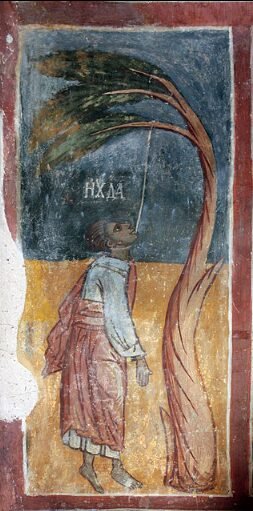
Image: A 16th-century fresco from Tarzhishte Monastery, Strupets, Bulgaria, depicting Judas’s hanging from Matthew 27.
Judas’s Death in Early Church Doctrine
Early Church Fathers and theologians often used Judas’s death to illustrate moral lessons or to advance specific doctrinal points. For example, Augustine and other early theologians interpreted Judas’s fate as a stark reminder of the dangers of despair and the rejection of God’s mercy.
Judas’s suicide, in this context, is seen as his ultimate failure, as he chose self-destruction rather than seeking repentance. This reading casts Judas not only as a betrayer of Jesus but also as a figure who embodies the consequences of abandoning hope in divine forgiveness.
The dual narratives of Judas’s death, however, have posed challenges for the doctrine of biblical inerrancy. Some Church Fathers attempted to harmonize these accounts, while others acknowledged their differences and focused on the underlying theological messages.
The moral implications of Judas’s death, regardless of the specific details, became part of Christian teachings on sin, guilt, and the importance of repentance.
Psychological Interpretations of Judas’s Actions and Death
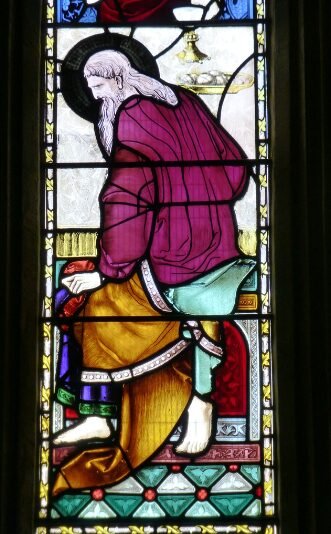
Modern scholars and psychologists have examined Judas’s actions and death through the lens of psychological theory. Some argue that Judas may have suffered from profound guilt and cognitive dissonance following the betrayal, resulting in a psychological breakdown.
His attempt to return the silver could indicate a need to undo his actions, reflecting remorse and inner conflict. From this perspective, Judas’s death by suicide can be seen as an escape from the unbearable shame and guilt of his betrayal.
Others suggest that Judas may have been motivated by a misunderstanding of Jesus’s mission. Some scholars theorize that Judas expected Jesus to lead a political uprising against Roman rule and became disillusioned when Jesus pursued a spiritual path.
The above view presents Judas as a tragic figure, one who perhaps saw his betrayal as a way to force Jesus into a position where he would assert his messianic role more assertively. When this strategy failed, Judas’s disillusionment may have led to despair.
Judas’s Legacy and Interpretative Evolution
Over the centuries, Judas’s death and his role in the Passion narrative have evolved in cultural and theological interpretation. During the medieval period, Judas was often portrayed as the archetypal traitor and was sometimes symbolically associated with the Jewish people, a connection that contributed to anti-Semitic sentiments in certain Christian communities. This association has been widely criticized in modern scholarship and is viewed as a misuse of the Gospel narrative for political or social ends.
The portrayal of Judas as a villain also served as a moral archetype in medieval literature and art, where he symbolized the ultimate betrayal of trust. Renaissance artists frequently depicted Judas as separated from the other apostles, emphasizing his role as an outsider, and this visual distancing reinforced his symbolic status as a pariah.
Throughout history, Judas’s character has often been linked to the Jewish people, unfortunately fueling Christian antisemitism.
In more recent centuries, literary and theological works have re-evaluated Judas’s character, with some authors exploring the possibility of his redemption or reimagining his motives.
For instance, Jorge Luis Borges’s short story “Three Versions of Judas” offers alternative interpretations of Judas’s actions, challenging traditional views of his betrayal.
Other writers, such as Nikos Kazantzakis in The Last Temptation of Christ, portray Judas as a deeply conflicted figure, whose betrayal was motivated by a sense of duty or a misunderstood loyalty to Jesus’s mission. Kazantzakis’s interpretation suggests that Judas believed he was helping fulfill Jesus’s destiny, adding a layer of tragic complexity to his actions and implying that Judas’s betrayal might have been an unwitting act of faith. Such literary reimaginings offer a more sympathetic perspective, exploring the inner turmoil that may have driven Judas to act as he did.

Image: Calling of the Apostles (1481) by Italian painter Domenico Ghirlandaio
The Gospel of Judas and Gnostic Perspectives
The Gospel of Judas, discovered in the 20th century and attributed to Gnostic origins, offers one of the most radical reinterpretations of Judas’s role.
According to this text, Judas acted at Jesus’s own request, betraying him as part of a divine plan that only Judas was capable of understanding. This Gnostic gospel portrays Judas as the favored disciple who alone comprehended Jesus’s teachings about the impermanence of the material world and the necessity of transcending it.
Despite his betrayal, Judas’s actions are interpreted as integral to the events leading to Jesus’s crucifixion and resurrection, central to Christian salvation theology.
Unlike the canonical Gospels, which often depict Judas’s actions as rooted in earthly motives like greed or betrayal, the Gospel of Judas presents a spiritualized version of Judas who plays a critical role in Jesus’s transition from the physical to the divine realm.
Though the Gospel of Judas is not part of mainstream Christian canon and is considered non-historical by most scholars, it provides a fascinating insight into the diverse ways early Christian communities understood Judas. The text challenges conventional interpretations and invites reflection on themes of loyalty, sacrifice, and the tension between divine knowledge and human misunderstanding.

The Gnostic Gospel of Judas presents an alternate perspective, suggesting Judas acted on Jesus’s instructions and uniquely understood his teachings. Image: First page of the Gospel of Judas (Page 33 of Codex Tchacos)
Theological Reflections on Judas’s Fate
Judas’s eternal fate has been a subject of significant theological debate within Christianity. Some theologians argue that Judas’s betrayal, coupled with his despair and suicide, led him to eternal damnation, as symbolized by Dante Alighieri in his Inferno, where Judas is placed in the lowest circle of Hell, eternally devoured by Satan. This depiction has historically reinforced the view of Judas as a figure irredeemably damned, condemned not only for his betrayal but also for his choice to end his life in despair rather than seeking repentance.
In contrast, other theological perspectives offer more nuanced interpretations. Some argue that Judas’s actions were necessary within the framework of divine providence, suggesting that his role in the Passion was predestined and therefore absolving him from ultimate guilt. This view raises complex questions about free will and predestination, as it implies Judas was an instrument in the unfolding of God’s plan. If his actions were necessary for salvation, then some theologians contend that he may not be personally culpable in the same way as a free agent acting purely out of malicious intent.
Additionally, some Christian theologians, particularly in modern times, have questioned the traditional condemnation of Judas, pondering whether God’s infinite mercy might extend even to him. This view promotes the possibility of universal reconciliation and forgiveness, suggesting that Judas’s remorse could, in a theological sense, open the door to divine mercy.
Modern Cultural and Psychological Interpretations
In modern times, Judas has also become a complex psychological figure, embodying themes of guilt, shame, and the consequences of betrayal. Psychological interpretations of Judas’s story often examine his actions through the lenses of cognitive dissonance and moral conflict. By betraying someone he followed closely, Judas is seen as embodying the inner struggle between loyalty and self-interest, or between personal beliefs and societal pressures. His eventual remorse and despair are interpreted as signs of an unresolved moral conflict that culminated in his tragic end.
Contemporary literature, theater, and film continue to explore Judas’s character, often delving into his motivations and struggles with greater empathy than traditional portrayals allow. Plays like Stephen Adly Guirgis’s The Last Days of Judas Iscariot question whether Judas should be eternally condemned or whether he might deserve forgiveness. The play, set in a courtroom in purgatory, re-examines Judas’s actions and challenges the audience to consider the possibility of redemption even for the greatest of sinners.
Judas’s Death and Its Symbolic Legacy
The legacy of Judas’s death endures as a powerful moral symbol across cultures and religions. His name remains synonymous with betrayal, yet his story also serves as a cautionary tale about the dangers of despair and the importance of seeking redemption. The different accounts of his death reflect varying theological interpretations, each emphasizing different aspects of his character—his remorse, his punishment, his spiritual downfall, and, in some views, his misunderstood loyalty.
In this way, Judas Iscariot’s death remains a narrative charged with symbolic meaning, embodying both the tragedy of moral failure and the complex interplay between human free will and divine destiny. The contradictions in his story have fueled theological, literary, and psychological inquiry for centuries, underscoring Judas’s unique and enduring role within Christian tradition as a figure both reviled and redeemed by the interpretations imposed upon him.
Conclusion
The death of Judas Iscariot remains a multifaceted and deeply symbolic element of Christian tradition. Depictions of Judas’s demise, from the remorseful hanging in Matthew to the gruesome fall in Acts, reflect the theological tensions surrounding issues of guilt, punishment, and redemption.
Over centuries, Judas has served as a literary and theological symbol of ultimate betrayal, but his character has also invited empathy and complex reinterpretations. Whether viewed as a tragic sinner, a misunderstood follower, or a necessary agent in the divine plan, Judas’s story compels reflection on themes of human frailty, divine mercy, and the possibility of redemption even for the most notorious betrayers.
His life, and particularly his death, continue to provoke debate and inspire both cautionary lessons and philosophical inquiries into the nature of faith, loyalty, and forgiveness.
Frequently Asked Questions

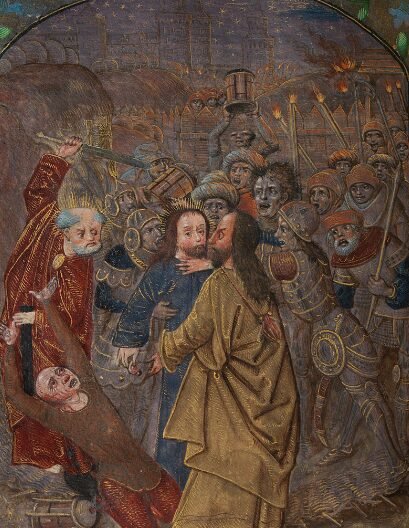
Judas Iscariot was one of the twelve apostles of Jesus, widely regarded as the disciple who betrayed Jesus to the authorities. His betrayal is consistent across the Gospels, with variations in detail and emphasis. Image: The Kiss of Judas Iscariot, colored engraving, 15th century.
Is Judas’s historical existence widely accepted by scholars?
Yes, secular historians generally accept Judas’s historical existence, although some debate remains. Early references to him, such as in Paul’s First Epistle to the Corinthians, suggest he was involved in handing over Jesus.
What is the significance of the name “Iscariot”?
“Iscariot” may signify Judas’s origin, “man from Kerioth,” or could relate to “Sicarii,” a group of Jewish rebels. Some suggest it refers to “the false one” or “choking,” possibly relating to his fate by hanging, though these interpretations remain speculative.
Why do some scholars question Judas’s historicity?
Hyam Maccoby and John Shelby Spong argue that “Judas” may represent a symbol rather than an actual person, used to criticize Judaean religious authority. Most scholars dismiss this view, as “Judas” was a common name, and several other figures with this name appear in a positive light throughout the New Testament.
How is Judas’s betrayal depicted across different Gospels?
In the Synoptic Gospels, Judas is an active disciple. In the Gospel of John, however, he is presented as the betrayer, with Jesus predicting the betrayal during the Last Supper. Matthew mentions thirty silver coins as payment, while John implies Judas handled the group’s finances and may have been dishonest with funds.
What motivations for Judas’s betrayal do the Gospels suggest?
The Gospels differ in their portrayal of Judas’s motives. Mark shows Judas approaching the chief priests without a clear motive, Matthew depicts him seeking a reward, and Luke and John attribute his actions to Satan’s influence. John also suggests financial dishonesty could have been a factor.
How did Judas die according to different sources?
The Gospels and early Christian sources present varying accounts of Judas’s death. Matthew describes him returning his bribe and then hanging himself, while Acts states he purchased a field and died after falling. Early Christian writers, like Papias, elaborated further, describing Judas’s body swelling as a form of divine punishment.
How have scholars addressed the contradictions in Judas’s death accounts?
Some scholars view the accounts as symbolic rather than literal, aiming to convey theological points rather than historical accuracy. David A. Reed suggests Matthew’s account uses imaginative details to provide deeper meaning.

Judas’ Remorse (1880) by Brazilian artist Almeida Júnior
How do some scholars view Judas’s betrayal in the context of divine purpose?
Many scholars believe Judas’s betrayal was necessary for fulfilling divine purpose, as suggested in apocryphal texts like the Gospel of Judas, where Judas is depicted as following Jesus’s instructions to carry out the betrayal. This view interprets Judas’s role as part of God’s plan rather than mere treachery.
How did Judas’s legacy evolve over time?
Judas became a symbol of ultimate betrayal, often demonized in medieval Christianity and associated with anti-Semitic sentiments. Gnostic sects, however, viewed him as a misunderstood disciple, acting under divine guidance. In modern literature, he continues to appear as a complex figure, such as in Dante’s Inferno, where he suffers eternal punishment in Hell’s ninth circle.
What was the impact of the 2006 Gospel of Judas publication?
Published by National Geographic, the Gospel of Judas sparked renewed debate, portraying Judas as the only disciple who truly understood Jesus’s mission. Though its translation accuracy was questioned, this interpretation has fueled discussions on Judas’s actual role.
What themes are associated with Judas in theological discussions?
Judas’s role raises questions about free will, destiny, and redemption. Theological perspectives vary, with some viewing his actions as necessary for the Passion narrative and others seeing his fate as predetermined. These complex themes continue to be debated among scholars, theologians, and literary figures.





